
Structural Welding for Small Construction Projects
Structural welding is not something that only happens on large commercial construction sites. Steel frames, supports, brackets, posts, beams, stairs, platforms, gates and other load-bearing components appear across a wide range of smaller projects — from shed and carport builds to renovation work, property improvements and custom fabrication jobs.
The size of the project does not change the nature of the task. Even a relatively modest structure can involve meaningful structural loads, and welding that forms part of a load-bearing connection needs to be approached with the right materials, proper joint design, careful preparation and sound workmanship. A small project handled poorly is still a structural problem.
This article covers what structural welding means, the kinds of small construction projects where it comes up, the processes and materials involved, how to prepare steel correctly, what to watch out for, and when it makes sense to bring in a professional welding service.
What Is Structural Welding?
Understanding Structural Welding
Structural welding is the process of permanently joining steel or other compatible metals to form components that carry, transfer or withstand loads. The weld becomes part of a connection that is expected to perform mechanically — not just look acceptable.
The key distinction from decorative or non-load-bearing welding is function. A structural weld forms part of a connection where failure would affect the integrity or safety of the finished structure. That might be a column base plate on a small shed, a bracket supporting a stair stringer, or a beam splice in a steel-framed extension. Understanding basic welding terminology is a useful starting point when discussing or specifying this kind of work.
What Makes a Weld “Structural”?
A weld is structural when the component it forms part of carries a load or transfers forces between structural members. Structural welds may be subject to tension, compression, shear, bending or combinations of these forces depending on the application.
Joint design and weld size both matter. A weld that looks neat and clean is not automatically suited to the structural role it is being asked to perform. The correct weld size, throat dimension and joint configuration need to match the load demands of the connection. Visual appearance alone does not establish structural adequacy.
In Australia, structural steel welding is governed by AS/NZS 1554.1 (Structural Steel Welding – Welding of Steel Structures), which sets out the requirements for weld quality, joint preparation, inspection and welder qualification. The overarching steel structures design standard is AS 4100, while many lighter structures built from thin cold-formed sections — common in sheds, carports and purlins — are designed to AS/NZS 4600. These standards commonly apply to the design and fabrication of structural steel connections across commercial and residential construction, including smaller projects where the components carry real loads.
Structural Welding vs General Metal Fabrication
Fabrication and structural welding often overlap. Many fabrication jobs involve creating brackets, frames, enclosures or supports, and some of those components will carry loads. When a fabricated part is expected to perform structurally — to carry weight, resist movement or form part of a building or load-bearing assembly — the welding involved is structural welding, regardless of how the job was described.
The distinction matters because structural applications call for a more disciplined approach to joint design, material selection, preparation and inspection than straightforward light-duty or cosmetic work.
Common Small Construction Projects That Require Structural Welding
Steel Frames and Structural Supports
Small steel frames for buildings, sheds, workshops and extensions often involve welded connections between posts, beams, braces and other sections. The individual components may seem modest, but the connections between them need to work together properly as a structural system. Maintaining correct alignment during fabrication is important — a frame that is out of square or plumb will create problems at every subsequent stage of the build.
Steel Posts, Beams and Bracing
Welded connections involving posts and beams are common in both new construction and modification work. Bracing is used to improve lateral stability, and welded joints can create rigid or reinforced connections where the design requires it. Even a single incorrectly welded connection in a braced frame can reduce the overall performance of the structure.
Steel Stairs, Platforms and Walkways
Stair frames, elevated platforms and walkways all involve structural welding. The stringer connections, landing supports, handrail posts and balustrade frames need to be properly constructed and firmly supported. An elevated structure that has not been properly welded or dimensionally checked creates unnecessary risk for anyone who uses it.
Carports, Sheds and Small Steel Structures
Carports and residential sheds might seem straightforward, but they can experience significant wind loading depending on their location and roof profile. The welded joints in posts, roof supports and knee braces need to be sound. A structure that looks solid may still have weak connections if the welding was rushed or the joint preparation was poor.
Gates, Fences and Security Structures
Heavy-duty steel gates involve both standard fabrication and structural welding. The hinges, mounting points and frame connections that support a large gate carry real loads — especially a motorised or frequently used gate. These components behave differently from a lightweight decorative fence panel, and the welding needs to reflect that.
Equipment Platforms, Frames and Supports
Custom steel support frames, equipment mounting structures, and small platforms are regularly fabricated for workshops, farms and small industrial applications. Understanding how the finished component will actually be used — what loads it will carry, how often, from which directions — is essential before any welding begins.
Why Structural Welding Is Important on Small Projects
Creating Strong, Permanent Connections
Welding creates a permanent metal connection between components. When the joint is correctly designed and properly executed, the weld and the surrounding base material work together to transfer forces through the connection. The strength of the joint depends on the weld being fully fused to the base metal with the right size and profile for the application.
Improving Structural Stability
Properly positioned welded connections help maintain alignment and rigidity in a fabricated assembly. Bracing that is correctly welded into a frame resists racking and movement. A connection that has not been properly designed or executed may allow movement that was not intended, which can affect the performance of the whole structure over time.
Allowing Custom Steel Fabrication
Welding makes it possible to fabricate steel components to suit specific site dimensions, unusual configurations or non-standard requirements. This is particularly useful where standard off-the-shelf components do not provide the required profile, connection geometry or size. Custom structural steel fabrication allows designs to be built to what the project actually needs rather than what happens to be available in standard stock.
Repairing or Modifying Existing Steel Structures
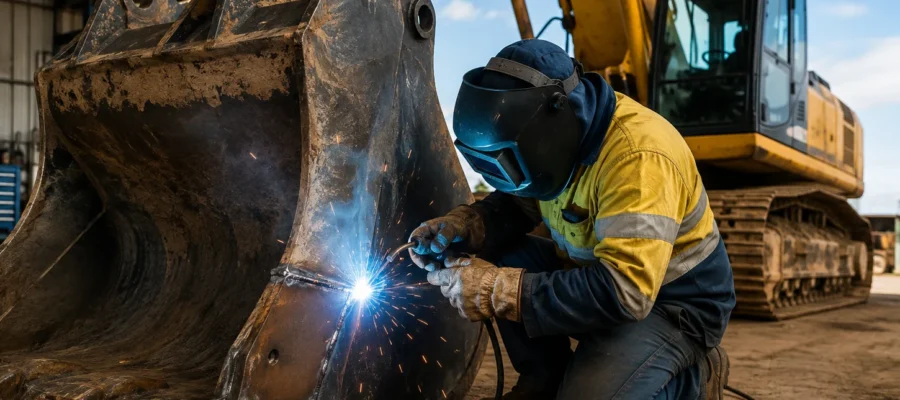
Welding can be used to repair damaged steel or modify structures that need to be altered or extended. However, existing structural damage should always be assessed before repair work begins. A visible crack or deformation is a symptom — not always just a surface defect — and the underlying cause needs to be understood before work proceeds. The same principle applies whether the damaged steel is part of a building frame or a working machine — welding repairs on earthmoving equipment also start with diagnosing the cause, not just filling the crack.
Common Welding Processes Used for Structural Work
MIG Welding
MIG welding (technically GMAW, and often MAG when welding steel with an argon/CO₂ mix) feeds a continuous wire electrode through the torch while shielding the arc with a gas mixture. It is a fast and versatile process well suited to many steel fabrication applications. MIG allows relatively high welding speeds and is practical for a wide range of material thicknesses and joint configurations.
One consideration when welding outdoors or on site is that shielding gas can be disrupted by wind, which can affect the quality of the weld. This is worth accounting for when working in exposed locations.
Stick Welding
Shielded metal arc welding (SMAW), or stick welding, uses a coated electrode that provides both the filler material and the shielding from the flux coating. It is well suited to outdoor and site-based work because it does not depend on a separate shielding gas supply. Stick welding tolerates less controlled environments better than MIG, which makes it practical for construction sites, rural locations and field repair work.
Electrode selection matters. The correct electrode type and size for the material and joint needs to be chosen before starting, and technique affects the outcome significantly.
TIG Welding
TIG (Tungsten Inert Gas) welding, or GTAW, uses a non-consumable tungsten electrode and a separate filler rod fed by hand. It offers greater control and precision than MIG or stick, and produces clean, high-quality welds on a range of materials. However, TIG is slower and generally requires greater welder skill and preparation time. It is not the default choice for every structural steel application — the process should be matched to the material, the joint and what the project actually requires.
Choosing the Right Welding Process
There is no single welding process that is universally best for structural steel. The right choice depends on the base material, material thickness, joint configuration, welding position, whether the work is indoors or outdoors, the required finish, available equipment and the welder’s experience with that process in that application. MIG, TIG and stick welding each have their place, and the practical conditions of the job often influence the decision as much as the material specifications do.
Structural Welding Joints and Connections
Fillet Welds
A fillet weld joins two pieces of metal at an angle — typically at a T-joint, lap joint or corner. It is one of the most common weld types in structural steel fabrication. Fillet welds are used extensively for connecting brackets, supports and members that meet at angles. The throat size and leg length determine the load-carrying capacity of the weld.
Butt Welds
A butt joint connects two pieces along the same plane — end to end or edge to edge. Butt welds are used where sections need to be joined in line, such as splicing lengths of plate or structural section. The joint may be a simple square butt for thin material or require bevelling for full-penetration welds on thicker sections.
Lap Joints
A lap joint overlaps two pieces of metal, with welds applied along the edges. Lap joints are found in various fabrication applications where one plate or section overlaps another. They require careful attention to ensure both pieces are fully engaged by the weld.
T-Joints and Corner Joints
T-joints appear wherever one steel member connects to the face of another at roughly 90 degrees — a common configuration in fabricated frames and supports. Corner joints connect pieces at the edges to form a corner. Both joint types are common in structural steel fabrication and each presents different considerations for welding position and access.
Why Joint Design Matters
The joint design affects weld size, joint preparation requirements, the direction and magnitude of the loads the joint can carry, accessibility for welding, and the welding position required. A joint that is difficult to access may result in a weld that cannot be completed properly. Getting the joint design right at the planning stage avoids problems during fabrication. AS/NZS 1554.1 provides specific guidance on joint preparation, minimum weld sizes and inspection requirements, including the distinction between SP (structural purpose) and GP (general purpose) weld categories depending on the application and the structural consequence of the connection.
Materials Commonly Used in Small Structural Welding Projects
Mild Steel
Mild steel (low carbon steel) is the most common material in structural and fabrication work. It welds readily with all standard processes, is available in a wide range of profiles and thicknesses, and provides reliable mechanical properties for most structural applications. Common forms include flat plate, angle, box section (RHS/SHS), channel and structural sections such as I-beams and columns.
Structural Steel Sections
Different steel profiles are selected based on their structural performance characteristics:
| Section Type | Common Applications |
| I-beams / UB / UC sections | Beams, columns, structural frames |
| RHS (rectangular hollow section) | Frames, supports, beams |
| SHS (square hollow section) | Columns, posts, smaller frames |
| Angle | Brackets, bracing, connections |
| Channel (PFC) | Framing, supports, purlins |
| Flat plate | Connection plates, gussets, brackets |
Selecting the right profile involves matching the structural demands of the application with the available section’s bending, shear and compression properties.
Stainless Steel and Other Metals
Stainless steel, aluminium and other metals require different welding approaches from mild steel. The correct filler material, process, shielding gas and heat input settings all differ. Working on an unidentified metal without confirming the material is a risk — techniques and consumables that work well on mild steel may produce poor or unreliable results on other materials.
Why Material Identification Matters
Using the wrong filler material or welding procedure for a given base metal can result in welds that appear adequate but have poor mechanical properties or are susceptible to cracking. Where preheating is required — typically for thicker sections or higher-carbon steels — failing to apply it can cause problems that are not immediately visible. Confirming the material before work begins is a straightforward step that avoids avoidable problems.
Preparing Steel for Structural Welding
Inspecting the Material Before Welding
Before welding begins, the steel should be inspected for cracks, corrosion, contamination and deformation. Material dimensions should be confirmed, and any previous repairs or existing welds should be identified. An existing weld in a critical area may affect how new work needs to be approached.
Cleaning the Welding Area
Rust, mill scale, paint, oil, grease, dirt and moisture can all affect weld quality. Contaminants in or near the weld zone contribute to defects including porosity and lack of fusion. The extent of cleaning required depends on the material condition and the welding process being used, but starting with clean steel is always the right approach.
Cutting and Preparing the Joint
Accurate cutting and correct joint preparation establish the fit-up that the weld needs to be made properly. Bevel preparation may be required for thicker sections or where full penetration is needed. The root gap and bevel angle need to match the joint design. Excessive gaps, misalignment or incorrect bevel geometry make it harder to achieve the required weld quality.
Correct Alignment and Fit-Up
Components should be clamped and secured before welding. Dimensions, angles and alignment should be checked against the drawings or specifications before tack welding, and rechecked before completing permanent welds. Poor fit-up that gets welded and distorted into position creates stress concentrations and dimensional problems that are difficult to correct afterwards.
Controlling Heat and Distortion
Welding heat causes steel to expand locally and then contract as it cools, which can move or distort the workpiece. A correctly planned welding sequence, balanced tack placement and controlled heat input all help minimise distortion. In a complex fabrication, distortion that is allowed to accumulate through the earlier stages can result in a finished assembly that does not meet dimensional requirements.
What Happens During the Structural Welding Process?
Reviewing the Project Requirements
Before any material is touched, the project requirements need to be understood: what the structure needs to support, what the connection details are, and whether engineering drawings or specifications have been provided. Welding without understanding what the finished component is expected to do creates unnecessary risk.
Preparing and Positioning the Components
Steel is cleaned, cut and prepared to the required dimensions. Components are positioned and secured. Alignment is confirmed before any welding begins.
Tack Welding and Initial Checks
Tack welds hold the assembly in position while measurements and alignment are rechecked. This is the time to correct any errors — before the permanent welds lock the geometry in place.
Completing the Weld
The appropriate welding process, settings and consumables are selected for the joint and material. Technique, travel speed and heat input are managed consistently across the joint. The welding sequence for the assembly is planned to minimise distortion and manage residual stresses.
Inspecting the Finished Weld
A visual inspection checks for obvious surface defects such as cracks, porosity, undercut or incomplete fusion at the weld toes. Dimensional checks confirm that the finished fabrication meets the required geometry. Where project requirements call for it — whether due to the nature of the structure, engineering specifications or quality requirements — additional inspection or testing may be appropriate.
Common Structural Welding Defects to Watch For
Porosity
Porosity appears as small voids or pits in the weld, caused by gas becoming trapped in the weld metal as it solidifies. Contamination of the base metal, electrode or filler wire, moisture, or shielding gas problems are common contributors. Porosity reduces the cross-sectional area of the weld and can affect its mechanical properties.
Cracking
Cracking is particularly significant in structural welds. Cracks can appear during or after welding due to a range of factors including hydrogen-induced cracking, incorrect heat input, inadequate preheat for the material, or high residual stresses. A cracked weld should not simply be covered with another weld pass without proper assessment — the cause needs to be identified first. Before attempting a crack repair, it’s worth understanding when cracked steel can be safely repaired and when replacement is the better option.
Lack of Fusion
Lack of fusion occurs when the weld metal does not fully fuse with the base material or the previous weld pass. It may not be visible on the surface of the finished weld. Lack of fusion reduces the effective weld area and can leave planar defects in the joint that affect its load-carrying capacity.
Undercutting
Undercutting is a groove or notch melted into the base material along the weld toe. It creates a stress concentration in the surrounding material and reduces the effective thickness at that point. Undercutting is typically caused by excessive current, incorrect travel speed or poor torch angle.
Slag Inclusions
Slag inclusions are pockets of flux residue trapped within the weld metal. They are most relevant to stick welding and multi-pass welds where slag from a previous pass has not been fully removed before the next pass is deposited. Slag inclusions reduce the quality of the weld metal and can act as initiation points for cracking under load.
Distortion and Misalignment
Excessive heat causes steel to move during welding, which can change the geometry of the finished fabrication. If the components are not properly restrained or if the welding sequence is not managed, the result may be a structure that does not meet the required dimensions or alignment tolerances.
Preventing Welding Defects
Most defects trace back to a handful of avoidable causes — contamination, wrong parameters, poor fit-up or rushed technique — and most of them can be prevented with the right preparation and technique. Clean materials, appropriate process and parameter selection, skilled workmanship and inspection at the right stages of the work all play a part.
Safety Considerations for Structural Welding
Welding Hazards on Construction Sites
Welding on a construction site involves exposure to heat, molten metal, sparks, hot surfaces, welding fumes, intense UV radiation, electric shock hazards, fire risks, and compressed gas where gas cylinders are in use. These hazards need to be identified and managed before work begins, not addressed reactively.
Personal Protective Equipment
Appropriate PPE for structural welding includes:
- A welding helmet with the correct shade rating for the process
- Appropriate eye protection for tasks such as grinding and chipping
- Welding gloves suited to the process and temperatures involved
- Flame-resistant clothing with no exposed skin
- Safety footwear appropriate to the site
- Respiratory protection where the welding environment or material requires it
Fire Prevention and Hot Work Controls
Combustible materials should be removed from the work area where practicable. Where removal is not possible, appropriate shielding or protection should be in place. Hot work procedures may apply depending on the site and the nature of the work. The area should be monitored after welding for any signs of smouldering material.
Working at Heights
Welding elevated structures — stairs, platforms, mezzanines or structural frames at height — introduces fall hazards on top of the standard welding risks. Appropriate fall-prevention measures, safe access and correct positioning are all required. Reaching an awkward weld by placing yourself in an unsafe position creates a risk that is not justified by the convenience.
Ventilation and Welding Fumes
Welding fumes contain metal oxides and other compounds and are classified as a known human carcinogen (IARC Group 1), so exposure needs to be actively controlled. Outdoor welding generally provides natural ventilation, but working in partially enclosed spaces, sheds or confined areas can allow fume concentrations to build up. Adequate ventilation, or appropriate respiratory protection, needs to be in place for any welding work in enclosed environments.
Do Small Structural Welding Projects Need Engineering Input?
When Engineering Design May Be Required
Not every welded steel bracket or frame needs a structural engineer’s involvement. But load-bearing structural components, building structures, significant modifications to existing structures, and projects that need to comply with specific engineering specifications are situations where engineering input is appropriate. The relevant trigger is not the size of the project — it is the consequences of the connection or structure not performing as required.
In Queensland, structures such as sheds and carports often require building approval through a building certifier, and some will also need engineering certification as part of that process. Checking the approval requirements before fabrication starts avoids having to modify or re-certify work later.
Why Welders Should Not Guess Structural Requirements
Welding skill does not replace structural engineering design. A weld that is properly executed is only part of what makes a structural connection work. The connection design, steel section sizes, load paths and overall structural behaviour all need to be correct. A welder who is producing good welds on an inadequately designed connection is still producing a substandard structural outcome.
Following Project Drawings and Specifications
Where engineering documentation has been provided, the welding work needs to follow it. Weld sizes, connection details, material specifications and dimensions specified on drawings are not suggestions — they define what the finished fabrication needs to be. Deviating from engineering drawings without proper authorisation can affect both structural performance and compliance.
Engineering drawings for structural steel projects typically reference AS 4100 (or AS/NZS 4600 for cold-formed sections) for design and AS/NZS 1554.1 for the welding requirements. Where a drawing specifies a weld category, weld size or inspection requirement, those details come from those standards and need to be followed as written.
Structural Welding for Repairs and Modifications
Repairing Cracked Steel Components
Repairing a cracked steel component by welding requires more than simply filling the crack. The cause of the cracking needs to be identified — whether it is fatigue, overload, corrosion-assisted cracking, or a welding defect from the original fabrication. The material condition and the structural requirements of the component determine whether welding repair is appropriate and how it should be approached.
Reinforcing Existing Steel
Reinforcing an existing steel member with plates, gussets or additional supports can be effective, but the reinforcement needs to address the actual structural requirement. Adding steel to a connection without understanding the load demands can provide a false sense of security. Reinforcement should be designed around what the structure actually needs.
Modifying Existing Structures
Adding brackets, altering frames, extending or adapting steel structures all require consideration of whether the modification changes load paths or the structural behaviour of the assembly. An extension that adds weight or changes how loads travel through a frame can affect connections elsewhere in the structure that were never intended to carry the new loads.
When Replacement May Be More Appropriate
Severe deformation, significant material loss from corrosion, extensive cracking, or components where repair cannot meet the required structural outcome are situations where replacement is the better path. Attempting to weld over extensive damage without addressing the underlying condition often results in a component that is still inadequate, regardless of the quality of the welding itself.
How to Choose a Structural Welding Service
Look for Relevant Welding Experience
Experience with structural steel, steel fabrication and structural repairs is a meaningful indicator. A welding service that regularly works from drawings and specifications, understands different welding processes, and has handled similar applications is better placed to produce a reliable result on a structural job.
Ask About the Welding Process
It is reasonable to ask what process will be used and why it is appropriate for the material, joint and working conditions. Consumable selection, shielding gas, and whether the process suits the working environment — indoors or outdoors, sheltered or exposed — are all relevant to the outcome.
Discuss the Project Before Work Begins
Provide dimensions, explain the intended use, supply any drawings or specifications, and identify whether the component is load-bearing. If there is existing damage or a history of previous repairs, that information is relevant. A welding service that asks these questions before quoting is more likely to deliver a result that matches what the project actually requires.
Consider Inspection and Quality Control
Visual inspection, dimensional checks and, where the project warrants it, additional testing or documentation are all part of delivering reliable structural welding. Understanding what inspection will be carried out before signing off on the work is a reasonable expectation.
Benefits of Professional Structural Welding for Small Projects
Better Attention to Joint Preparation
Correct fit-up, proper edge preparation and clean material have a significant effect on weld quality. Professional welding services are more likely to invest the time in preparation rather than treating it as an optional step.
Appropriate Welding Technique
Process selection based on the application, consistent technique and controlled heat input all contribute to producing welds that meet the structural requirements of the job. Technique matters — the same joint prepared to the same standard can be completed well or poorly depending on the welder.
More Reliable Results
Consistency across multiple joints, reduced risk of avoidable defects and more predictable dimensional outcomes all follow from disciplined workmanship. For structural applications, this reliability is what matters — not just that most of the welds look acceptable.
Avoiding Costly Rework
Defective welds need to be ground out or cut out before being redone — and in some cases, components damaged by poor welding need to be replaced entirely. Getting the preparation, process and technique right from the start is considerably less expensive than discovering a problem after the structure has been assembled.
Structural Welding vs DIY Welding: When Should You Call a Professional?
Simple Non-Structural Welding Jobs
Decorative fabrication, light-duty brackets, non-structural ornamental work and general repairs that do not involve structural loads can be appropriate for competent DIY welding, depending on the welder’s experience and available equipment. The question is not the size of the project — it is the structural importance of what is being welded.
Load-Bearing Components
Structural frames, beams, posts, platforms, critical brackets and connections subject to significant loads are not the place to experiment with welding technique. These are applications where the workmanship needs to be right, and where the consequences of a poorly executed weld are more serious.
Projects Requiring Specialist Knowledge
Complex joint configurations, thicker steel sections, unusual materials, difficult welding positions, existing structural damage, and work governed by engineering specifications all benefit from professional structural welding services. These are not necessarily unusual projects — they include the kind of work that comes up regularly on small construction and renovation sites.
When the Consequences of Failure Are Serious
If a failed weld could cause injury, structural collapse, significant property damage or liability, professional assessment and workmanship are appropriate regardless of how the project looks from the outside. The cost of professional structural welding services is typically modest relative to the cost of the alternative.
Frequently Asked Questions About Structural Welding
What is structural welding used for?
Structural welding is used to create permanent connections in load-bearing steel structures. Applications include frames, beams, columns, supports, brackets, platforms, stairs, gates and other components where the weld forms part of a structurally loaded connection.
Can structural welding be used for small construction projects?
Yes. Structural welding is relevant to projects of many sizes. The importance of the welding is determined by the function of the component, not the scale of the overall project. A small shed, a residential steel stair or a custom support bracket can all involve genuine structural welding requirements.
What type of welding is best for structural steel?
There is no universal answer. MIG welding is widely used for steel fabrication because of its speed and versatility. Stick welding is practical for outdoor and site-based work where shielding gas is not suitable. TIG welding offers greater precision for specific applications. The right process depends on the material, thickness, joint design, welding position, working environment and available equipment.
Is MIG welding suitable for structural steel?
MIG welding can be suitable for many structural steel fabrication applications when the material, thickness, joint design and working conditions are appropriate. Wind is a consideration for outdoor MIG work because it can disrupt the shielding gas and affect weld quality.
Can cracked structural steel be welded?
It depends on the cause, material, location and severity of the cracking, and the structural requirements of the component. Professional assessment should come before any repair work. Welding over a crack without understanding what caused it does not address the underlying problem.
How do you know if a weld is structurally sound?
A visual inspection can identify obvious surface defects such as cracks, porosity, undercut and incomplete fusion. However, visual inspection alone cannot detect internal defects such as lack of fusion or internal porosity. For projects where the structural consequences are significant, additional inspection or testing may be appropriate.
Does structural welding require an engineer?
It depends on the project, the nature of the structure, applicable building regulations and any engineering specifications that have been set. Structural design (AS 4100 or AS/NZS 4600) and welding execution (AS/NZS 1554.1) are separate responsibilities, and both need to be addressed.
How long does structural welding take?
Timing depends on the number and type of joints, material thickness, joint preparation requirements, welding position, site access conditions and any inspection requirements. There is no meaningful universal timeframe — a realistic estimate requires an assessment of the specific project.
Structural Welding in Hervey Bay and Booral
The work covered throughout this article — fabricating steel frames, supports and brackets, joining structural sections, constructing platforms and stairs, reinforcing or modifying existing steel, and carrying out structural steel repairs — requires a considered approach. Material identification, joint preparation, process selection, heat control and inspection all contribute to whether the finished result is actually fit for purpose.
Structural welding in Queensland also comes with its own practical considerations: wind exposure, coastal environments, a mix of new construction and older steel infrastructure, and the range of fabrication requirements that come with rural and semi-rural properties. These affect process selection, material condition, preparation requirements and access.
Based in Booral, CJS Machinery Hire has more than 25 years of experience in construction and related trades work across Hervey Bay, Maryborough and surrounding areas. The welding team handles structural steel fabrication, repairs and site-based welding for the kinds of small and medium construction projects common in the region.
If you have a structural welding requirement — a new fabrication, a repair, a modification or part of a broader construction project — the most useful first step is to discuss the details before work begins. Bring the dimensions, photographs, drawings or specifications where you have them, and describe what the finished component needs to do. That information makes it possible to assess the work properly and provide an accurate quote.
Get in touch with the CJS team to discuss your project, or see the full range of CJS welding services.
Related Posts
Post a Comment