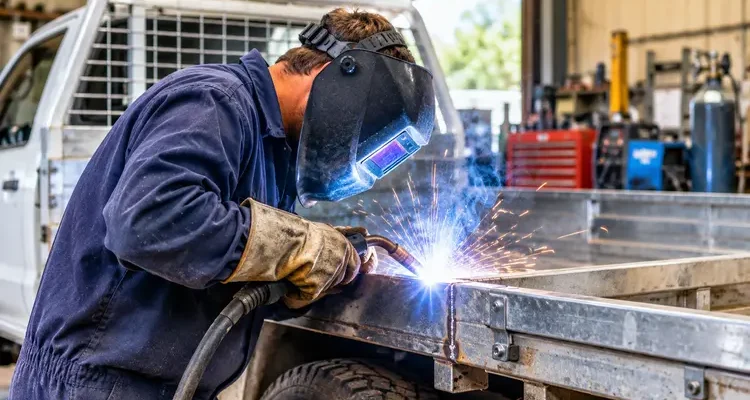
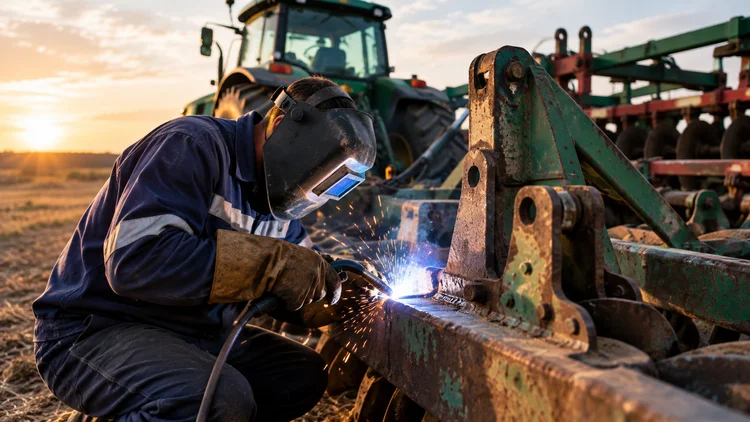
Agricultural equipment takes a beating. Tractors, ploughs, slashers, balers, and trailers are pushed hard across demanding terrain, often far from the nearest workshop. Metal cracks, mounts break, frames twist — and welding is one of the most practical ways to get things back running.
At CJS Machinery Hire, we provide agricultural welding services for farms across Hervey Bay, Booral, and the surrounding region. This guide covers what can be repaired with welding, how it’s done, and when to repair versus replace.
Why Welding Matters for Farm Machinery
The Demands Placed on Farm Equipment
Farm machinery operates under conditions most industrial equipment never faces. High loads, rough terrain, vibration, impact, and exposure to the elements all place enormous stress on metal components. Over time, that stress leads to wear, cracking, and failure — often right in the middle of a busy season.
How Welding Extends Equipment Life
A proper weld repairs a cracked or broken component and, done correctly, restores it to a condition where it can continue working safely. Welding can close cracks before they spread, rebuild worn or thinned sections, reinforce high-stress areas, and reattach broken mounts and brackets. For many components, it is a durable repair — not a temporary fix — that keeps equipment in service for many more seasons.
Welding makes particular sense for structural components like frames and drawbars, high-wear items like bucket edges, and older or custom equipment where direct replacement parts are hard to find. This makes farm equipment welding a cost-effective alternative to replacement in most cases.
Common Signs That Farm Equipment Needs Welding
- Visible cracks or fractures in metal components
- Brackets or mounts that have broken away from the frame
- Components that flex or move where they should be rigid
- Worn cutting edges or thinning metal on ground-engaging parts
- Rust or corrosion that has eaten through the metal
- Unusual noise or vibration suggesting a loose or failing structural element
- Previous welds that have cracked or separated
Tractor Welding Repairs
Repairing Cracked Tractor Frames
Tractor frames develop cracks around high-stress areas like hitch points and loader mounts. A cracked frame should be assessed carefully before welding. If the damage is in a non-critical area and structural integrity is intact, welding is often a viable repair.
It is also important to understand what the frame is actually made from. Many modern tractors are not built around a conventional mild-steel chassis — the engine block, transmission housing, and axle cases form the structural backbone, and these are typically cast iron or cast steel. Welding cast iron with standard MIG or stick electrodes without specialist nickel-alloy filler rods and controlled pre-heat and post-heat procedures will almost always result in re-cracking. If a tractor’s structural housings are cracked, the repair must be handled by a welder with specific experience in cast-iron welding.
Brackets, Mounting Points and Loader Arms
Brackets and mounting points on tractors take considerable stress from attached implements. When these fail, the implement cannot be used safely. Welding broken brackets and fabricating replacement mounts is a common repair that restores functionality quickly.
Loader arms are exposed to high stress — lifting, pushing, and carrying heavy materials through demanding conditions. Cracks in loader arms, broken attachment points, and damaged pivot areas can all be welded, though the repair needs to be thorough given the loads these components carry.
Three-Point Hitch Repairs
The three-point hitch is one of the most-used components on any tractor. Cracked linkage arms, broken mounting points, and damaged lift components can be repaired by welding, provided the damage is not too extensive.
Tractor Drawbar and Tow Point Repairs
Drawbars and tow points are directly loaded when towing and can crack or fail over time. A broken tow point presents a genuine safety hazard. Primary tow hitches on tractors used for road towing are subject to regulatory considerations under Queensland WHS law. Welding repairs to certified tow hitch components without appropriate assessment may affect their rated capacity and could void farm machinery insurance. If a primary drawbar has been significantly damaged, it is worth having the repair assessed by a qualified engineer.
ROPS and Safety-Critical Components
Damage to main structural members, engine mounts, or safety-critical components requires professional assessment before welding is done.
One area requiring specific attention is the Roll-Over Protective Structure (ROPS). ROPS are safety-certified structures designed to protect the operator in a rollover. In Queensland, any welding, modification, or repair to a certified ROPS must comply with Queensland Workplace Health and Safety requirements. A modified or improperly repaired ROPS may no longer meet its certified load rating, exposing the operator to risk and the operator or business to significant WHS liability. If a ROPS has been damaged, it must be assessed by a suitably qualified engineer before the tractor returns to service.
Welding Repairs for Ploughs and Tillage Equipment
Plough frames operate under sustained heavy load, pulling through hard, rocky soil season after season. Frame cracks are a natural consequence. Welding cracked plough frames involves cleaning and preparing the cracked area, removing any compromised material, and completing the weld with appropriate filler material for the steel type.
Mounting points wear over time as components shift and load cycles accumulate. Rebuilding worn mounts through welding restores correct geometry and extends working life. Tines and shanks in direct contact with soil, rocks, and roots can be welded or built up when worn.
Plough frames that have seen many seasons often show stress around main beam joints and depth adjustment pivot points. These locations can be reinforced by welding in gusset plates or boxing open sections before cracking begins — particularly worthwhile on equipment used intensively in rocky soils.
Hardfacing is commonly applied to ground-engaging surfaces, tine tips, and disc edges to extend the time between replacements. Disc blades made from high-carbon steel are a different matter: they can warp when heat is applied unevenly. Hardfacing on disc blades should only be attempted by welders with specific experience in the technique; in many cases, replacing worn discs is more practical.
Welding Repairs for Cultivators, Harrows, Seeders and Planters
Cultivators and Harrows
Tines break regularly, particularly in rocky or root-heavy ground. Welding broken tines is a quick repair. Tine mounts — the brackets that hold tines to the frame — can also crack and are readily repaired by welding. The frame and crossmembers should be repaired promptly when cracked; a thorough, fully penetrating weld is important for a lasting result.
The point where each tine mount connects to the toolbar is one of the highest-stress locations on a cultivator or harrow. On older equipment, running a fillet weld or gusset plate between the mount and toolbar — where the original design did not include one — adds significant stiffness to a joint that is already under stress.
Seeders and Planters
Seeder and planter frames are lighter than plough frames but still crack over time. Frame repairs need to maintain correct geometry — a misaligned frame or incorrectly repaired depth control can affect row spacing, seeding depth, and plant establishment.
Seeders and planters vibrate constantly in operation, and fatigue at fan housings, toolbar joints, and seed tube mounts is predictable. Where a seeder cracks in the same spot season after season, a reinforcing gusset or plate can fix the cause rather than just the symptom. Cracked or worn hitches should be repaired before planting season begins.
Welding Repairs for Slasher and Mowing Equipment
Decks, Frames and Mounts
Slasher decks take repeated impacts from rocks, timber, and debris, and they crack. Full penetration welds are essential — a partial or surface weld on a slasher deck will fail quickly once the deck resumes flexing under impact. The frame, mounts, and three-point hitch connections carry both the weight of the implement and the shock of debris strikes; these should be inspected regularly and any cracks repaired promptly.
The front edge and underside of a slasher deck take the most direct impact. Welding additional mild-steel or wear-plate sections to these areas provides a sacrificial layer that absorbs future impacts. Damaged guard supports should also be repaired — guards protect bystanders from thrown debris and should never be left broken.
Slasher Blades Must Always Be Replaced, Not Welded
Slasher and mower blades are hardened, high-speed rotating components. They must never be welded or hardfaced. Applying weld heat creates localised embrittlement and dynamic imbalance. At operating speed, a compromised blade can shatter and throw fragments with enough force to cause serious injury or death. Worn or damaged slasher blades must always be replaced with new ones.
What can be welded on slashing equipment are the non-rotating structural components: the deck, frame, mounts, and guard supports. The blade holders (carriers or cradles) that attach to the rotating disc vary — some are mild steel and some are hardened. If in doubt, discuss the specific component with a qualified welder before proceeding.
Welding Repairs for Hay and Bale Equipment
Hay rakes develop broken tines, cracked frames, and damaged hitch components. Broken tines can be welded or replaced, and frame cracks should be cleaned up and welded before they spread.
Baler frames crack over time, particularly around pivot points and areas that flex repeatedly during operation. Frame failures during haymaking cause significant unplanned downtime — cracks should be addressed as soon as they are found.
On round and square balers, the most vibration-prone areas are the bale chamber corners, pickup tine bar mounts, and knotting mechanism frame. On rakes, the rotor arm attachment points and hitch frame take the most fatigue loading. Welding gussets into these areas before cracks appear is a targeted way to reduce the maintenance burden through the hay season.
Bale forks, spikes, and handling frames attached to tractors and loaders carry heavy loads and need careful attention when repaired — the attachment point must be secure enough for the loads it will handle.
Welding Repairs for Harvesting Equipment
Harvesters and headers are large, complex machines. Structural components — main frames, feeder house mounts, and chassis sections — can crack or fail. These repairs need to be approached carefully, with proper understanding of the loads involved.
Auger tubes, flighting, and conveyor components can crack, wear through, or have mounting points fail. Welding repairs on these components restore function and can often be completed without major disassembly. Chutes, guards, and body panels are not typically structural but do affect function and safety — welding repairs on them are generally straightforward.
Harvesters develop predictable failure points — feeder house hinge lugs, reel arm pivot tubes, and the main auger drive housing are common. If a header has cracked in the same place in previous seasons, reinforcing that area before the next harvest is far less disruptive than an emergency paddock repair.
Harvest windows are short. Inspecting equipment and completing any outstanding farm machinery welding repairs before the season begins is far better than dealing with a failure mid-harvest.
Farm Trailer Welding Repairs
Trailer frames carry heavy, often uneven loads repeatedly. Cracks in the main chassis rails, crossmembers, and gooseneck sections are common and should be repaired as soon as they appear. Drawbar and tow coupling cracks are a safety issue — on a loaded trailer, a drawbar failure can result in the trailer becoming uncontrolled.
Trailer floors, particularly on grain and stock trailers, can wear through or corrode. Plating worn or rusted sections by welding new steel over the top is a practical repair. Tailgates, hinges, and loading ramps can generally be repaired by welding. The area around axle mounts is one of the highest-stress zones on any trailer chassis — welding gussets around axle brackets before cracking begins is a cost-effective preventative measure on older trailers that are otherwise sound.
Road Trailer Compliance After Structural Welding
Farm trailers used on public roads in Queensland must comply with Queensland Transport and Main Roads requirements. Structural welding on road-registered trailer chassis, drawbars, or tow components must also comply with Vehicle Standards Bulletin 1 (VSB1), which sets out engineering standards for trailer modifications and structural repairs.
A trailer that has had structural welding repairs to its chassis or drawbar may need to be certified by a Registered Engineer or inspected by a licensed vehicle examiner before it is legally compliant for road use. Owners who skip this step risk having the trailer deemed non-roadworthy and may face liability if it is involved in an incident. If you are unsure whether a repair requires certification, contact Queensland Transport and Main Roads for guidance.
Welding Repairs for Front-End Loader Attachments
Loader buckets take constant punishment — pushing into hard ground, scooping gravel and rocks, carrying heavy loads, and taking occasional impacts. Cracks in the bucket floor, side plates, and back plate are common and well-suited to welding repair. Cracks in side plates typically start at the corners and where the plate meets the floor — catching and welding these early prevents them from running the full height of the plate.
The cutting edge of a loader bucket wears continuously. When worn significantly, it can be rebuilt by welding new material onto the worn section, or a new bolt-on or weld-on cutting edge can be fitted. The bucket floor, side plates, and cutting edges can also be hardfaced to extend the time between repairs — particularly on buckets used in abrasive conditions like gravel or dry soil.
Damaged mounting points should be repaired by welding with attention to geometry, so the attachment sits correctly. Bale forks, pallet forks, and other loader attachments can crack or have mounts fail; welding repairs restore function when done correctly.
The inner corner where the bucket floor meets the back plate, and the root of each fork tine, are the areas that typically fail first. Running an additional weld bead along these joints during a service — before cracking becomes visible — costs very little and prevents a more involved repair later.
Welding Livestock and Farm Handling Equipment
Livestock panels and cattle yard structures take significant impact from animals and repeated use. Broken rails, cracked posts, and damaged connection points can all be repaired by welding. Broken gate hinges and cracked gate frames are among the most common small welding jobs on farms — a broken gate is a livestock containment issue at worst and a daily inconvenience at best.
Cattle crushes are safety-critical. A crush that fails while an animal is being restrained presents a real danger to the handler. Cracks and broken components should be repaired by someone who understands how the component is loaded. Loading ramps, chutes, feeders, and hay racks can all be repaired by welding — the repair needs to be solid enough to withstand ongoing use by animals. High-use structures like race entries and crush approaches can also be reinforced with additional steel to reduce the frequency of repairs.
Welding Repairs for Irrigation Equipment
Steel frames, supports, and brackets on travelling irrigators, pump sets, and irrigation infrastructure can corrode or crack. Welding repairs on these frames are generally straightforward, provided the steel is properly prepared and any corrosion is dealt with before welding. Severely corroded sections may need to be cut out and replaced with new steel rather than patched. Repaired areas should be treated with appropriate corrosion protection after welding.
Custom Welding for Agricultural Equipment
Welding is not just for repairs. Existing machinery can be modified to better suit particular farm tasks — adding new attachment points, widening a frame, fabricating custom brackets and mounts, or adapting hitches to suit different tractors. Purpose-built or modified equipment often performs better for specific tasks than off-the-shelf alternatives.
Reinforcement plates can be welded to areas with a history of cracking, extending equipment life without modifying the overall design. Any modification should be appropriate for the loads involved, should not compromise the original structural integrity, and should not create new hazards. If you are unsure whether a planned modification is suitable, get a professional opinion before proceeding.
Hardfacing for Agricultural Equipment
What Is Hardfacing?
Hardfacing is a welding process where a layer of hard, wear-resistant material is deposited onto a metal surface using a specially formulated electrode or wire. The deposited layer is significantly harder than the base steel, making it far more resistant to abrasion. You can learn more about where hardfacing fits within the broader field of welding in our guide to welding terminology.
Where Hardfacing Is Used on Farm Machinery
Farm machinery components in constant contact with soil, gravel, and crop material wear down continuously. Hardfacing extends service life — often significantly — by providing a harder surface that resists abrasion. Suitable candidates include plough shares and points, cultivator tines and shanks, loader bucket edges and floors, and wear plates on ground-engaging implements.
Hardened rotating blades — such as slasher blades — must not be hardfaced. These must always be replaced when worn.
Hardfacing is typically cheaper than component replacement and extends service intervals. However, when a component has worn to the point where insufficient base material remains to bond the hardfacing to, replacement is the appropriate choice.
How Agricultural Equipment Welding Repairs Are Performed
A good repair starts with a thorough inspection — identifying all cracks and understanding why the damage occurred. If the cause was overloading, reinforcing the repair area may be worthwhile. If corrosion is involved, it must be dealt with before welding begins.
The area to be welded needs to be cleaned thoroughly — paint, rust, oil, and grease all need to be removed before the weld can bond properly to the base metal. Our guide to common welding repairs for heavy machinery covers preparation in more detail.
Simply welding over a crack without removing the damaged material is not a sound repair. The cracked section must be ground out or cut back to sound metal so the weld fully penetrates and bonds to solid material on both sides.
The right welding process and filler material are then selected for the steel type and application. After welding, excess material is ground back. On structural components, a smooth weld profile is important — sharp transitions create stress concentrations. A completed weld should be inspected visually for porosity, undercutting, incomplete fusion, and weld cracking before equipment is returned to service. Where possible, repaired equipment should be tested under load before returning to full-duty use.
MIG, TIG and Stick Welding for Agricultural Equipment
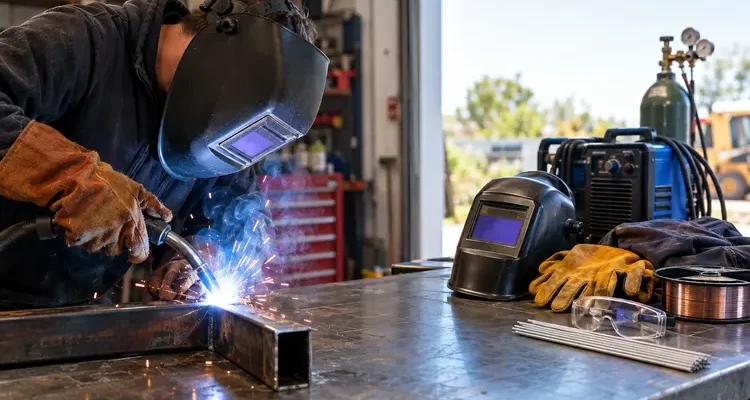
MIG welding is the most commonly used process for farm machinery welding in Australia — fast, versatile, and effective on most mild steel used in farm equipment construction. TIG welding produces cleaner, more precise welds and is used where thinner materials, specific alloys, or a higher-quality finish are required. It is slower and requires more skill, but delivers lower heat input where that matters.
Stick welding (MMA or arc welding) is well-suited to heavy farm equipment repairs, particularly outdoors. It handles surface contamination better than MIG and is less affected by wind, making it a practical choice for on-site work on heavy frames and thick structural components.
For outdoor farm repairs, stick welding or carefully managed MIG welding are the practical choices. Wind significantly affects MIG welding quality, so outdoor conditions need to be accounted for. The right welding process depends on the material, steel thickness, weld quality required, and working environment — our guide to different types of welders explains the differences in more detail.
Can Agricultural Equipment Be Welded On-Site?
Not all farm machinery can be easily transported to a workshop. Large equipment, machinery that has broken down in the paddock, or fixed farm structures are all good candidates for on-site welding. Combines, headers, and large trailers cannot always be moved without significant effort and expense — mobile welding brings the repair to the equipment rather than the other way around.
A breakdown in the middle of a busy season needs to be addressed quickly. Mobile welding services can respond to emergency farm machinery failures, getting equipment back in service without waiting for transport and workshop queues.
To get the most from a mobile welding visit, make the equipment as accessible as possible, depressurise fuel and hydraulic systems where relevant, and clear flammable materials from the work area. Dry grass, stored hay, fuel, and oil all present fire risks. A fire extinguisher should be on hand.
Should You Weld or Replace Damaged Farm Equipment?
A single crack in a non-critical location is a different proposition from a frame with multiple intersecting cracks or a significantly bent structural member. The key factors are: the extent and location of the damage; the overall age and condition of the equipment; and the relative cost of repair versus replacement.
In most cases, farm machinery welding repairs cost considerably less than replacement — particularly for structural components, large equipment, and older or custom-built machinery where parts are expensive or hard to source. A well-executed weld repair on a clean, properly prepared surface using appropriate materials can be a permanent fix; there is no inherent reason a welded joint cannot be as strong as the surrounding material.
Replacement makes more sense when the equipment is extensively damaged, when repair costs approach or exceed the machine’s value, when safety requirements cannot be met through repair, or when the overall condition does not justify the investment.
Some damage — particularly to main structural members or safety-critical components — requires professional assessment before a decision is made. An honest assessment from an experienced welder tells you whether a repair is feasible, how durable it is likely to be, and what it will cost.
Common Causes of Agricultural Equipment Damage
Understanding why damage occurred is part of carrying out the right repair. Common causes include:
- Heavy loads and overloading — overloaded frames, hitches, and attachment points crack sooner than those used within design limits
- Impact and shock loading — sudden strikes from rocks, stumps, or hard ground apply loads far exceeding normal operating loads
- Repeated vibration — continuous vibration during normal operation causes metal fatigue, typically at joints, welds, and stress concentrations
- Metal fatigue — the accumulation of many small load cycles over time, even within rated capacity; older equipment is more susceptible
- Abrasion and general wear — ground-engaging components and cutting edges wear down through normal use
- Corrosion and rust — moisture, chemical fertilisers, and soil contact all weaken steel over time
- Poor previous repairs — a repair done without proper preparation or with the wrong welding method can fail sooner than the original component
- Incorrect use — using equipment for tasks it was not designed for, or operating outside design parameters
Preventing Agricultural Equipment Welding Problems
Regular visual inspections — at the start of each season and after intensive use — allow damage to be identified early, when repairs are smaller and less expensive. Frame joints, hitch points, and loader arm roots should receive particular attention, as these are the areas most likely to develop cracks.
Repairing small cracks early is one of the most cost-effective maintenance practices on a farm. A crack caught early is a quick weld repair; left until it has propagated through a structural member, it becomes a major job. Scheduling farm machinery repairs before the planting, growing, or harvest season means equipment is ready when it is needed most.
Monitoring wear components — cutting edges, tine tips, plough shares — and addressing them before they wear through to the base component also reduces repair costs. Protecting bare steel with paint or protective coatings, particularly in moisture-trapping areas, slows corrosion and extends equipment life. If the same component keeps cracking in the same location, investigate the root cause — recurring damage is often a sign of overloading or a repair that has not addressed the underlying issue.
Agricultural Equipment Welding Safety
Before welding any structural component, understand what load it carries and what effect welding heat may have on adjacent materials or systems. Welding near hydraulic hoses, fuel lines, or electronic components requires particular care.
Welding onto oily or greasy surfaces is both a fire hazard and a quality issue — thorough cleaning before welding is not optional. Dry grass, stored hay, fuel, oil, and chemical containers should be removed from the vicinity. Weld spatter can travel considerable distances and ignite dry material; a fire extinguisher should be on hand whenever welding is performed.
Electronic control units, sensors, and other sensitive electronics should be disconnected where possible before welding on farm machinery, and the earth clamp should be positioned close to the weld site to prevent current flowing through sensitive components.
Welding near fuel tanks or hydraulic systems is dangerous. These should be emptied and purged before any welding begins — residual vapours in a fuel tank can ignite from weld spatter even when the tank appears empty. Pressurised components — hydraulic cylinders, gas accumulators, pneumatic systems — must never be welded. Any pressurised system must be fully depressurised before work begins in the area.
Structural welding repairs on load-bearing frames, hitches, and drawbars should be performed by welders with the knowledge and experience to select appropriate methods and materials and to execute the repair to a standard suitable for the loads involved.
Frequently Asked Questions About Agricultural Equipment Welding
What agricultural equipment can be repaired with welding?
Most steel farm machinery components can be repaired by welding, including tractor components, ploughs, cultivators, harrows, seeders, slashers, balers, harvesters, trailers, loader buckets, and livestock handling equipment. The suitability of a repair depends on the type and extent of the damage and the condition of the surrounding material.
Can tractors be welded?
Yes, but it depends on which part is damaged. Mild-steel components — brackets, loader arms, drawbars, steps, and guards — can be welded using standard processes. Many modern tractors use cast-iron or cast-steel structural housings rather than a conventional mild-steel frame. Welding these requires specialist nickel-alloy electrodes with controlled pre-heat and post-heat procedures; standard MIG or stick welding without these measures will almost always result in re-cracking. ROPS must not be welded or modified without engineering re-certification in compliance with Queensland WHS requirements.
Can farm trailers be repaired with welding?
Yes. Frames, drawbars, floors, tailgates, and ramps can all be repaired by welding. For road-registered trailers, structural welding on the chassis or drawbar must comply with Queensland Transport and Main Roads requirements and Vehicle Standards Bulletin 1 (VSB1). Certification by a Registered Engineer or inspection by a licensed vehicle examiner may be required before the trailer is road-legal again. Contact Queensland Transport and Main Roads if you are unsure.
Can cracked farm machinery be welded?
Yes, in most cases. The cracked area needs to be properly prepared — the crack ground out to sound metal before welding begins — so the weld fully bonds to solid material rather than bridging existing damage.
Can old agricultural equipment be welded?
Generally yes, provided there is sufficient sound metal remaining and the equipment is otherwise worth repairing. Very old or heavily corroded steel may require additional preparation.
Can slasher and mower decks be welded?
Yes — slasher decks and frames can be welded. Full penetration welds are important on decks, as the deck continues to flex and take impacts in normal use. Slasher blades themselves must never be welded or hardfaced — they are hardened rotating components. Weld heat causes embrittlement and balance disruption; at operating speed a compromised blade can fail catastrophically. Worn or damaged blades must always be replaced.
Can ploughs and cultivators be repaired with welding?
Yes. Plough frames, shanks, tines, disc mounts, and hitch points can all be repaired by welding. Ground-engaging components can also be hardfaced to extend wear life, with the caveat that high-carbon disc blades require specialist technique and are often better replaced when worn.
Can agricultural equipment be welded on-site?
Yes. Mobile welding is a practical option for machinery that is difficult to transport, has broken down in the paddock, or requires emergency repairs during a busy season. Stick welding is particularly well-suited to outdoor on-site work.
Is hardfacing suitable for farm machinery?
Yes, for the right components. Hardfacing works well on mild or low-alloy steel ground-engaging components — plough shares, cultivator tines, loader bucket edges, and wear plates are common examples. Hardened rotating blades such as slasher blades must never be hardfaced; replace them when worn.
How do I know whether farm equipment should be welded or replaced?
A professional assessment gives you the most accurate answer. As a general guide, welding is worth considering when the damage is localised, the equipment is otherwise in sound condition, and repair costs are significantly less than replacement. If the equipment is extensively damaged, heavily corroded throughout, or repair costs approach the machine’s value, replacement may be more appropriate.
How long does an agricultural welding repair take?
It depends on the damage. A simple bracket or tine repair may take an hour or less. A structural frame repair or major rebuild can take a full day or more. We can give you an estimate once we have assessed the damage.
Agricultural Welding Services From CJS Machinery Hire
At CJS Machinery Hire, we provide agricultural welding services across Hervey Bay, Booral, and the surrounding areas. We carry out structural welding on frames, chassis, and load-bearing components, hardfacing on high-wear items like plough shares and loader bucket edges, and repairs across a wide range of equipment — tractors, trailers, ploughs, slashers, loaders, and livestock handling structures.
For equipment that is difficult or impractical to transport, we offer mobile welding services. Whether your equipment has broken down in the paddock or is simply too large to move, we can come to you.
CJS Machinery Hire is based in Booral and serves the Hervey Bay region and surrounding communities.
Get Your Agricultural Equipment Back to Work
Farm machinery downtime costs money in lost productivity and disrupted operations. If you have machinery that needs welding repairs — whether it is a cracked frame, a broken hitch, a worn cutting edge, or anything in between — get in touch with CJS Machinery Hire. We provide agricultural equipment welding across Hervey Bay, Booral, and the surrounding region, for both workshop and on-site work.
We will assess the damage, tell you what we can fix and how long it will take, and give you a straightforward quote.
Contact CJS Machinery Hire to discuss your equipment and arrange a time that suits you.
Related Posts
Post a Comment