
Choosing the right material and welding approach for a marine project isn’t just a technical decision — it’s one that affects safety, longevity, and the cost of upkeep over the life of the vessel or structure. Saltwater is one of the most corrosive environments a weld can be exposed to, and when you add in constant humidity, UV radiation, wave impacts, and vibration, the margin for error is much smaller than it is in general fabrication.
Aluminium and steel are the two materials most commonly used in marine fabrication and repair. Each has its place, and the right choice depends on what you’re building, how it will be used, and what your budget allows. This article covers the key differences between the two materials, the welding processes that suit each one, how to protect welds in a marine setting, and what to watch out for when planning a marine welding job.
CJS Machinery Hire provides professional welding services across Hervey Bay and surrounding areas, including marine fabrication, structural repairs, and custom metalwork. Whether you’re dealing with a cracked boat hull or a worn trailer frame, our team has the experience to get it done properly.
Why Marine Welding Is Different from General Fabrication
Constant Exposure to Corrosion
In a standard workshop or construction environment, a weld can last decades with minimal protection. In a marine environment, that same weld faces a very different reality.
Saltwater is highly corrosive. It accelerates oxidation in steel and can trigger galvanic corrosion when dissimilar metals are in contact. Humidity keeps metal surfaces damp between uses, and UV exposure degrades protective coatings over time. Marine growth — barnacles, algae, and other organisms that attach to submerged surfaces — can also trap moisture against metal and worsen corrosion over time.
All of this means marine welds need to be executed with more care and better protection than welds used in sheltered environments.
Structural Loads on Marine Equipment
A boat or marine structure isn’t just sitting still. It’s constantly dealing with movement — wave impacts, vibration from engines, dynamic loading as cargo or passengers shift, and the cumulative fatigue that comes from years of use in rough water. Welds that seem solid when first done can develop cracks or separation points if they weren’t made with these forces in mind.
This is why marine welding requires proper technique and, in many cases, adherence to specific structural standards — not just a clean-looking bead.
Common Marine Components That Require Welding
Marine welding covers a wide range of components, including:
- Boat hulls (aluminium and steel)
- Boat trailers
- Aluminium pontoons
- Fuel tanks
- Deck structures
- Railings and safety barriers
- Marine ladders
- Engine mounts and frames
Each of these has different structural requirements, material thicknesses, and exposure levels — which is why the material choice and welding process need to be matched carefully.
Understanding Aluminium in Marine Applications
Why Aluminium Is Popular for Boats
Aluminium has become the material of choice for a large portion of recreational and light commercial marine builds. The three main reasons come down to weight, corrosion resistance, and the strength-to-weight ratio it offers.
A lighter hull means better fuel efficiency, easier towing, and often faster performance on the water. And because aluminium naturally forms a thin oxide layer that protects it from further corrosion, it holds up well in marine environments without the same level of ongoing coating maintenance that steel requires.
Common Marine Aluminium Grades
Not all aluminium is suitable for marine use. The grades that appear most often in boat building and marine fabrication are:
| Grade | Key Characteristics | Common Use |
| 5083 | High strength, excellent corrosion resistance | Hulls, structural components |
| 5086 | Good weldability, strong in saltwater | Hulls, fuel tanks, pressure vessels |
| 5052 | Moderate strength, very good corrosion resistance | Decking, panels, non-structural work |
Using the right marine-grade alloy matters. Standard aluminium grades used in general fabrication or extrusion work may not provide the same level of corrosion resistance and could degrade much faster in a saltwater environment.
Advantages of Aluminium Construction
Aluminium’s advantages in marine applications include:
- Reduced overall vessel weight, which improves fuel efficiency
- Easier towing with a standard tow vehicle
- Higher speeds, particularly for smaller recreational and fishing boats
- Lower long-term maintenance costs compared to steel
- A long service life when properly fabricated and maintained
Challenges of Welding Aluminium
Welding aluminium is more demanding than welding mild steel, and getting it wrong leads to welds that look fine but fail under load. The main challenges include:
- High thermal conductivity: aluminium draws heat away from the weld pool quickly, making it harder to achieve proper fusion
- Oxide layer: the aluminium oxide that protects the material from corrosion also has a much higher melting point than the base metal and must be removed before welding
- Distortion: because aluminium expands and contracts significantly with heat, distortion can occur if heat input isn’t carefully controlled
- Cleanliness requirements: even small amounts of moisture, grease, or contamination can introduce porosity into the weld
- Technique demands: aluminium responds differently under the torch and requires welders experienced with the material
This is why aluminium marine welding should always be handled by someone with specific experience in the material, not just general fabrication skills.
Understanding Steel in Marine Applications
Why Steel Is Still Widely Used
Despite aluminium’s popularity in recreational boating, steel remains the dominant material in commercial marine applications. Its structural strength makes it suitable for vessels and structures that carry significant loads or need to withstand heavy impacts — barges, workboats, and offshore equipment are common examples.
Steel is also more familiar to many welders and fabricators, and mild steel in particular is forgiving to work with, which keeps labour costs lower on large-scale fabrication jobs.
Common Types of Marine Steel
| Type | Characteristics | Typical Applications |
| Mild steel | Affordable, easy to weld, prone to rust | Trailers, frames, utility structures |
| Structural steel | Higher strength grades | Larger vessels, load-bearing components |
| Stainless steel | Very corrosion-resistant, harder to weld | Railings, fittings, hardware |
It’s worth noting that stainless steel is not used for hulls due to cost and its susceptibility to severe crevice corrosion in oxygen-deprived saltwater — without adequate oxygen, the passive oxide layer that makes stainless steel corrosion-resistant breaks down, leaving submerged sections vulnerable to rapid pitting. It’s more typically found in above-water fittings and hardware where oxygen access is not an issue.
Advantages of Steel Construction
Steel’s advantages in marine contexts include:
- High load capacity, making it suitable for commercial vessels and heavy equipment
- Easier and faster fabrication compared to aluminium
- Strong resistance to impact damage
- Wide availability and lower raw material cost
- Familiarity among tradespeople, which keeps fabrication straightforward
Challenges of Steel Welding
The biggest ongoing challenge with steel in marine environments is corrosion. Steel will rust when exposed to saltwater, and that process can move fast without proper protection. Managing this requires:
- Thorough surface preparation before welding and coating
- Application of appropriate marine primers and paint systems
- Regular inspection and maintenance of coatings over the vessel’s life
- Attention to weld quality, since porous or incomplete welds allow moisture in and accelerate corrosion from the inside
The structural strength that makes steel appealing can be undermined quickly if corrosion protection is neglected.
Aluminium vs Steel Welding: Side-by-Side Comparison
Weight
Aluminium is significantly lighter than steel — roughly one-third the weight by volume. This makes a meaningful difference in vessel performance, towing capacity, and fuel use, particularly for smaller and mid-sized boats.
Strength
Steel is stronger in absolute terms. For applications where high loads or impacts are the primary concern, steel is difficult to match. Aluminium compensates through its strength-to-weight ratio — it offers good structural performance without the mass.
Corrosion Resistance
Aluminium is naturally more corrosion-resistant in marine environments. Steel requires a consistent protection regime to prevent rust; without it, degradation happens relatively quickly.
Ease of Welding
Steel, particularly mild steel, is easier to weld. Aluminium requires more specialised technique and cleaner conditions. Both materials require experienced welders for structural marine work, but aluminium demands more precise control.
Repair Difficulty
Aluminium repairs require skilled technique and proper setup. Steel repairs are generally more straightforward, but require attention to corrosion control both before and after the repair.
Material Cost
Steel is typically cheaper per kilogram than aluminium. However, the cost picture over time shifts when you factor in corrosion maintenance requirements on steel structures.
Long-Term Maintenance
Aluminium requires less ongoing maintenance in most marine environments. Steel hulls and structures need regular inspection and recoating to remain serviceable.
Lifespan in Marine Environments
Both materials can provide long service lives when properly fabricated and maintained. Aluminium tends to be more forgiving with marine corrosion; steel can match it when coatings are kept in good condition.
Sustainability and Recyclability
Both aluminium and steel are highly recyclable. Aluminium does require significant energy to produce, though its recyclability partially offsets this. Steel production and recycling infrastructure is well-established in Australia.
Welding Processes Used for Marine Fabrication
TIG Welding
TIG (Tungsten Inert Gas) welding is the preferred process for precision marine work, particularly with aluminium. It allows the welder to control heat input carefully, which helps manage distortion and produces a clean, high-quality weld bead. TIG is commonly used for:
- Aluminium hull repairs and fabrication
- Thin material sections
- Fuel tanks and sealed components where weld quality is critical
- Work where appearance and finish matter
As part of understanding how different types of welders are used across applications, TIG is often the first choice where quality takes priority over speed.
MIG Welding
MIG (Metal Inert Gas) welding is faster and better suited to larger structural jobs. It’s widely used in marine fabrication for:
- Structural steel fabrication
- Larger repairs on hulls and frames
- Trailer construction and repair
- Heavy-duty components where deposition rate matters
MIG can also be used on aluminium with the right setup (spool gun or push-pull setup), though it requires more preparation than TIG to achieve clean results on the material.
Choosing the Right Process
The decision comes down to a few factors:
| Factor | TIG | MIG |
| Material thickness | Better for thinner sections | Better for thicker sections |
| Component purpose | Precision and sealed components | Structural and production work |
| Structural requirements | High-quality, low-distortion joints | Strong, fast structural welds |
| Finish expectations | Clean, aesthetically finished welds | Functional finish, may require dressing |
Getting familiar with welding terminology helps when discussing process options with a qualified welder — particularly when specifying requirements for marine jobs.
Preventing Corrosion After Welding
Protecting Steel Welds
After welding steel in a marine application, corrosion protection is not optional. The standard approach involves:
- Applying a suitable marine primer to bare metal as soon as possible after welding
- Using a marine-grade paint system designed for saltwater exposure
- Ensuring all weld areas, including hard-to-reach spots, are fully coated
- Scheduling regular inspections to catch any coating failure before rust takes hold
Protecting Aluminium Welds
Aluminium is more corrosion-resistant by nature, but the weld area can still be vulnerable, particularly if the wrong filler material was used or contamination occurred during welding. Protection involves:
- Selecting the right filler alloy for the base material — for 5000-series marine alloys such as 5083 and 5086, the correct fillers are 5356, 5183, or 5556; 5183 is the industry standard for structural 5083 hull plate specifically
- Cleaning the weld area thoroughly after completion
- Keeping dissimilar metals separated with appropriate isolation materials or coatings to prevent galvanic corrosion
- Avoiding contact between aluminium and copper, bronze, or other metals known to cause galvanic reactions in saltwater
Why Weld Quality Directly Affects Corrosion Resistance
A weld that looks clean on the outside can still have internal defects that compromise its long-term performance in a marine environment. The most common issues include:
- Porosity: gas pockets trapped in the weld metal that create pathways for moisture
- Incomplete penetration: where the weld hasn’t fully fused through the joint, leaving gaps that can hold water
- Surface contamination: oils, oxides, or other residues left in the weld zone that weaken the joint
- Poor finishing: rough or irregular weld surfaces that trap debris and accelerate local corrosion
Understanding common welding defects and how they’re prevented is an important part of quality control for any marine welding job.
Common Marine Welding Repairs
Aluminium Boat Hull Cracks
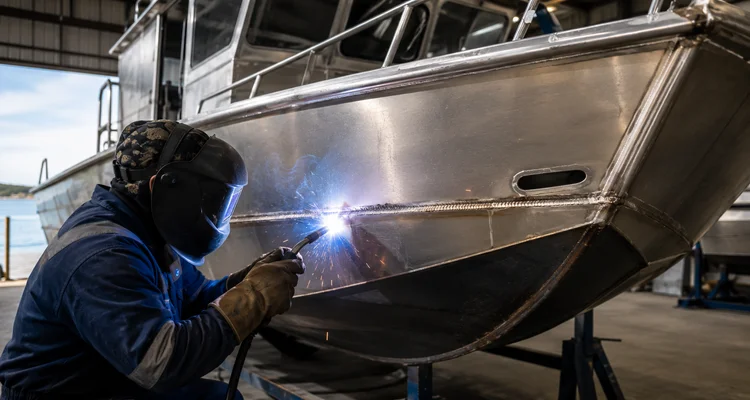
Cracks in aluminium hulls are one of the more common marine repair jobs. They can result from impact damage, fatigue from repeated wave loading, or stress concentration around fittings and fixtures. Proper repair involves cleaning the crack thoroughly, preparing the material, and welding with the correct filler for the alloy grade. A poorly repaired aluminium hull crack can reopen under load, so technique matters here.
Steel Boat Hull Repairs
Steel hull repairs range from patching corroded sections to repairing impact damage. The challenge is always corrosion — rust around the weld site needs to be fully removed before work begins, and the finished repair needs to be coated promptly. In some cases, plating sections of the hull may be more practical than trying to repair a section that has deteriorated too far.
Boat Trailer Repairs
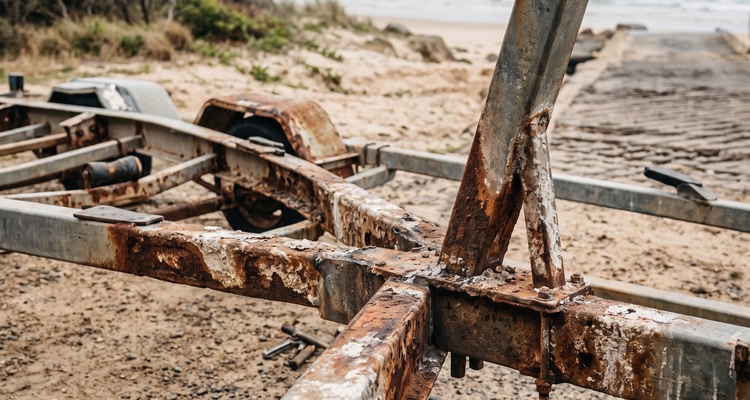
Trailer frames take a significant amount of punishment — road vibration, load stress, and regular exposure to saltwater when launching and retrieving boats. Welds on trailer frames can crack or separate over time, and the structural consequences of a failure while towing are serious. For more detail on what to look for, boat trailer welding repairs covers the key inspection and repair considerations.
Marine Fabrication Modifications
Not all marine welding is repair work. Modifications to existing vessels — adding deck fittings, reconfiguring layouts, mounting accessories or equipment — often require welding that ties into the original structure. Getting these right means understanding the base material, matching it with the right process and consumables, and ensuring any new welds don’t create stress concentration points.
Custom Marine Components
From custom fuel tanks and storage boxes to railings, steps, and equipment mounts, custom marine fabrication is a common need for both recreational boat owners and commercial operators. Custom work gives you the opportunity to spec the right material and design from the start, rather than working around existing constraints.
Which Material Is Better for Your Marine Project?
Choose Aluminium If…
- Weight is a primary consideration — recreational fishing boats, tinnies, and ski boats benefit significantly from aluminium’s lighter weight
- The vessel will spend a lot of time in saltwater without consistent maintenance
- Fuel efficiency or towing ease matters to the operator
- You’re building or repairing a pontoon, dinghy, or lightweight commercial vessel
Choose Steel If…
- The application involves heavy loads — barges, workboats, and commercial vessels typically require steel’s structural capacity
- The project involves large structural components where fabrication speed and cost are factors
- The vessel operates in conditions where impact resistance takes priority over weight
- Budget is the primary constraint and ongoing maintenance is manageable
When Professional Advice Makes the Difference
Some projects sit in the middle — a hybrid construction, a repair on an unfamiliar alloy, or a modification that ties into both materials. In these cases, the right advice upfront can save a lot of money and trouble later. Key areas where professional input is valuable include:
- Material compatibility between new and existing sections
- Correct welding procedures and consumable selection for the specific alloy
- Long-term maintenance planning based on how the vessel will be used
The cost of getting professional advice before a repair is always less than fixing a failure after the fact.
Common Mistakes to Avoid
Mixing Incompatible Metals
Welding steel directly to aluminium isn’t practical with standard processes — the two metals have very different melting points and metallurgical properties. Attempting it produces a joint that’s brittle and unreliable. If a design calls for both materials to be connected, there are purpose-built transition joints or mechanical fastening methods that do the job correctly.
Using the Wrong Filler Material
The filler rod or wire used in a weld needs to be compatible with the base metal and suited to the application. Using the wrong filler can reduce weld strength, increase porosity, and cause cracking. On aluminium, filler selection also affects the corrosion resistance of the finished weld.
Ignoring Surface Preparation
Both aluminium and steel need to be clean before welding. On aluminium, this means removing the oxide layer and any oils or contaminants. On steel, it means removing rust, mill scale, paint, and coatings. Skipping or rushing surface preparation is one of the most common causes of poor welds. It’s also one of the most avoidable.
Attempting DIY Marine Structural Repairs
Marine structural welds — hull repairs, trailer frames, fuel tanks, engine mounts — are not suitable candidates for DIY work unless the person doing it is a qualified welder with marine experience. The consequences of a structural failure at sea or on the road are serious. Understanding the scope of common structural welding repairs gives a clearer picture of why qualified work matters across all load-bearing applications.
Neglecting Post-Weld Corrosion Protection
Finishing the weld is not the end of the job. Leaving bare steel unprotected in a marine environment, or failing to address the heat-affected zone around an aluminium weld, shortens the life of the repair significantly. Post-weld treatment is part of the job, not an optional extra.
Australian Standards and Marine Welding Quality
Why Welding Standards Matter
Welding in Australia is governed by standards that set minimum requirements for structural welds in various applications. For marine work, this matters because a substandard weld in a load-bearing or safety-critical location creates real risk — not just to the vessel, but to the people on board.
The Australian Maritime Safety Authority (AMSA) sets requirements for commercial vessel construction and maintenance in Australian waters, including structural welding. For workplace welding safety, Safe Work Australia provides guidance on safe welding practices, hazard management, and personal protective equipment. Weld Australia provides industry standards and information on qualified welding procedures and welder certification.
Understanding which standards apply to your project is something a qualified welder or marine fabricator can advise on.
Importance of Qualified Welders
Marine welding isn’t a job for someone who has only worked on general steel fabrication. A qualified welder with marine experience will:
- Understand how different alloys behave in a marine environment
- Follow correct procedures for joint preparation, heat input, and post-weld treatment
- Select the right consumables for the material and application
- Know what certifications or standards may apply to the specific job
This is particularly true for structural repairs on vessels used commercially, where compliance with applicable standards isn’t just good practice — it may be a legal requirement.
Marine Welding Services in Hervey Bay — CJS Machinery Hire
Whether you’re dealing with a cracked pontoon, a boat trailer that’s seen better days, or a custom marine fabrication project, having access to qualified welding expertise in the Hervey Bay area makes the job straightforward.
At CJS Machinery Hire, we offer welding services across Hervey Bay and surrounding areas, including work on marine components, trailers, and structural fabrication. Our team has experience with both aluminium and steel in marine applications, and we understand what proper preparation, technique, and post-weld protection look like in a saltwater environment.
We’re a family-owned business based in Booral, and we’ve been working with the local community for over 25 years. We keep things straightforward — honest advice, proper work, and no unnecessary upselling.
If you’ve got a marine welding job that needs to be done right, get in touch with our team to discuss what’s involved. We’ll give you an honest assessment of the work and what to expect.
Get in touch with CJS Machinery Hire to discuss your marine welding needs across Hervey Bay, Maryborough, and the surrounding region.
Related Posts
Post a Comment