
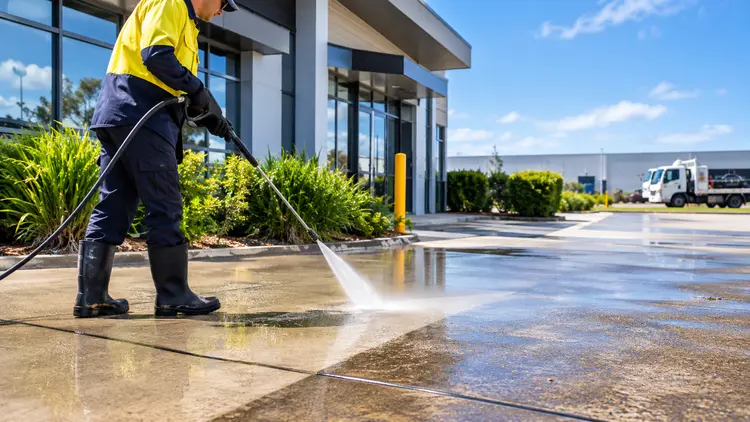
The outside of a commercial property says something before anyone walks through the door. When entrances are clean, paths are clear and car parks are well-maintained, the message is that the business runs a tight ship. When grime, oil stains and algae take hold, that impression works the other way.
Dirt, mould, algae, oil, grease, tyre marks, dust and general grime are common problems on commercial properties — and they build up fast. High foot traffic, vehicle movement, nearby construction and Queensland’s humid conditions all accelerate contamination. Commercial pressure washing is one of the more efficient ways to clean suitable hard surfaces, though the right pressure, technique and cleaning method depend on the surface and what is on it.
CJS Machinery Hire provides commercial pressure washing services across Hervey Bay, Maryborough and the surrounding areas, covering commercial premises, car parks, warehouse floors, service station forecourts and more.
What Is Commercial Pressure Washing?
Understanding Commercial Pressure Cleaning
Commercial pressure washing uses a motorised pump to force water through a wand and nozzle at high pressure, dislodging dirt, mould, algae, oil and other contaminants from suitable hard surfaces in a fraction of the time manual scrubbing would take.
The difference from a basic residential clean is not just scale. Commercial jobs involve heavier contamination, more demanding surface types, more complex site logistics and a higher expectation of consistent results across large areas. A high-traffic car park with embedded oil stains and significant algae growth requires a fundamentally different approach to washing a home driveway.
Commercial Pressure Washing vs Residential Pressure Washing
| Factor | Residential | Commercial |
| Property size | Small to medium | Often large or extensive |
| Cleaning frequency | Periodic | Regular or ongoing |
| Surface types | Mostly home surfaces | Concrete, pavers, brick, metal, hardstand |
| Contamination level | Light to moderate | Moderate to heavy, including oil and grease |
| Equipment | Consumer-grade | Commercial-grade |
| Site access | Straightforward | Vehicles, machinery, public access |
| Safety | Standard | Planning around staff, customers and operations |
A commercial property cannot simply be treated as a larger residential job. The contamination, surface variety, safety requirements and expectations around consistency are all different.
Pressure Washing vs Soft Washing for Commercial Properties
High-pressure cleaning suits hard surfaces like concrete, pavers and brick — but not every surface on a commercial property. Painted walls, rendered surfaces and certain cladding types can be damaged by conventional pressure washing. Soft washing — lower pressure combined with appropriate cleaning solutions — is the better fit for those materials. Choosing the correct method for each surface is one of the most important calls in any commercial pressure washing job — and not every surface that looks dirty should be pressure washed.
Why Do Business Properties Need Regular Pressure Washing?
Dirt and Grime Build Up Quickly
Foot traffic, vehicles, weather and nearby construction all contribute to continuous contamination on commercial properties. A busy car park or main entrance will start accumulating fresh grime almost immediately after a clean. Left to sit, surface-level dirt becomes ingrained contamination that requires considerably more effort to remove.
Mould, Algae and Organic Growth
Queensland’s warm, humid climate creates conditions where mould and algae establish themselves quickly. Shaded areas, drainage zones and moisture-retaining surfaces are particularly prone — and once established, organic growth does not wash away with rain alone.
Common locations include concrete paths, building exteriors in shaded positions, car parks and hardstand, retaining walls, and outdoor stairs. Beyond the appearance problem, established organic growth on walkways can contribute to slippery conditions.
Oil, Grease and Vehicle Contamination
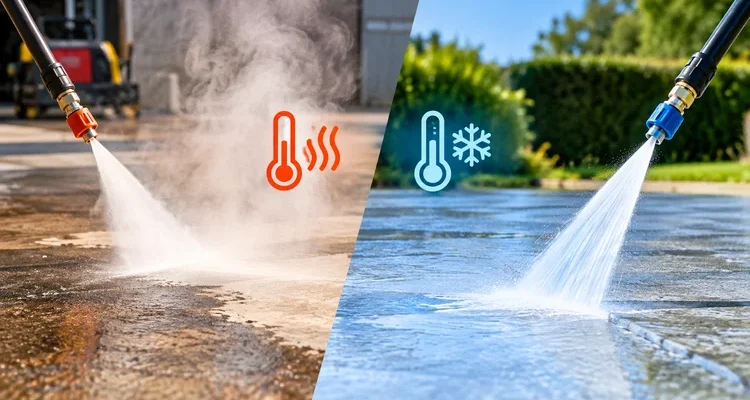
Workshops, service stations, warehouses, loading areas and automotive businesses all generate ongoing oil and grease contamination. This behaves differently from ordinary dirt — it bonds to porous surfaces and does not respond well to cold water alone. The heat in hot-water pressure washing helps break down hydrocarbon contamination before it is flushed away, making it considerably more effective on oil and grease than cold water alone.
Weather and Coastal Exposure
The Fraser Coast experiences significant rainfall, high humidity and — in coastal areas around Hervey Bay — salt-laden air. Salt deposits accumulate on building exteriors, metal surfaces and equipment. Rainfall often redistributes dirt rather than washing it away. Regular commercial exterior cleaning is part of sensible ongoing property maintenance in these conditions.
Where Can Commercial Pressure Washing Be Used?
Commercial Building Exteriors
Suitable surfaces — including certain types of brick, concrete block and stone — can be cleaned using pressure washing. The method must match the material. Rendered finishes, painted surfaces, heritage brick and softer materials require soft washing or lower-pressure approaches to avoid damage.
Concrete Paths and Footpaths
Walkways accumulate foot traffic dirt, organic growth and general outdoor grime. Keeping them clean matters for presentation and for the practical reason that slippery organic buildup on paths is a hazard responsible property managers take seriously.
Commercial Car Parks
Car parks see tyre marks, dirt, oil and fluid stains, organic growth and ongoing vehicle-related contamination. Regular car park pressure washing maintains the appearance of what is often the first surface customers encounter at a commercial property and removes contamination that becomes progressively harder to shift if left in place.
Warehouse and Factory Floors
Warehouse floors accumulate dust, dirt, oil and grease from ongoing operations. Where oil and grease are present, hot-water pressure washing is more effective than cold water alone. Appropriate drainage management is a key consideration, particularly where contaminated runoff needs to be controlled.
Service Station Forecourts
Forecourts handle fuel-related contamination, oil and grease deposits and heavy vehicle traffic daily. Forecourt cleaning carries specific environmental obligations. Under Queensland’s Environmental Protection Act 1994 and local council trade waste bylaws, hydrocarbon-contaminated wastewater — including wash water containing oil, grease or fuel residue — must not be directed into stormwater drains. Appropriate containment and recovery of contaminated runoff is required. Discuss your site’s drainage setup and compliance obligations with your operator before any forecourt cleaning takes place.
Loading Zones and Delivery Areas
Loading docks handle heavy vehicle traffic, mud, dirt, oil, grease and construction or agricultural debris. These areas can become heavily contaminated quickly. Regular cleaning keeps them functional and presentable; ingrained contamination is considerably harder to shift than surface-level buildup addressed more regularly.
Commercial Outdoor Areas
Courtyards, patios, outdoor seating, paths and hard-surface common areas all benefit from regular cleaning. As with other surfaces, the method should match the material — sealed pavers and concrete respond well to pressure washing; softer or more delicate surfaces may call for a lower-pressure approach.
Heavy Equipment and Machinery
Earthmoving equipment, construction machinery, plant, trailers and commercial vehicles accumulate compacted mud, grease and debris. Pressure washing removes this buildup efficiently, keeping equipment easier to inspect, maintain and store. CJS handles equipment cleaning as part of its broader pressure washing offer.
Benefits of Commercial Pressure Washing for Your Business
Improve Your Property’s Appearance
Clean entrances, paths, car parks and outdoor areas create a better first impression. A well-maintained exterior signals that the business pays attention to detail — a neglected one undermines that impression before anyone steps inside.
Help Reduce Slippery Organic Buildup
Mould, algae and biofilm on suitable hard surfaces can make those surfaces slippery. Removing organic growth from concrete, pavers and paths is part of a sensible exterior maintenance approach. Cleaning does not guarantee slip-free surfaces, but addressing established organic buildup is a sound step.
Support Ongoing Property Maintenance
Commercial exterior cleaning works best as a preventative activity. Addressing contamination before it becomes heavily established is easier and less costly than cleaning a surface that has been neglected. In environments where oil and grease are a regular issue, cleaning should be part of the routine rather than something arranged only when staining becomes visually obvious.
Save Staff Time and Keep Things Professional
Cleaning large commercial areas manually is time-consuming and physically demanding. Professional equipment and experience get large areas cleaned efficiently — freeing up staff for the work they are there to do. Clean external areas, paths and car parks also contribute to a workplace that looks and feels well-managed, which matters to customers, tenants and anyone who uses the site.
What Surfaces Can Be Pressure Washed at a Commercial Property?
Concrete
Concrete paths, slabs, car parks, loading areas, warehouse floors and forecourts all respond well to pressure washing when the correct technique is used. Excessive pressure can etch or pit concrete surfaces, particularly older or softer concrete — using the right PSI for the surface condition matters more than simply turning the pressure up.
Pavers
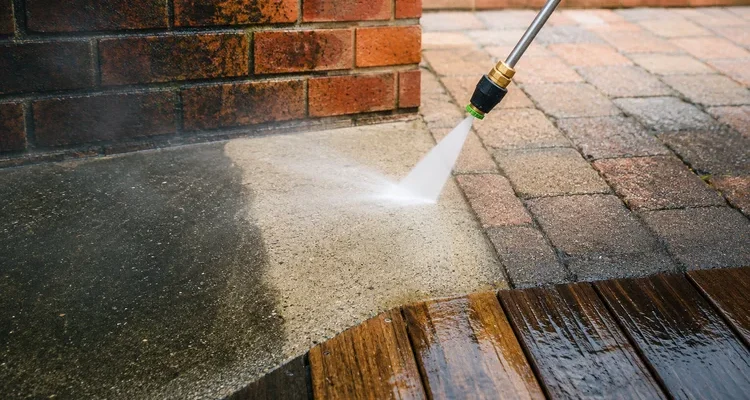
Pavers can be cleaned effectively, though excessive pressure can disturb the sand or mortar jointing between them. Where jointing material is removed, it may need to be replaced to keep the surface stable and sealed.
Brick
Brick and mortar require appropriate pressure and technique. The mortar is often softer than the bricks themselves, and excessive force can erode joints over time. Brick should not be treated the same way as a concrete slab.
Timber
Timber decking, boardwalks and fencing generally benefit from soft washing rather than conventional pressure washing. Cleaning solutions at low pressure break down mould, algae and grime without the mechanical force that can raise the grain, cause splintering or open the surface to water ingress. Where pressure washing is used on timber, it should be at significantly reduced PSI with a wide-angle nozzle — and a surface assessment is important before any approach is chosen.
Painted and Rendered Surfaces
These surfaces are generally not suitable for conventional high-pressure cleaning. Soft washing — lower pressure with appropriate cleaning solutions — is typically the correct approach. A surface assessment before work begins is essential.
Metal and Commercial Equipment
Commercial machinery, vehicles and metal surfaces can be cleaned with pressure washing, with care around sensitive components — electrical fittings, bearings, seals. Where oil and grease are involved, hot-water cleaning is more effective.
How Often Should a Business Property Be Pressure Washed?
Cleaning frequency depends on foot and vehicle traffic, property location, rainfall and humidity, nearby vegetation, mould and algae growth rate, oil and grease exposure, surface materials and seasonal conditions. There is no fixed schedule that applies across the board.
High-traffic commercial sites — retail properties, service stations, hospitality businesses — may need monthly cleaning of key areas. Industrial and workshop environments often need cleaning based on contamination levels rather than appearance. How often pressure washing makes sense comes down to the specifics of each site — traffic, climate, surface type and what is actually accumulating on the property.
Queensland’s wet season accelerates organic growth and deposits mud and debris across commercial sites. Post-storm cleaning is often needed, and preparing outdoor areas before busier seasonal periods is worth building into the schedule.
Planned, scheduled maintenance cleaning consistently outperforms ad-hoc cleaning arranged only when things look bad. It keeps contamination from building up to a point requiring more intensive treatment and allows cleaning to be timed around business operations with minimal disruption.
When Should You Hire a Professional Commercial Pressure Washing Service?
Professional cleaning makes sense when:
- The area is too large for DIY — large car parks, warehouse floors and extensive outdoor areas require commercial-grade output and flow rate that consumer equipment cannot match
- Heavy contamination is present — oil, grease, embedded grime, heavy organic growth and compacted dirt need the right combination of temperature, cleaning agents, pre-treatment and technique
- Access or safety is a consideration — commercial cleaning can involve elevated surfaces, tight spaces, areas near electrical fittings and the need to manage pedestrian and vehicle traffic around active cleaning
- You are unsure which cleaning method to use — pressure washing is not always the right answer, and on some surfaces it causes damage or produces a poor result
- Consistent results matter — achieving even coverage across a large area without patches or streaks requires the right equipment and the experience to work systematically
Renting commercial-grade equipment is not the same as knowing how to use it. The correct pressure for the surface, nozzle selection, knowledge of which surfaces should not be pressure washed, appropriate cleaning agents and technique all matter independently of what the equipment is capable of. Using the right equipment incorrectly can still damage concrete, lift render or dislodge paver jointing material.
Preparing Your Site for a Commercial Pressure Washing Job
Getting the most out of a commercial pressure washing service comes down to a few practical steps:
- Clear vehicles, machinery and movable equipment from the areas to be cleaned
- Secure or cover stock, electrical equipment and sensitive items
- Let staff and customers know when and where cleaning is happening, particularly if areas will be temporarily out of use
- Schedule cleaning outside peak operating hours where practical
- Identify drainage and runoff points so the operator can plan for contaminated wastewater management
- Walk the site with the operator beforehand and point out oil stains, delicate surfaces, existing damage, difficult access areas and any operational concerns
Can Pressure Washing Damage a Commercial Property?
Yes — when it is done incorrectly. The most common causes of damage are:
Too much pressure. Higher PSI is not automatically better. Excessive pressure can etch concrete, erode mortar, lift paint and render, and raise timber grain — the same equipment that cleans concrete effectively can damage brick, render or pavers if the operator does not adjust for the surface.
Wrong nozzle. A narrow-angle nozzle concentrates force into a small area and can damage surfaces that a wider-angle nozzle at the same PSI would clean safely.
Same approach on every surface. Concrete, brick, timber, render and painted surfaces all behave differently under pressure. Each requires its own assessment.
Ignoring drainage and runoff. In Queensland, discharging trade waste — including wash water contaminated with oil, grease or fuel residue — into stormwater systems is a breach of the Environmental Protection Act 1994. Local council trade waste bylaws impose additional requirements across the Fraser Coast region. For sites involving hydrocarbon contamination, runoff must be contained or recovered, not hosed toward the nearest drain. Failing to plan this before a job starts can expose the property owner and operator to regulatory liability.
Failing to protect surrounding areas. Doors, windows, landscaping, electrical fittings, stored stock and parked vehicles all need to be considered before cleaning begins.
Commercial Pressure Washing in Hervey Bay and the Fraser Coast
Why Local Conditions Matter
Hervey Bay and the Fraser Coast experience warm temperatures, high humidity, regular rainfall and coastal salt exposure. These conditions accelerate mould and algae growth, promote surface staining and drive salt deposit buildup on building exteriors and equipment. Commercial exterior cleaning is not an occasional activity in this environment — it is a routine part of keeping a commercial site in good condition.
CJS Machinery Hire’s Coverage
CJS provides commercial pressure washing in Hervey Bay across a wide range of applications:
- Business premises and building exteriors (suitable surfaces)
- Commercial car parks
- Industrial and workshop hardstand areas
- Warehouse floors
- Service station forecourts
- Heavy equipment and commercial vehicles
- Paths, courtyard areas and commercial outdoor spaces
CJS also services Maryborough and the surrounding Fraser Coast region.
Why Choose CJS Machinery Hire for Commercial Pressure Washing?
CJS Machinery Hire is a family-owned business based in Booral, with over 25 years’ experience in construction and earthmoving. That background brings a practical understanding of commercial and industrial environments — what contamination looks like, how it accumulates, and what the site access and operational constraints actually are.
The approach CJS takes starts with the surface: identify what is being cleaned, what the contamination is, and select the appropriate method — pressure washing, soft washing, hot-water cleaning, or pre-treatment — for that specific situation. Appropriate equipment for the job rather than simply maximum pressure. The right technique, matched to the material.
Applications cover commercial building exteriors, car parks, warehouse and factory floors, service station and industrial forecourts, heavy equipment and plant, paths, loading zones and commercial hard-surface areas — across Hervey Bay, Maryborough and the broader Fraser Coast region.
Frequently Asked Questions About Commercial Pressure Washing
What is commercial pressure washing?
Commercial pressure washing uses high-pressure water delivered through a pump, wand and nozzle to clean hard surfaces on commercial properties, removing dirt, grime, mould, algae, oil, grease and other contamination from concrete, pavers, brick, metal and similar materials.
What can commercial pressure washing remove?
Surface dirt, mud, grime, mould, algae, oil stains, grease, tyre marks, dust, carbon deposits, bird droppings and general organic buildup from suitable hard surfaces. Heavily embedded contamination may also require pre-treatment or hot-water cleaning.
What commercial surfaces can be pressure washed?
Concrete, sealed pavers, brick, stone and metal are generally suitable when the correct pressure and technique are used. Asphalt requires careful handling — high pressure can strip the binder and dislodge aggregate, so low-pressure or soft-wash methods are the appropriate approach. Painted surfaces, rendered walls and timber require lower-pressure or soft washing.
How often should a commercial property be pressure washed?
It depends on traffic, local climate, surface types and contamination. High-traffic retail and service station sites may need monthly cleaning of key areas. Industrial properties often clean to contamination levels rather than a fixed schedule.
Can pressure washing remove oil stains from concrete?
It can remove surface oil staining. For deeply embedded or older stains, pre-treatment with appropriate cleaning agents and hot-water pressure washing is more effective than cold water alone.
Can pressure washing remove mould and algae?
Yes, from suitable hard surfaces including concrete, pavers, brick and paths. In Queensland’s climate, mould and algae are a recurring issue, and regular cleaning is often necessary to manage organic growth.
Is pressure washing safe for commercial buildings?
For suitable hard surfaces, yes, when the correct pressure, nozzle and technique are used. Painted walls, render, certain cladding types and heritage materials may require soft washing or lower-pressure alternatives.
Is pressure washing suitable for warehouse floors?
Yes, on concrete warehouse floors with appropriate drainage and where the floor is clear of stock or machinery in the cleaning area. Oil and grease contamination often benefits from hot-water pressure washing or pre-treatment.
Can pressure washing damage concrete?
Yes, if done incorrectly. Excessive pressure can etch or pit concrete surfaces. Using the correct PSI, nozzle and technique for the surface condition and contamination type prevents damage.
Should commercial properties use pressure washing or soft washing?
Hard surfaces like concrete, pavers and brick generally suit pressure washing. Painted surfaces, render, certain cladding and building façades are better suited to soft washing. Many commercial properties have both types — the method should be matched to each surface.
How long does commercial pressure washing take?
It depends on the area size, contamination level, surface types and site access. A small property may take a few hours; a large car park, warehouse floor or extensive exterior will take considerably longer.
Is commercial pressure washing worth it?
For most commercial properties, yes. Regular professional cleaning maintains appearance, removes contamination that affects surfaces over time and is generally more cost-effective than addressing heavily ingrained buildup after the fact.
Does CJS Machinery Hire provide commercial pressure washing in Hervey Bay?
Yes. CJS provides commercial pressure washing across Hervey Bay, Maryborough and the surrounding Fraser Coast region. Contact CJS to discuss your property and requirements.
Keep Your Business Property Clean With CJS Machinery Hire
Dirt, mould, algae, oil, grease and heavy traffic take their toll on commercial exterior surfaces — and in Queensland’s climate, the rate at which things deteriorate can be faster than expected. Getting the right result comes down to the right equipment, the right pressure for each surface, and the technique and experience to apply both consistently across a demanding commercial environment.
CJS Machinery Hire offers commercial pressure washing across Hervey Bay, Maryborough and the surrounding Fraser Coast region. Whether you manage a retail property, run a workshop, oversee a warehouse operation or look after a commercial portfolio, the team at CJS can assess your site and discuss a cleaning approach that fits.
Get in touch with CJS Machinery Hire to request a quote or talk through your requirements.
Related Posts
Post a Comment