
When it comes to arc welding, three processes dominate most fabrication and repair work: MIG, TIG, and stick welding. Each has its place, and choosing the right one can make a real difference to your finished result — whether you’re working in a workshop, on a construction site, or out in the paddock.
The welding process you select affects weld strength, appearance, speed, and how well the job suits the material and working conditions. A process that works well on stainless steel in a controlled workshop setting may not be the right choice for a field repair on heavy steel in windy conditions. Understanding the differences between MIG, TIG, and stick welding helps you make a more informed decision — or know when to call in a professional.
Here’s a brief summary of how each process works:
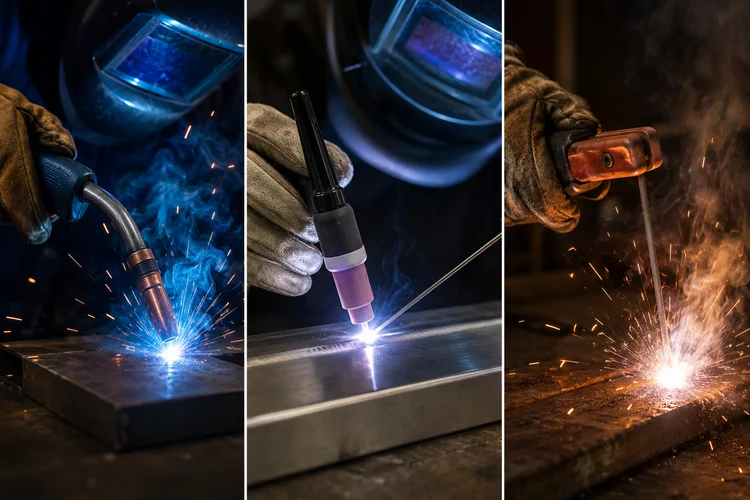
- MIG welding uses a continuously fed wire electrode and shielding gas to protect the weld pool.
- TIG welding uses a non-consumable tungsten electrode and shielding gas, with filler metal added separately when required.
- Stick welding uses a flux-coated consumable electrode that creates its own shielding during the welding process.
There is no single best welding method for every application. The right choice depends on the job, the material, the working environment, and the skill of the operator. What follows is a practical comparison of all three processes to help you understand when each one is appropriate — and when it makes sense to hand the work to a professional welding service.
What Is MIG Welding?
How MIG Welding Works
MIG welding — formally known as Gas Metal Arc Welding (GMAW) — is one of the most widely used welding processes in fabrication and repair work. The process involves a continuously fed consumable wire electrode that passes through a welding gun. An electrical arc forms between the wire and the base metal, generating the heat needed to melt both the wire and the base metal to form the weld.
Shielding gas is fed through the welding gun alongside the wire. Its job is to protect the molten weld pool from atmospheric contamination — oxygen, nitrogen, and moisture in the air can all cause weld defects if they reach the pool before it solidifies. The type of shielding gas used depends on the base metal and the requirements of the job.
The welder controls the arc by managing the gun angle, travel speed, and distance from the work surface. Wire feed speed and voltage are set on the machine and directly affect the weld bead profile and penetration. When correctly set up, MIG is a fast and productive welding process, which makes it a practical choice across a wide range of fabrication and repair applications.
Advantages of MIG Welding
- Fast welding speeds with continuous wire feed, reducing the interruptions that come with replacing electrodes
- Relatively straightforward to learn compared with TIG welding
- Suitable for a broad range of fabrication and repair applications
- Produces clean welds when correctly set up and using appropriate consumables
- Well suited to repetitive welding work and longer weld runs
- Can be used on mild steel, stainless steel, aluminium, and other metals with the appropriate wire, gas, and machine settings
Disadvantages of MIG Welding
- Shielding gas makes conventional solid-wire MIG (GMAW) less suitable for exposed or windy outdoor environments, where gas coverage can be disrupted. That said, running self-shielded flux-cored wire (FCAW-S) through a compatible MIG machine is an option for outdoor work where stick welding isn’t preferred — the flux core generates its own shielding without an external gas supply
- Equipment can be less portable than a basic stick welding setup — the machine, wire, and gas cylinder all need to be on site
- Incorrect settings or technique can result in poor penetration, excessive spatter, porosity, or incomplete fusion
- Requires the correct wire, shielding gas, and machine configuration for the material being welded
When Is MIG Welding a Good Choice?
MIG welding is commonly used for general metal fabrication, mild steel repairs, structural and workshop fabrication, and production-style work where welding speed matters. It suits applications involving longer, continuous weld runs and jobs where a relatively clean weld finish is needed without the slower pace of TIG welding.
What Is TIG Welding?
How TIG Welding Works
TIG welding — formally known as Gas Tungsten Arc Welding (GTAW) — uses a non-consumable tungsten electrode to create the arc. Unlike MIG welding, the electrode itself does not melt into the weld. When additional filler material is required, the welder feeds a separate filler rod into the weld pool by hand.
Shielding gas — typically argon — protects the weld pool and the tungsten electrode from contamination during welding. The process gives the welder a high degree of control over the arc, the heat input, and the amount of filler material being added. This makes TIG particularly useful for applications where precision and appearance are priorities.
Because the welder manages the arc, the torch, and the filler rod independently, TIG demands greater coordination than MIG. It is generally a slower process, but when correctly performed on suitable materials, it can produce welds with a very clean, consistent appearance.
Advantages of TIG Welding
- Excellent control over the welding arc and heat input
- Suitable for thin materials and detailed work where precise heat control matters
- Can produce clean welds with minimal spatter when correctly performed
- Allows the welder to control filler material independently from the arc
- Can be used on a variety of metals including stainless steel, aluminium, mild steel, and some other alloys with the appropriate setup
- High-quality weld appearance when performed correctly
Disadvantages of TIG Welding
- Generally slower than MIG welding, making it less practical for high-volume fabrication
- Requires greater operator skill and coordination — managing the torch, filler rod, and foot pedal (where used) simultaneously takes practice
- More demanding setup than MIG or stick
- TIG is not the most economical option when welding speed is the main priority
- Requires careful control of contamination and shielding gas to maintain weld quality
When Is TIG Welding a Good Choice?
TIG welding is commonly selected for precision fabrication, thin metal applications, visible welds where appearance matters, and detailed repair work. It is frequently used on stainless steel and aluminium applications where heat control and surface finish are important. Where weld quality and appearance are more important than speed, TIG is often the process of choice.
What Is Stick Welding?
How Stick Welding Works
Stick welding — formally known as Shielded Metal Arc Welding (SMAW) — uses a consumable electrode coated in flux. When the arc is struck, the flux coating burns and produces a shielding gas and slag that protects the molten weld pool from contamination. As the electrode is consumed during welding, it is progressively replaced.
This self-contained shielding mechanism is what makes stick welding particularly practical for outdoor and field applications. Without the need for an external shielding gas cylinder, the equipment is simpler to transport and set up. Stick welding remains a widely used process for repair work, field maintenance, and fabrication involving thicker steel.
Advantages of Stick Welding
- Relatively simple equipment setup — no external shielding gas required
- Highly portable, making it practical for field repairs and remote locations
- Useful for outdoor applications where wind conditions could disrupt shielding gas coverage
- Suitable for a wide range of repair and fabrication applications
- Can be effective on thicker materials when the correct electrode and technique are used
- Equipment is practical for site work and rural environments
Disadvantages of Stick Welding
- Generally slower than MIG welding
- Requires replacing electrodes during the welding process, creating more interruptions
- Produces slag that needs to be removed between passes and after welding
- Different electrode types are required for different materials and applications
- Less convenient for thin sheet metal
- Weld appearance may be less refined than properly performed TIG or MIG welding
- Maintaining a consistent arc requires practice and technique
When Is Stick Welding a Good Choice?
Stick welding is a practical choice for outdoor welding, field repairs, maintenance work in remote locations, and heavier-duty steel applications. It suits situations where shielding gas is impractical to transport, where portability is important, or where the working environment makes conventional MIG difficult.
MIG vs TIG vs Stick Welding: Key Differences
MIG vs TIG
| Factor | MIG Welding | TIG Welding |
| Welding speed | Generally faster | Generally slower |
| Precision and control | Moderate | High |
| Ease of use | More accessible for beginners | Requires greater skill and coordination |
| Weld appearance | Clean when correctly set up | Very clean when correctly performed |
| Thin materials | Suitable with correct settings | Particularly well suited |
| Operator skill required | Moderate | High |
| Equipment and setup | Wire, machine, shielding gas | Machine, tungsten electrode, filler rod, shielding gas |
MIG is generally more practical when speed and productivity are priorities, or for general fabrication on mild steel. TIG becomes the preferred choice when precision, heat control, or weld appearance are more important than welding speed — particularly on thin materials or detailed work.
MIG vs Stick
| Factor | MIG Welding | Stick Welding |
| Welding speed | Generally faster | Slower due to electrode changes |
| Portability | Requires machine, wire, and gas cylinder | More portable setup |
| Outdoor suitability | Shielding gas can be affected by wind | Well suited to outdoor use |
| Weld cleanliness | Clean with correct settings | Slag requires removal |
| Setup requirements | More involved | Simpler |
| Thicker materials | Suitable | Suitable with correct electrode |
| Ease of learning | More accessible | Requires technique for arc consistency |
MIG generally has the advantage for workshop-based fabrication and repetitive work. Stick becomes more practical when equipment portability matters, when working outdoors, or when shielding gas is difficult to use on site.
TIG vs Stick
| Factor | TIG Welding | Stick Welding |
| Precision and control | Very high | Moderate |
| Welding speed | Slower | Moderate |
| Portability | Requires machine, gas, and consumables | More portable |
| Outdoor suitability | Shielding gas can be affected by wind | Well suited to outdoor use |
| Weld appearance | Very clean | Less refined; slag removal required |
| Skill required | High | Moderate |
| Suitability | Detailed, precision work; thin materials | Heavier-duty applications; field repairs |
TIG suits precision and appearance-focused applications. Stick is more practical for heavier-duty work, outdoor environments, and field repairs where portability is a priority.
MIG vs TIG vs Stick Welding Comparison
Welding Speed
MIG generally has the advantage for productivity. The continuous wire feed means fewer interruptions during welding, which suits longer runs and repetitive fabrication work. TIG is typically slower — the process requires the welder to manage the torch, arc, and filler rod independently, which demands more care and time. Stick welding sits somewhere in between depending on the application, electrode size, and the frequency of electrode changes.
Weld Quality and Appearance
Each process is capable of producing quality welds — but the result depends heavily on operator skill, material preparation, and correct machine settings. TIG can produce a very clean, consistent weld appearance when correctly performed. MIG can produce clean welds too, particularly on suitable materials with the right setup. Stick welding generally produces a less refined appearance due to the slag and spatter involved, though this is less relevant for functional repairs and heavy fabrication where appearance is not the priority.
It’s important not to assume that one process automatically produces a stronger weld than another. Weld quality depends on the complete welding procedure, not the process name alone. For a detailed look at what affects weld reliability, the common welding defects and how they’re prevented article covers this in more depth.
Material Thickness
All three processes can handle a range of material thicknesses with appropriate machine settings, electrode or wire selection, and joint preparation. TIG offers particularly good control on thinner materials where excess heat input can cause distortion or burn-through. MIG and stick can both be suitable for heavier steel applications, depending on machine capacity and procedure. Selecting a process based on thickness alone isn’t the full picture — joint design, material type, welding procedure, and machine output all play a part in the result.
Portability
Stick welding has the clear advantage for portability. A basic stick setup requires a welding machine and a supply of electrodes — no gas cylinder to transport. MIG welding requires the machine, wire, and a shielding gas cylinder, which adds to the equipment that needs to be moved. TIG welding similarly requires shielding gas plus additional consumables, making it less convenient for field work. For remote or rural repair work, stick is often the more practical option.
Ease of Use
MIG is generally considered the most accessible of the three for someone learning to weld. Setting up the machine and running a bead is more straightforward than TIG, and the continuous wire feed means less manual coordination is required. TIG demands more from the operator — managing the arc, the filler rod, and in many cases a foot pedal simultaneously takes time to develop as a skill. Stick welding requires practice to maintain a consistent arc as the electrode shortens during use. All three processes require proper technique to produce quality results, regardless of how the learning curve compares.
Outdoor Welding
Wind is the main challenge for conventional solid-wire MIG and TIG in outdoor environments. Shielding gas can be disrupted by even moderate wind, which leads to contamination of the weld pool and defects such as porosity. Stick welding avoids this issue because shielding comes from the flux coating on the electrode rather than an external gas. It’s also worth noting that self-shielded flux-cored wire (FCAW-S) — which runs through a compatible MIG machine without requiring a gas cylinder — can be a practical alternative for outdoor applications where stick welding isn’t the preferred option. Weather, site conditions, and appropriate safety controls still need to be considered before starting any outdoor welding work regardless of process.
Equipment and Setup
| Component | MIG | TIG | Stick |
| Welding machine | Required | Required | Required |
| Torch / electrode holder | MIG gun | TIG torch | Electrode holder |
| Wire / electrodes / filler | Consumable wire | Tungsten electrode + filler rods | Flux-coated electrodes |
| Shielding gas | Required | Required | Not required |
| Cables | Welding lead + earth | Welding lead + earth | Welding lead + earth |
| Consumables | Wire, contact tips, nozzle | Tungsten, filler rod, collets, cups | Electrodes |
Equipment requirements vary considerably between processes. A basic stick setup is the simplest and most portable. MIG and TIG setups involve more components and a shielding gas supply, which adds cost, weight, and logistical requirements — particularly for on-site work.
Which Welding Process Is Best for Different Jobs?
Best Welding Method for General Fabrication
MIG welding is often a practical choice for general fabrication work. Its combination of speed, continuous wire feed, and relatively straightforward operation makes it well suited to workshop settings where a range of jobs come through regularly. It handles mild steel well and can be adapted for other materials with appropriate consumables and settings.
Best Welding Method for Thin Metal
TIG welding offers very good control over heat input on thinner materials, which helps to reduce the risk of distortion or burn-through. MIG can also be suitable for many thin-metal applications when the machine is correctly configured and the operator has appropriate technique. The key factor for thin metal is heat control rather than the process name. Choosing a process based on material thickness alone without considering joint design, fit-up, and technique can still produce poor results.
Best Welding Method for Thick Steel
MIG and stick welding are both commonly used on thicker steel, depending on the application and working environment. Machine output, correct electrode or wire selection, joint preparation, and welding procedure all affect the result. For outdoor or remote work on heavy steel, stick welding is often the practical choice. For workshop-based fabrication involving thicker sections, MIG is frequently used with appropriate machine settings and multi-pass technique where required.
Best Welding Method for Outdoor Repairs
Stick welding is well suited to outdoor repair work because it does not rely on shielding gas. This makes it more resistant to wind interference than MIG or TIG. For equipment repairs, infrastructure maintenance, and field work on rural properties, stick welding is often the most practical option. That said, safe welding outdoors still requires consideration of surroundings, fire risks, and working conditions. On-site or field welding repairs also need to be performed by someone with the appropriate skill and equipment for the job.
Best Welding Method for Precision Welding
TIG is commonly selected for precision welding applications — particularly where appearance, tight tolerances, or careful heat input are important. Stainless steel, aluminium fabrication, and visible structural joints where finish matters are typical applications. The process demands a skilled operator, but the control it offers over the arc and filler material makes it well suited to this type of work.
Best Welding Method for Fast Welding
MIG is generally preferred where productivity is a priority. The continuous wire feed reduces interruptions and allows longer weld runs without stopping to replace electrodes. For production fabrication, repetitive welds, or jobs with long seam lengths, MIG is typically the most efficient process.
Best Welding Method for Remote or On-Site Repairs
Portability often makes stick welding the preferred option for remote or on-site repairs. A stick welder and a supply of electrodes can be transported without the additional weight and logistics of a gas cylinder. For farm machinery, agricultural equipment, structural repairs, and similar applications in remote locations, stick welding is frequently the most practical choice. On-site welding still requires appropriate safety controls, correct technique, and a welder with the skill to assess the joint and select the right electrode for the material.
What Factors Should You Consider When Choosing a Welding Process?
Type of Metal
The base metal has a significant influence on process selection. Different materials require different equipment configurations, consumables, shielding gases, and techniques:
- Mild steel can be welded using MIG, TIG, or stick with appropriate consumables
- Stainless steel welding typically requires careful selection of filler material, shielding gas, and heat control to avoid sensitisation and surface contamination
- Aluminium welding requires specific MIG or TIG configurations — not all machines are suitable, and the process differs from steel welding in several important ways
- Other compatible metals may require specialist consumables or process knowledge
For a broader overview of how materials affect welding process selection, the aluminium vs steel welding for marine applications article provides a useful reference.
Thickness of the Material
Material thickness affects the choice of process, machine settings, and consumables — but it should not be the only consideration. A thick section of steel welded with incorrect settings or technique will produce a poor result regardless of which process is used. Joint design, fit-up, welding procedure, and operator skill all play a role in how well a process handles a given thickness.
Location of the Job
Where the welding is taking place affects the practical options:
- Workshop or controlled environment: all three processes are typically suitable
- Construction site or industrial site: portability, shielding gas logistics, and safe working conditions need to be considered
- Farm or rural property: portable equipment and independence from gas supply can make stick welding more practical
- Outdoor location: wind and weather can affect MIG and TIG shielding gas
- Confined or difficult-to-access areas: equipment size and manoeuvrability matter alongside process selection
Required Weld Appearance
For functional welds where appearance is not a priority, the most suitable process for the material and environment is generally the right choice. For visible fabrication or applications where the weld surface will be seen, MIG and TIG can both produce clean results with appropriate settings and technique. Where appearance and precision are particularly important — such as exposed stainless steel fabrication or detailed precision work — TIG is commonly the preferred option.
Required Welding Speed
Production-style work, long weld runs, and time-sensitive repairs generally favour MIG for its continuous wire feed and relative speed. Small repairs, detailed work, or applications where precision matters more than speed may be better suited to TIG. Stick welding is generally used where portability or outdoor capability is required rather than for speed-focused applications.
Accessibility of the Joint
Awkward angles, restricted access, and difficult welding positions affect the suitability of both the process and the equipment. The size and flexibility of the welding torch, the electrode holder, and the cable setup all play a role in how well the welder can access and control the weld. Process selection should take the actual joint into account — not just the material and thickness.
Welder Skill and Experience
Operator experience affects the quality of the result across all three processes. An experienced welder can produce sound welds with MIG, TIG, or stick when the correct process is selected for the job. An inexperienced operator using an appropriate process can still produce defective welds without correct preparation, settings, and technique. If weld quality and reliability are important — particularly for structural, load-bearing, or safety-critical applications — this is a key reason to use a qualified professional welding service.
MIG vs TIG vs Stick: Which One Produces the Strongest Weld?
Does Welding Process Determine Weld Strength?
Weld strength is determined by more than the welding process. A weld that looks solid externally can still have internal defects that reduce its load-bearing capacity. The factors that actually affect weld strength include:
- Material compatibility between the base metal and the filler
- Joint design and the size of the weld relative to the load
- Depth of penetration and fusion with the base metal
- Welding parameters — current, voltage, travel speed
- Surface preparation and cleanliness before welding
- Welder technique and consistency
- Applicable welding specifications or engineering requirements
All three processes are capable of producing sound, strong welds in appropriate applications when performed correctly. None of them automatically produces a stronger weld than the others.
Why the “Strongest” Welding Method Is Not Always the Best Choice
A larger or more visually impressive weld is not necessarily a correctly engineered weld. The appropriate process should match the material, joint type, load requirements, and working conditions. Selecting a process because it is perceived as “stronger” without considering the full picture can lead to mismatched consumables, incorrect heat input, or unnecessary cost.
For structurally important or safety-critical applications, weld selection should be based on engineering requirements and relevant standards — not assumptions about which process sounds most capable.
Common Welding Problems Across MIG, TIG and Stick
Understanding common welding problems helps set realistic expectations across all three processes. These defects are not unique to any one process, though some are more commonly associated with specific methods. For a more detailed reference, see this guide to common welding defects and how they’re prevented.
Poor Penetration
Poor penetration occurs when the weld does not fuse sufficiently with the base metal. Common causes include incorrect current or voltage settings, travel speed that is too fast, inadequate joint preparation, and insufficient machine output for the material thickness. Poor penetration reduces the strength of the completed weld.
Porosity
Porosity refers to voids or gas pockets within the weld metal, typically caused by contamination or inadequate shielding. Dirty base metal, oil, moisture, rust, or paint can all introduce contaminants into the weld pool. Disrupted shielding gas coverage in MIG or TIG — or a damaged electrode coating in stick — can have similar effects. Clean material and appropriate shielding are both important in reducing porosity.
Lack of Fusion
Lack of fusion occurs when the weld metal fails to properly bond with the base metal or between weld passes. Incorrect technique, insufficient heat input, and poor joint preparation are common contributing factors. Adequate heat and a correctly prepared joint are important for achieving complete fusion.
Excessive Spatter
Excessive spatter is most commonly associated with MIG welding and is often the result of incorrect voltage or wire feed settings, contamination, or inappropriate shielding gas. While some spatter is normal in MIG welding, excessive spatter can indicate a setup problem and leads to more time spent cleaning up the finished weld.
Slag Inclusions
Slag inclusions are primarily a concern in stick welding. Slag from one pass that is not properly removed before the next pass can become trapped within the weld, reducing its integrity. Correct technique and thorough slag removal between passes help to prevent this.
Cracking and Other Weld Defects
Weld cracking can result from a range of factors including material composition, high heat input, rapid cooling, hydrogen in the weld metal, or joint restraint. Cracking is not unique to any one welding process. Where weld integrity is critical — for structural members, load-bearing components, or safety-related repairs — a professional assessment of the joint, material, and welding procedure is important.
Preparing Metal Before Welding
Correct preparation before welding makes a significant difference to the quality of the finished weld, regardless of which process is used.
Clean the Welding Area
Remove dirt, oil, grease, rust, paint, and other surface contaminants from the weld area before starting. Contamination on the base metal can introduce impurities into the weld pool, leading to porosity, lack of fusion, and other defects. Contamination can also affect the generation of welding fumes — cleaning the material is part of a responsible approach to both weld quality and workplace safety.
Check the Joint and Fit-Up
Ensure that components are correctly positioned and aligned before welding begins. Poor fit-up — gaps that are too large or inconsistent, misaligned edges, or incorrectly prepared joint faces — can make achieving a sound weld more difficult regardless of the process being used. Clamps and fixtures help to maintain position during welding.
Select the Correct Consumables
Wire, electrode, or filler rod selection needs to match the base metal and the welding process. Using the wrong consumable for the material can result in compatibility issues, poor mechanical properties, or increased defect risk. Electrode selection in stick welding is particularly important, as different electrode types suit different materials and applications.
Set the Correct Welding Parameters
Welding parameters — current, voltage, wire feed speed (for MIG), shielding gas flow rate, and travel speed — all affect the weld result. Following the equipment manufacturer’s guidance and any applicable welding procedure helps to ensure that parameters are appropriate for the material and joint. Incorrect settings are a common cause of weld defects across all three processes.
Welding Safety: What You Need to Know
Welding involves genuine hazards — fumes, arc radiation, burns, fire, and the risks that come with confined or poorly ventilated spaces. Understanding these hazards and applying appropriate controls is not optional.
Protecting Against Welding Fumes
Welding fumes can contain hazardous substances including metal oxides and flux breakdown products. The composition of fumes depends on the base metal, filler material, coatings or contaminants on the metal, and the welding process. Ventilation and local exhaust ventilation are important controls — not just open windows or relying on personal protective equipment alone. Australian workplace safety guidance on welding fumes should inform how fume controls are implemented on any work site.
Protecting Against Burns and Arc Radiation
Welding arc radiation can cause eye injury and skin burns without appropriate protection. A welding helmet with the correct shade for the process being used is essential. Welding gloves, protective clothing, and suitable footwear protect against burns from spatter and hot metal. Screens and barriers prevent arc radiation from affecting bystanders.
Fire and Hot Work Risks
Welding creates sparks, molten metal droplets, and hot surfaces that can ignite combustible materials. Before beginning any welding work, the surrounding area should be checked for flammable or combustible materials, and appropriate clearance maintained. Hot work can create an ignition risk well beyond the immediate weld area — this is particularly important indoors or in environments where flammable vapours, gases, or liquids may be present.
Welding in Enclosed or Poorly Ventilated Areas
Welding in enclosed or poorly ventilated areas creates additional risk from fume and gas accumulation. Oxygen-enriched or oxygen-deficient atmospheres can form in confined spaces, creating serious hazards. Appropriate ventilation, gas monitoring, and confined space controls need to be in place before commencing welding in these environments. PPE is one layer of control, but it should not be the primary or only measure.
When Professional Welding Services Make Sense
Some welding work is well suited to a capable operator with the right equipment. Other work genuinely needs a professional — either because of the technical requirements, the consequences of a failure, or the difficulty of the job itself.
Consider professional welding services for:
- Structural or load-bearing components where weld integrity is critical
- Important machinery or equipment repairs where failure could cause significant damage or safety risk
- Difficult-to-access welding that requires specialist equipment or technique
- Larger fabrication projects where consistency and quality need to be maintained across a significant volume of work
- Jobs requiring specialised equipment for particular materials or joint types
- Situations where weld quality and reliability are critical to the application
- On-site repairs where transporting the item is impractical
MIG vs TIG vs Stick Welding: Pros and Cons at a Glance
MIG Welding Pros and Cons
| Pros | Cons |
| Fast welding speeds | Shielding gas affected by wind outdoors |
| Continuous wire feed reduces interruptions | Requires wire, gas, and machine on site |
| Relatively accessible for beginners | Incorrect settings produce defects |
| Suitable for general fabrication and repair | Less portable than stick |
| Clean welds when correctly set up | Requires correct wire and gas for the material |
TIG Welding Pros and Cons
| Pros | Cons |
| Excellent arc and heat control | Slower than MIG |
| Very clean weld appearance when done correctly | Requires high operator skill and coordination |
| Suitable for thin materials and precision work | More demanding setup |
| Works on a range of metals with appropriate setup | Shielding gas affected outdoors |
| Minimal spatter | Less economical for high-volume fabrication |
Stick Welding Pros and Cons
| Pros | Cons |
| Highly portable | Generally slower than MIG |
| No external shielding gas required | Requires electrode replacement during welding |
| Well suited to outdoor welding | Slag removal required |
| Practical for field and remote work | Less refined weld appearance |
| Effective on thicker steel with correct electrode | Electrode selection important for different materials |
MIG vs TIG vs Stick Welding: Which Is Best?
Choose MIG When You Need Speed and General-Purpose Fabrication
MIG is a strong all-round choice when productivity is a priority and the work takes place in a workshop or controlled environment. It suits general fabrication, mild steel repair, and longer weld runs where continuous wire feed offers a real advantage. The right wire, gas, and machine settings are important — MIG is versatile, but it requires correct setup for the material.
Choose TIG When Precision and Finish Matter Most
TIG is the practical choice for detailed, controlled welding work where appearance and heat management are important. It takes more time and demands more from the operator, but for stainless steel, aluminium, and applications where the weld surface will be visible or inspected, TIG is often the most suitable process.
Choose Stick When Portability and Outdoor Capability Matter
Stick welding is the practical option for field repairs, outdoor work, and remote locations where transporting shielding gas is inconvenient or impractical. It suits heavier steel applications and is less affected by wind than MIG or TIG. Weld appearance is generally less refined than the other two processes, but for functional repairs and maintenance work, this is rarely the priority.
Choose a Professional Welder When the Application Requires More Than a DIY Solution
The best process depends entirely on the specific job — the material, thickness, joint type, location, and required outcome. For structural repairs, machinery components, or any application where weld integrity matters, having the work assessed by a qualified professional is the right approach. A professional welder can identify the correct process, consumables, and procedure for the job rather than making assumptions about what will work.
Frequently Asked Questions About MIG, TIG and Stick Welding
Is MIG or TIG welding better?
Neither is universally better. MIG generally prioritises speed and productivity and is well suited to general fabrication and repair work. TIG generally prioritises precision and finish and is better suited to detailed work, thin materials, and applications where appearance matters. The right process depends on the job.
Is MIG or stick welding stronger?
Weld strength depends on the complete welding procedure — material preparation, joint design, correct consumables, welding parameters, and operator technique — not the process name alone. Both MIG and stick welding are capable of producing sound welds in appropriate applications when correctly performed.
Is TIG welding stronger than MIG welding?
TIG is not automatically stronger than MIG. Weld strength is determined by factors including joint design, base metal compatibility, filler material selection, penetration, and welding technique. A correctly performed MIG weld on appropriate material is not inherently weaker than a TIG weld.
Which type of welding is easiest for beginners?
MIG welding is generally considered the most accessible for beginners because the continuous wire feed and machine-controlled parameters simplify some of the coordination required. However, producing structurally sound, professional-quality welds with any process still requires proper training, correct settings, and practical technique. Being easier to start with does not mean MIG produces acceptable results without proper practice and understanding.
Which welding process is best for outdoor work?
Stick welding is generally the most practical for outdoor work because it does not depend on shielding gas. Wind and weather can disrupt MIG and TIG shielding gas coverage, leading to weld defects. Stick welding’s flux-coated electrode provides its own shielding, making it more suitable for variable outdoor conditions. Site safety and appropriate controls still need to be considered regardless of process.
Which welding process is best for thick steel?
MIG and stick welding can both be suitable for thicker steel, depending on the application and environment. Machine output, electrode or wire selection, joint preparation, and welding procedure all affect the result. Stick welding is often the practical choice for outdoor or remote work on heavy steel. MIG is commonly used for thick steel in workshop settings with appropriate machine settings and multi-pass technique.
Which welding process is best for thin metal?
TIG can offer excellent control on thin materials because of the precise heat management it allows. Properly configured MIG can also be suitable for many thin-metal applications. The key is heat control — too much heat input on thin material leads to distortion or burn-through regardless of process. Setup, settings, and operator technique matter as much as process selection.
Can MIG, TIG and stick welding all be used on steel?
All three processes can be used for suitable steel applications with the correct equipment, consumables, and technique. Different steel grades and material thicknesses may favour one process over another, but steel is not exclusive to any single welding process.
Can MIG and TIG weld aluminium?
Suitable equipment and process configurations are required for aluminium welding, and not all machines are set up for it. TIG welding aluminium requires a machine capable of AC (Alternating Current) output with high-frequency arc start — the AC cycle is necessary to break through the aluminium oxide layer that forms on the surface. DC TIG machines used for steel are not suitable for aluminium. MIG welding aluminium typically requires a spool gun, push-pull gun, or a Teflon-lined torch to prevent the soft aluminium wire from birdnesting in a standard steel liner; 100% argon is used as the shielding gas rather than the argon/CO₂ mixes common for mild steel. If you are considering aluminium welding, confirming that your equipment is correctly configured for the process before starting is important.
Does stick welding require gas?
Conventional stick welding uses a flux-coated electrode that produces its own shielding during welding. An external shielding gas is generally not required, which is one of the reasons stick welding is well suited to outdoor and field applications.
Why does TIG welding take longer than MIG?
TIG involves a more controlled and deliberate welding process. The welder manages the arc, the torch, and the filler rod independently, which requires more care and time than MIG’s continuous wire feed. TIG is intentionally precise — the slower pace is a feature of the process rather than a limitation, suited to the type of work it is typically used for.
How do I know which welding process I need?
Key considerations include:
- What metal are you welding, and what are its properties?
- How thick is the material?
- Where is the job located — workshop, outdoor, remote, or confined space?
- How important is the weld appearance?
- What are the strength or specification requirements?
- How much time does the job allow?
- How accessible is the joint?
If the application involves structural components, critical machinery, or any situation where weld integrity matters, consulting a qualified welding professional before deciding on a process is the most sensible approach.
Welding Services in Hervey Bay and the Fraser Coast — CJS Machinery Hire
For welding work in the Hervey Bay, Maryborough, and Fraser Coast area, CJS Machinery Hire provides professional welding services for a range of repair and fabrication requirements. With over 25 years of experience across construction, earthmoving, and heavy equipment, we understand what a well-executed weld looks like — and what’s required to get there.
Whether you have a field repair that needs to be assessed, machinery components that need attention, or a fabrication job that requires the right process and equipment, we’re here to help. We work with clients across Hervey Bay, Booral, Maryborough, and surrounding regions, and we can advise on the right approach for your job before any work begins.
If you’re unsure which welding process suits your job, or you want the work assessed by an experienced professional, get in touch with the team at CJS Machinery Hire today. We’ll discuss your requirements, assess the job, and make sure the right approach is used from the start.
Contact CJS Machinery Hire about welding services
Related Posts
Post a Comment