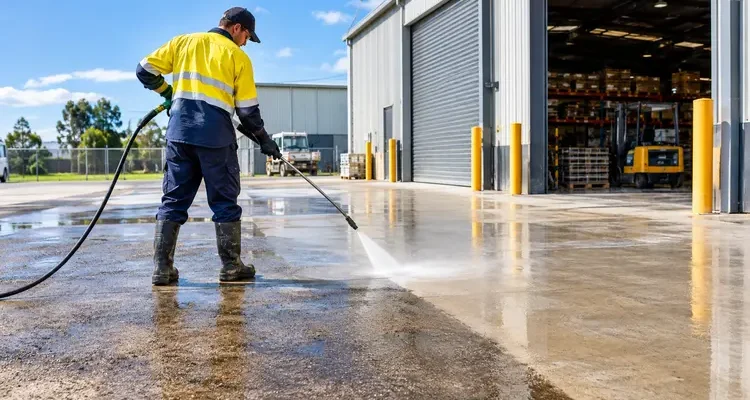
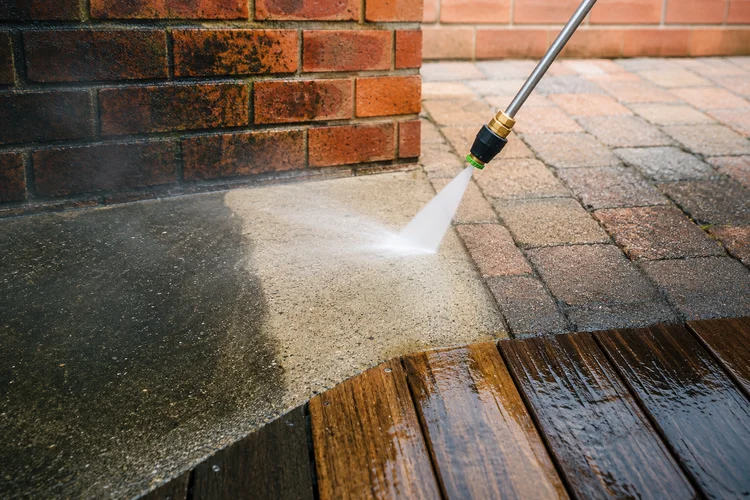
Short answer: yes, pressure washing can damage concrete, brick, timber, render and other outdoor surfaces — but only when the pressure, nozzle or technique doesn’t match the surface being cleaned. Done properly, it’s one of the safest and most effective ways to clean the outside of a home or commercial property.
The common misconception is that pressure washing is simply blasting dirt away. Point the wand, pull the trigger, and the grime disappears. In reality, a pressure washer doesn’t know the difference between a layer of algae and the top few millimetres of your driveway. Water at the wrong pressure, at the wrong distance, through the wrong nozzle will happily remove both.
The good news is that damage is almost always preventable. It comes down to matching the equipment and the method to the material in front of you.
The main risks worth understanding before anyone picks up a wand:
- Concrete etching — visible marks, striations and roughened patches
- Brick and mortar damage — eroded joints and deteriorated brick faces
- Paver joint erosion — jointing sand washed out from between pavers
- Paint stripping — coatings lifted or removed entirely
- Timber damage — raised grain, splintering and furring
- Surface coatings and sealers being removed unintentionally
- Water being forced into vents, cavities, window frames and roof spaces
Running through all of these is one simple principle: the lowest effective pressure is almost always better than the highest available PSI. More pressure doesn’t mean a better clean. It usually just means a smaller margin for error.
This article covers which surfaces handle pressure washing well, which need extra care, what damage actually looks like, and how professional operators avoid causing it in the first place.
Can Pressure Washing Actually Damage Outdoor Surfaces?
Why High-Pressure Water Can Cause Damage
Water leaving a pressure washer nozzle carries a lot of concentrated force into a very small area. That force is what lifts dirt, oil, mould and algae off a surface. The problem is that the force doesn’t stop at the dirt.
Every outdoor surface has a top layer — the cement paste on concrete, the weathered face of a brick, the soft fibres of timber, a coat of paint or sealer. Cleaning removes contaminants sitting on that layer. Damage happens when the water starts removing the layer itself.
This is why PSI alone tells you very little about whether a pressure washer is safe. A machine rated at 4000 PSI used with a wide nozzle at sensible distance can be gentler than a 2000 PSI unit held 50mm from the surface with a zero-degree tip.
The factors that actually determine cleaning force include:
| Factor | Why it matters |
| Pressure (PSI) | Sets the maximum force available, not the force applied |
| Water flow (litres per minute) | Determines rinsing power and how quickly grime is carried away |
| Nozzle type | A narrow tip concentrates force; a wide tip spreads it out |
| Spray angle | Angled spray lifts contamination; direct spray drives into the surface |
| Distance from surface | Force drops off sharply the further back you hold the wand |
| Dwell time | How long the spray stays in one place before moving on |
| Surface condition | Sound material tolerates far more than deteriorated material |
Change any one of these and the outcome changes with it. That’s the part most DIY users miss.
Pressure Washing Is Not Automatically Dangerous
None of this means pressure washing is inherently risky. On durable surfaces, correctly applied pressure washing is fast, thorough and genuinely hard to beat.
Concrete driveways, paths, patios, garage floors, shed slabs, commercial hardstand and most sound masonry are all well suited to it. These materials are designed to sit outdoors and take punishment, and a properly set up machine will strip years of grime off them without leaving a mark.
Damage is almost always a technique problem or an equipment problem — not a pressure washing problem. That distinction matters, because plenty of homeowners avoid cleaning their driveway for years out of fear, then end up with staining that’s far harder to remove than it needed to be.
The pressure washing services offered by CJS Machinery Hire are built around exactly this: assessing the surface first, then choosing the method that will clean it properly without wrecking it.
The Importance of Using the Lowest Effective Pressure
Experienced operators work upward, not downward. Start conservative, check the result, and only increase pressure if the surface genuinely needs it.
There are a few reasons this approach wins:
- Higher pressure doesn’t always clean better. Deep-set stains often sit below the surface, so extra force damages the substrate without touching the stain.
- Detergents and pre-treatments do work that pressure can’t. Organic growth, oil and grease respond far better to the right chemistry and a bit of dwell time than to brute force.
- Damage isn’t always visible while the surface is wet. By the time it shows up, it’s already done.
An experienced operator adjusts as they go — nozzle, distance, pressure and cleaning solution all shift depending on what’s underfoot. That’s a very different process from setting a machine to maximum and working across the whole property the same way.
Can Pressure Washing Damage Concrete?
Is Pressure Washing Safe for Concrete?
Concrete is the single most common surface people pressure wash, and for good reason. Sound, properly cured concrete handles it very well.
Typical applications include:
- Driveways
- Concrete paths and footpaths
- Patios and verandah slabs
- Garage and shed floors
- Commercial concrete and hardstand areas
- Outdoor entertaining areas
The key word is sound. Concrete that has cured properly, hasn’t broken down and doesn’t have significant surface deterioration will take a solid clean without complaint. Concrete that’s already crumbling is a different story.
New concrete is worth singling out. A freshly poured slab hasn’t reached full strength, and the surface layer is particularly vulnerable in the early weeks. As a general rule, give new concrete around 28 days to cure before pressure washing it. Cleaning too early is one of the easiest ways to etch a brand new driveway.
How Pressure Washing Can Etch Concrete
Etching is the most common form of pressure washing damage on concrete. It happens when concentrated spray removes or alters the smooth cement-rich layer at the top of the slab, exposing the rougher material underneath.
Two habits cause most of it:
Holding the nozzle too close. Cleaning force increases dramatically as the tip gets nearer the surface. What feels like “getting in there properly” on a stubborn spot can strip the surface in seconds.
Staying in one spot. A stationary wand concentrates all that force into one small area. Even a few extra seconds can leave a permanent mark.
There’s a genuine difference between cleaning a stain and damaging the concrete. A stain sits in or on the surface. Etching removes the surface. Once you’ve etched a driveway, no amount of further cleaning will bring it back — the texture has changed.
What Pressure Washing Concrete Damage Looks Like
Damage on concrete usually shows up as:
- Uneven patches where some areas are noticeably lighter or rougher
- Circular or wand-shaped marks from stationary or looping spray
- Striations — parallel streaks running in the direction of the passes
- Roughened areas that feel gritty compared with the surrounding slab
- Exposed aggregate, where the stones in the mix become visible
- Discolouration caused by uneven cleaning rather than by dirt
A lot of this is invisible while the slab is wet. It becomes obvious as the concrete dries, which is exactly when it’s too late to change approach. That’s one reason professional operators check their work progressively rather than at the end.
Can Pressure Washing Damage Old or Cracked Concrete?
Older concrete needs more caution. Decades of weathering, traffic and moisture movement can leave the surface weaker than it looks.
Points to watch:
- Existing cracks can widen or channel water underneath the slab
- Deteriorated or spalling areas may lose more material during cleaning
- Loose or flaking concrete should be assessed before any water hits it
- Previous patch repairs often clean differently from the surrounding slab
Pressure washing will not repair structural cracking, and it won’t hide it either. If anything, a clean slab makes existing damage more visible. That’s not the cleaner’s fault — but it’s a good reason to inspect and set expectations before starting.
A pre-cleaning inspection takes a couple of minutes and prevents most of these problems outright.
How to Pressure Wash Concrete Without Damaging It
A sensible sequence for concrete:
- Inspect the concrete first — look for cracks, spalling, coatings and previous repairs
- Remove loose debris with a broom or blower before introducing water
- Use an appropriate nozzle — a wider fan rather than a concentrated tip
- Maintain a consistent distance rather than drifting in and out
- Keep the wand moving at a steady, even pace
- Avoid unnecessarily high pressure — start lower and increase only if needed
- Use a rotary surface cleaner for large flat areas
- Pre-treat stubborn stains instead of simply cranking up the pressure
- Rinse consistently and evenly so the finish is uniform
That seventh point does a lot of heavy lifting. Rotary surface cleaners are strongly recommended for large concrete areas because they hold a fixed distance and sweep the spray in a controlled arc, which produces an even, streak-free finish that’s very difficult to achieve freehand with a wand.
Can Pressure Washing Damage Brick?
Is Pressure Washing Safe for Brickwork?
Brick is generally durable and cleans up well. Common applications include:
- Exterior brick walls and facades
- Garden and boundary walls
- Retaining walls
- General masonry structures
That said, brick condition matters as much as brick type. A modern extruded brick in good order is a very different proposition from a soft, weathered brick on a home built decades ago. Both are “brick” — they don’t clean the same way.
How High Pressure Can Damage Brick
Where brickwork gets into trouble:
- Surface erosion, where the fired outer face is worn away
- Removal of weathered material, leaving patchy light and dark areas
- Damage to softer or older bricks that have already broken down
- Increased water penetration once the outer face is compromised
- Damage around deteriorated mortar, which then spreads along the joint
Brick is also a vertical surface in most cases, which changes the approach entirely. Vertical masonry and rendered walls generally respond better to soft washing than to high-pressure cleaning, because the cleaning solution does the work instead of mechanical force.
Can Pressure Washing Damage Brick Mortar?
Mortar is usually the weak point, not the brick. It’s softer, it weathers faster, and on older properties it may already be crumbling before anyone turns a tap on.
High-pressure water directed straight into a mortar joint can wash out weakened material surprisingly quickly, and once the joint is open, water gets behind the wall.
Extra caution is warranted with:
- Older homes with lime-based or weathered mortar
- Heritage brickwork of any kind
- Visibly crumbling or sandy mortar joints
- Previously damaged or repaired masonry
If a joint is already deteriorating, cleaning won’t fix it — repointing will. The cleaning method just needs to avoid making it worse.
What About Painted Brick?
Painted brick is a coating problem, not a masonry problem. The paint is what you’re cleaning, so the paint is what determines the method.
High pressure will lift or strip paint, particularly where the coating is already flaking, chalky or blistered. Once a section lifts, the boundary between painted and stripped areas is obvious and difficult to blend.
The safe approach is to treat the surface as the coating it is: gentler pressure, a wider fan, greater distance, and cleaning solutions doing most of the work.
How to Pressure Wash Brick Safely
- Inspect both the brick and the mortar condition before starting
- Start with conservative pressure and work up only if required
- Use a wider spray pattern rather than a concentrated tip
- Avoid pointing the stream directly into mortar joints
- Keep the nozzle moving — no dwelling on stained spots
- Consider soft washing where the brick is old, painted or rendered
- Test a discreet section first and check it once dry
Can Pressure Washing Damage Pavers and Outdoor Paving?
Is Pressure Washing Safe for Pavers?
Most pavers clean up beautifully. Paving is one of the most satisfying pressure washing jobs there is, largely because the contrast between cleaned and uncleaned sections is so dramatic.
Common applications:
- Paved driveways
- Patios and courtyards
- Garden paths
- Pool surrounds
- Outdoor entertaining areas
Can Pressure Washing Wash Out Paver Joint Sand?
Yes — and this is the most common paver issue by far.
Sand-set pavers rely on jointing material to lock the units together and stop movement. A concentrated stream fired straight down into a joint will remove that sand faster than you’d expect.
What makes the difference:
- Nozzle angle. Spraying across the joint rather than into it reduces washout considerably.
- Pressure. Excessive pressure disturbs jointing material even with correct technique.
- Distance. Close-range spray concentrates force exactly where you don’t want it.
Poorly maintained joints lead to real consequences: pavers rocking underfoot, edges lifting, weeds and ants colonising the gaps, and eventually sections dropping or spreading. If jointing sand does come out during cleaning, it should be topped up afterwards rather than ignored.
Can Pressure Washing Damage Concrete Pavers?
Concrete pavers can suffer the same problems as concrete slabs:
- Surface damage and etching from close-range or stationary spray
- Uneven cleaning that leaves visible pass marks across the paving
- Removal of surface finishes, sealers or colour coatings
- Accelerated wear on pavers that have already begun to break down
Checking the condition and finish of the pavers first tells you which of these risks actually applies.
How to Clean Pavers Without Damaging Them
- Use appropriate pressure rather than maximum pressure
- Maintain a consistent working distance across the whole area
- Avoid aggressive, concentrated spray directed into joints
- Use a surface cleaner where the area suits it
- Refill or restore jointing material after cleaning if it has washed out
- Consider sealing once the paving is clean and fully dry
Can Pressure Washing Damage Timber, Decking or Fencing?
Why Timber Requires More Care Than Concrete
Timber is soft, fibrous and directional. Where concrete resists force, timber absorbs it — and once the fibres are disturbed, they don’t lie back down.
Pressure that a driveway wouldn’t even notice can gouge a deck board. Different species, ages and finishes also behave very differently, so a method that works on hardwood decking may be far too aggressive for a softwood fence.
How Pressure Washing Can Damage Timber
- Grain raising, where the softer material between the grain is stripped out
- Surface gouging from close-range or concentrated spray
- Splintering along board edges and end grain
- Furring — a fuzzy, rough texture that catches dirt and feels awful underfoot
- Uneven colour across boards cleaned at different pressures
- Damage to existing stains, oils and sealers
- Moisture penetration into the timber and any fixings
Can Pressure Washing Damage Painted or Stained Timber?
Readily. Pressure will strip paint, stain, decking oil, sealants and protective finishes — often faster than it removes the dirt sitting on top of them.
It’s worth being clear about what’s actually happening here. Removing a coating isn’t the same as cleaning the timber. A stripped deck may look brighter, but it’s now unprotected, and it’ll need recoating before the next wet season. That’s a much bigger job than a clean.
If the goal is preparation for recoating, that’s a legitimate use of pressure. If the goal is cleaning, the coating should survive the process.
Safer Alternatives for Timber
- Lower pressure throughout
- A wider spray pattern
- Greater distance between nozzle and surface
- Soft washing with an appropriate cleaning solution
- Gentle timber-safe cleaning products with adequate dwell time
- Working with the grain, never across it
Can Pressure Washing Damage Render, Stucco or Painted Surfaces?
Why Render and Stucco Need Lower Pressure
Rendered surfaces are essentially a thin coating over masonry. They’re more vulnerable to erosion than the substrate beneath them, and the damage tends to show up as a change in texture rather than an obvious hole.
Aggressive cleaning can smooth out textured render, leave visible clean patches, or take out sections where the render has already delaminated. Older render often has weak areas that aren’t obvious until water finds them.
Can Pressure Washing Strip Exterior Paint?
Yes. Excessive pressure will remove or damage exterior paint, and it’s one of the most common complaints after a DIY clean gone wrong.
Particularly relevant to:
- Painted rendered walls
- Painted brick
- Weatherboards
- Painted fences and gates
- Commercial building facades
Paint condition should be assessed before any cleaning begins. Sound, well-adhered paint tolerates gentle washing. Chalky, flaking or blistered paint will lift, and the cleaning will simply reveal how poor the coating already was.
When Soft Washing Is a Better Option
Soft washing uses low-pressure application of cleaning solutions, followed by a gentle rinse. The chemistry breaks down mould, algae, lichen and other organic growth, and the water simply carries it away.
Because it doesn’t rely on mechanical force, it’s far better suited to delicate vertical surfaces — painted walls, render, weatherboards and timber. Soft washing is the recommended approach for delicate or painted surfaces, with higher-pressure cleaning reserved for durable materials like concrete and sound masonry.
This is covered in more depth in the complete guide to pressure washing, which walks through how the two methods differ in practice.
Can Pressure Washing Damage Roofs and Outdoor Structures?
Roof cleaning is a specialist job in its own right, and the guidance below is general background rather than a service we quote on. It’s included because roofs are where pressure washing goes wrong most expensively, and because water forced into a roof cavity causes problems that show up inside the building rather than outside it.
Why Roof Cleaning Requires Extra Caution
Roofs are the highest-risk surface on any property, for two separate reasons.
The first is the material. Roof coverings are designed to shed water flowing downward, not to resist water driven upward and sideways at pressure. Force water under a tile or sheet and it goes straight into the roof cavity.
The second is safety. A wet roof is genuinely dangerous, and the combination of height, slope, water and a wand that produces significant recoil is a serious fall risk.
The cleaning method should always be based on the roof material and its condition — not on what worked on the driveway.
Can Pressure Washing Damage Roof Tiles?
It can, in several ways:
- Cracking, particularly on older or already-stressed tiles
- Surface and granular damage on coated or textured roofing
- Dislodging or shifting tiles out of alignment
- Water intrusion into the roof space, sarking and insulation
- Erosion of ridge capping mortar
High-pressure cleaning simply isn’t appropriate for every roof. Age, material and existing condition determine what’s viable.
What About Gutters, Eaves and Exterior Structures?
Different components need different pressure levels, and the risk on these areas is usually water intrusion rather than surface damage.
Avoid forcing water into:
- Roof and wall vents
- Electrical components, outlets and light fittings
- Window and door frames
- Roof cavities and under eaves
- Cladding gaps and expansion joints
- Air conditioning units
When Soft Washing Is More Appropriate for Roofs
Most roof grime is organic — mould, algae, lichen and moss. That responds far better to treatment than to pressure. A suitable solution applied at low pressure will break down the growth and continue working after the job is finished, without driving water into places it shouldn’t go.
Roof cleaning should be approached as a fundamentally different job from driveway cleaning, using different equipment and a different mindset.
What Other Outdoor Surfaces Can Be Damaged by Pressure Washing?
Outdoor Furniture
- Painted finishes chip and lift under direct spray
- Timber furniture furs and splinters like decking
- Plastics and resins can crack, dull or discolour
- Cushions and fabrics soak through and hold moisture
- Powder-coated and painted metal coatings can be stripped
Glass and Windows
- Window and glazing seals can be damaged by direct pressure
- Water is easily forced past frames and into wall cavities
- Older or already-stressed glass can crack under direct high-pressure spray
- Low-pressure cleaning and appropriate detergents are the safer route
Pool Surrounds
Pool areas often combine several materials in one small space — concrete, pavers, natural stone, tiles and coatings, sometimes all within a few metres. Identifying each material before cleaning matters more here than almost anywhere else, along with keeping runoff and cleaning solutions out of the pool.
Natural Stone
- Sandstone is porous and comparatively soft
- Limestone erodes and marks readily
- Other porous stone can lose its surface finish entirely
Porous or softer stone generally requires lower pressure or specialised cleaning methods, and it’s easy to permanently alter the texture in a single pass.
Outdoor Paint and Coatings
There’s a real difference between deliberate surface preparation and unwanted damage. Stripping a coating before repainting is a valid task. Stripping it while trying to clean it is a problem. Either way, the existing condition of the coating determines what will happen once water hits it.
What Causes Most Pressure Washing Damage?
Using Too Much Pressure
The obvious one. Maximum PSI is a capability, not a target. Most outdoor cleaning is done well below what the machine can deliver.
Using the Wrong Nozzle
Nozzle choice changes cleaning force more dramatically than the pressure setting does. A narrow tip concentrates everything into a tiny area; a wide fan spreads the same water across a much larger footprint.
| Nozzle | Spray pattern | Typical use |
| 0° (red) | Pinpoint jet | Rarely appropriate for outdoor surfaces |
| 15° (yellow) | Narrow fan | Heavy staining on sound concrete |
| 25° (green) | Medium fan | General concrete, pavers, hard surfaces |
| 40° (white) | Wide fan | Brick, render, painted surfaces, timber |
| Soap/low pressure (black) | Very wide, low force | Applying detergents and cleaning solutions |
| Rotary surface cleaner | Enclosed rotating arms | Large flat concrete and paved areas |
Nozzle selection should reflect the surface, not the stubbornness of the stain.
Holding the Nozzle Too Close
Distance is the single easiest variable to get wrong. Cleaning force falls away rapidly as you pull back, which means moving a few centimetres closer can multiply the impact on the surface. Getting closer is rarely the right answer to a stubborn stain — pre-treatment usually is.
Keeping the Spray in One Spot
A stationary wand concentrates everything into one place. It produces etching, wand marks and visible patching. Continuous, even movement is non-negotiable on any surface.
Ignoring the Condition of the Surface
Surfaces that need assessment before cleaning:
- Cracked or spalling concrete
- Loose or lifting materials
- Deteriorated mortar joints
- Flaking or chalky paint
- Existing sealers and coatings
- Previous repairs and patches
Using Pressure When a Cleaning Treatment Would Be Better
Organic growth responds to appropriate treatment far better than to force. Degreasers handle oil and grease that pressure alone will never shift. Giving a product time to work reduces the pressure required, often substantially — and dwell time costs nothing but patience.
Failing to Test a Small Area First
Test an inconspicuous section, let it dry completely, then look at it properly. Wet surfaces hide almost everything. Adjusting technique after a test patch is easy; adjusting it after the whole driveway is done is not.
Pressure Washing vs Soft Washing: Which Is Safer?
Neither method is safer in the abstract. Each is safer for particular surfaces.
Pressure Washing
Best suited to:
- Concrete slabs and driveways
- Paths and footpaths
- Pavers and hard paving
- Sound, unpainted brickwork
- Commercial hard surfaces and hardstand
- Heavy dirt, grime and traffic film
Soft Washing
Better suited to:
- Painted surfaces of any kind
- Render and stucco
- Timber decking and fencing
- Most roofs
- Delicate or aged exterior surfaces
- Mould, algae and lichen treatment
Why the Right Cleaning Method Matters
The goal was never to use pressure. The goal is to remove contamination without damaging what’s underneath it. Pressure is one tool for doing that, and on the wrong surface it’s the wrong tool.
Professional operators assess two things before starting: what the surface is made of, and what type of contamination is on it. Those two answers determine the method.
Can You Combine Pressure Washing and Soft Washing?
Frequently, yes. A pre-treatment applied at low pressure can break down organic growth, followed by controlled rinsing at moderate pressure to carry it away. That combination cleans more thoroughly than either approach alone, at lower risk.
Most properties need both. A driveway might take full pressure washing while the rendered walls above it get soft washed on the same visit. Different areas, different methods, same job.
How Professionals Prevent Pressure Washing Damage
Inspecting the Surface Before Cleaning
- Identify the material accurately
- Assess its age and general condition
- Look for existing cracks, spalling and deterioration
- Identify coatings, sealers and previous treatments
Selecting the Right Equipment
- A pressure washer suited to the job rather than the biggest available
- Correct nozzles for each surface on the property
- A rotary surface cleaner for large flat areas
- Extension equipment for safe access to height
- Appropriate cleaning solutions for the contamination present
Adjusting Pressure to the Surface
Concrete isn’t brick, brick isn’t timber, and timber isn’t render. There’s no universal setting that suits a whole property, which is why a single pass at one pressure across everything almost always damages something.
Maintaining the Correct Cleaning Distance
A consistent working distance produces a consistent finish. Drifting closer on stubborn areas is what creates the patchy, blotchy results people notice weeks later.
Using Controlled, Even Passes
Random wand movement leaves random results. Overlapping passes worked methodically across an area produce an even finish with no obvious start and stop points.
Protecting Surrounding Areas
- Plants, lawns and garden beds
- Windows and glazing
- Doors and door seals
- Outdoor furniture and fittings
- Electrical outlets, fittings and switchboards
- Vehicles parked nearby
- Adjacent painted surfaces
Inspecting the Finished Surface
- Check for remaining stains once the surface has dried
- Look for uneven cleaning and pass marks
- Ensure runoff has been managed appropriately
- Identify any areas needing additional treatment rather than more pressure
That last point is the difference between an experienced operator and an enthusiastic one. When a stain doesn’t lift, the answer is a different treatment — not a closer nozzle.
Signs That a Surface Has Been Damaged by Pressure Washing
| Surface | What damage looks like |
| Concrete | Etched patches, wand marks, uneven texture, exposed aggregate |
| Brick and masonry | Eroded mortar, surface deterioration, spalling brick faces, patchy appearance |
| Timber | Raised grain, splintering, gouging, fuzzy or rough texture |
| Painted surfaces | Peeling paint, stripped patches, chipped coating, uneven finish |
| Pavers | Displaced jointing material, uneven appearance, surface deterioration |
Most of these become obvious only once the surface is completely dry, which is usually a day or so after the job. It’s worth doing a proper walk-around at that point rather than judging the result while everything is still wet and dark.
Can Pressure Washing Make Concrete Look Worse Before It Looks Better?
Why Some Stains Don’t Disappear Immediately
Cleaning removes what’s on the surface, and some staining simply isn’t on the surface:
- Deep-set staining that has soaked into the concrete
- Oil contamination that has penetrated the slab
- Rust marks from steel, furniture or garden equipment
- Biological growth with roots into the surface pores
- Old sealers and coatings that have discoloured unevenly
- Efflorescence, the white powdery deposit that migrates out of concrete and masonry
Efflorescence deserves a mention of its own, because it behaves differently from ordinary staining. It’s salt carried to the surface by moisture moving through the concrete or brickwork, which means cleaning it off doesn’t stop it coming back — the moisture source is the actual problem. Pressure washing can remove the visible deposit, and sometimes makes it more obvious once the surface dries. It’s a maintenance issue rather than a cleaning failure.
A clean slab can also make remaining stains stand out more, simply because the surrounding concrete is now lighter.
Why Aggressive Pressure Isn’t Always the Solution
Turning the pressure up on a deep stain damages the concrete without removing the stain — you end up with an etched patch and the mark still there. Specialist cleaning products, targeted treatments and sometimes multiple applications are the right answer for that kind of staining.
Why Even Cleaning Matters
Spot cleaning a single stained area on an otherwise dirty driveway creates an obvious clean patch that looks worse than the original problem. Cleaning the full surface avoids those boundaries. On large flat areas, a rotary surface cleaner does this far more consistently than freehand wand work, which is exactly why it’s the standard tool for driveways and paths.
Is DIY Pressure Washing Worth the Risk?
When DIY Pressure Washing May Be Suitable
- Small, contained areas
- Sound, durable concrete in good condition
- Straightforward dirt rather than deep staining
- Appropriate equipment and nozzles available
- The user understands safe operating practice and surface limits
When You Should Consider Professional Pressure Washing
- Large driveways, paths or commercial areas
- Heavily stained or long-neglected surfaces
- Older or visibly deteriorated materials
- Properties with several different surface types
- Painted, rendered or otherwise delicate exteriors
- Commercial premises where appearance matters
- Any situation where you’re unsure which method applies
Working out how often the job actually needs doing is a separate question, and there’s practical guidance on how often you should pressure wash your home that covers it in more detail.
The Cost of Getting Pressure Washing Wrong
| Mistake | Likely cost |
| Etched concrete | Resurfacing, grinding or living with it permanently |
| Stripped paint | Full repaint of the affected elevation |
| Eroded mortar | Repointing sections of brickwork |
| Damaged timber | Sanding, recoating or replacing boards |
| Washed-out paver joints | Re-sanding and, in bad cases, relaying |
| Water intrusion | Ceiling, insulation or internal repairs |
| Uneven cleaning | Re-cleaning the whole area to blend it |
Professional cleaning isn’t only about saving yourself a weekend. Concrete etching, stripped paint, damaged timber and water intrusion are all realistic outcomes of inexperienced DIY pressure washing, and every one of them costs more to fix than the original job would have cost to do properly.
Frequently Asked Questions About Pressure Washing Damage
Can pressure washing damage concrete?
Yes, primarily through etching. Holding the nozzle too close, using too narrow a tip, or leaving the spray in one spot can remove the top layer of the slab and leave permanent marks. Correct distance and continuous movement prevent it.
Can pressure washing damage brick?
It can, especially on older or softer bricks. High pressure can erode the brick face and open up mortar joints. Sound modern brickwork handles moderate pressure well, but condition matters more than age alone.
Can pressure washing damage mortar?
Mortar is usually more vulnerable than the brick itself. Weathered or crumbling joints can be washed out quickly by concentrated spray. Avoid directing the stream straight into joints, and assess mortar condition before starting.
Can pressure washing damage pavers?
The main risk is jointing sand being washed out, which leads to movement, weeds and uneven paving over time. Surface etching is also possible on concrete pavers. Both are avoidable with correct angle, distance and pressure.
Can pressure washing damage timber?
Yes, more easily than most surfaces. Timber can suffer raised grain, splintering, gouging and furring. Lower pressure, wider spray, greater distance and working with the grain all reduce the risk considerably.
Can pressure washing strip paint?
It absolutely can, and this is one of the most common accidental outcomes. Flaking or chalky paint will lift first, but even sound paint can be stripped at close range with a narrow nozzle. Painted surfaces are better suited to soft washing.
What PSI is safe for concrete?
Sound concrete generally tolerates cleaning in the range of roughly 2000 to 3000 PSI with an appropriate nozzle and sensible distance. That figure is a guide, not a rule — nozzle type, distance and dwell time affect the outcome as much as the pressure setting does. Older or deteriorated concrete should be cleaned more conservatively.
What pressure should be used on brick?
Considerably less than concrete. Around 1000 to 1500 PSI with a wide fan is a reasonable starting point for sound brickwork, reduced further for older brick or questionable mortar. Painted brick is better handled with soft washing.
Is pressure washing safe for old concrete?
It can be, with caution. Older concrete should be inspected for cracking, spalling and loose material first, then cleaned at lower pressure. Pressure washing won’t repair existing damage, and a clean slab will make any deterioration more visible.
Can pressure washing damage outdoor tiles?
Yes. Tiles can chip or crack, glazes and surface finishes can dull, and grout can be eroded out of the joints. Lower pressure and a wider spray pattern are appropriate, and the tile type should be identified before cleaning.
Is soft washing safer than pressure washing?
For delicate surfaces, yes. Soft washing relies on cleaning solutions rather than mechanical force, which makes it the better option for paint, render, timber and roofs. For durable concrete and hard paving, pressure washing is more effective and equally safe.
How do you pressure wash without damaging surfaces?
Identify the material, start with the lowest effective pressure, use an appropriate nozzle, maintain a consistent distance, keep the wand moving, pre-treat stubborn stains instead of increasing pressure, and test a small area first.
Should you pressure wash a cracked or deteriorating surface?
Only after a proper assessment, and usually at reduced pressure. Cracked or crumbling surfaces can lose more material during cleaning, and water can be driven into cracks and beneath slabs. In some cases repair should come before cleaning.
Is professional pressure washing safer than DIY?
Generally yes, because the risk sits in the decisions rather than the machine. Experienced operators assess surfaces, select equipment accordingly and switch methods where needed — which is where most DIY jobs go wrong.
Get Your Surfaces Cleaned Properly by the CJS Team
Pressure washing done right transforms a property. Done wrong, it leaves marks you’ll be looking at for years.
At CJS Machinery Hire, we’ve been working around Hervey Bay, Booral and the wider Wide Bay region long enough to know how local conditions treat outdoor surfaces — the mould on the shaded side of a building, the salt exposure near the coast, the wet-season grime that comes back every year. As a family-owned business with 20 years of experience behind us, we assess every surface before we start and match the method to the material, rather than pointing the same machine at everything.
We clean concrete driveways, pathways and car parks, warehouse and factory floors, brick and masonry, tiled areas, retaining walls and fencing, decking and patio areas, and building facades — plus construction site washdowns and post-build cleans. Commercial-grade equipment, the right nozzles, and the right cleaning solutions for each surface.
If your driveway, paving or building exterior needs attention and you’d rather not gamble with it, get in touch with CJS Machinery Hire for a chat about professional pressure washing in Hervey Bay. We’ll tell you honestly what your surfaces need, what they don’t, and what it’ll cost — no fuss, no guesswork.
Related Posts
Post a Comment