Earthmoving equipment takes a hammering. Day after day, excavators dig through hard ground, loaders push heavy materials, and dozers battle some of the toughest conditions a machine can face. That kind of constant work leaves its mark — cracks develop in steel, brackets break, buckets wear through, and structural components start to fail.
Welding repairs are one of the most practical ways to address that damage. A well-executed repair can restore a component to working condition, reinforce areas under stress, and extend the life of machinery that would otherwise face a costly replacement. But welding heavy earthmoving equipment is not the same as general steel fabrication — the loads involved are extreme, the materials are often thick, and a poor repair can fail quickly or, in some cases, create a safety risk.
This article covers what welding repairs for earthmoving equipment involve, where they are most commonly needed, how they are carried out, and what to look for when choosing a welding service in Hervey Bay.
What Are Welding Repairs for Earthmoving Equipment?
How Welding Is Used to Repair Heavy Earthmoving Machinery
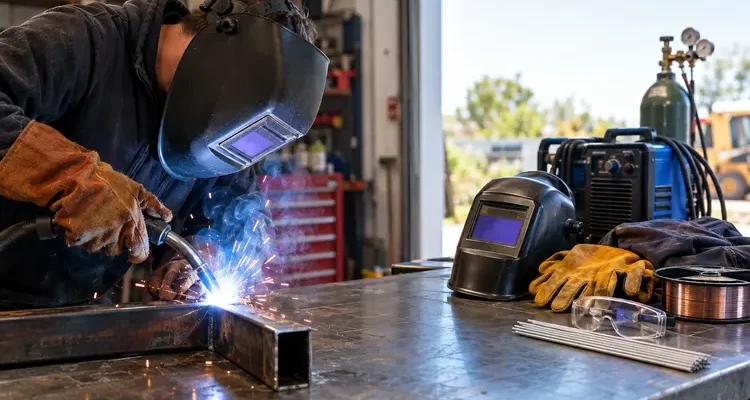
Welding repairs involve using heat and filler material to join, rebuild or reinforce damaged steel components. For earthmoving machinery, this typically means restoring structural integrity to parts that have cracked, fractured, worn or broken under load.
Repair welding is different from general fabrication. When fabricating new steel, a welder starts with clean, undamaged material and builds to a known specification. Repair welding involves working with steel that has already been stressed, deformed or compromised. The approach must account for the existing damage, the cause of that damage, and what the component will need to withstand once it goes back into service.
Earthmoving machinery is particularly well-suited to welding repairs because most of its structural components are made from steel — a material that can be welded, rebuilt and reinforced. Equipment exposed to heavy loads, sudden impact, continuous vibration and abrasive materials will develop wear and damage over time. In many cases, a targeted welding repair can address that damage without the cost and lead time of full component replacement.
Which Earthmoving Equipment Can Be Repaired by Welding?
Welding repairs are applicable across a wide range of earthmoving and construction equipment, including:
- Excavators
- Skid steer loaders
- Front-end loaders
- Bobcats
- Backhoes
- Bulldozers
- Graders
- Tipper trucks and truck bodies
- Trailers and transport equipment
- Earthmoving attachments of all types
- Buckets, blades, rippers and other steel components
If a component is made from steel and the damage is localised, welding is generally worth assessing as a repair option.
When Is Welding a Better Option Than Component Replacement?
Replacement is sometimes the right call — particularly when a component is severely deformed, extensively worn or structurally compromised beyond practical repair. But in many situations, welding can restore a damaged component at a fraction of the cost and downtime involved in sourcing and fitting a replacement part.
The decision depends on several factors: the type and location of the damage, how far it has progressed, the overall condition of the component, and what it will need to withstand in service. A small crack caught early is generally far easier and less costly to address than the same crack left to propagate through a structural section.
Structural and load-bearing components always require professional assessment before any repair is attempted. Appearance alone does not determine whether a component can be safely welded — the cause of the damage, the material condition and the repair method all need to be considered.
Why Earthmoving Equipment Needs Regular Welding Repairs
Heavy Loads and Repeated Stress
Every time an excavator digs, a loader lifts, or a dozer pushes, the forces involved travel through the machine’s steel structure. Over time, repeated loading and unloading creates stress concentrations in the material — particularly around welds, mounting points and areas of geometric change like corners, brackets and attachment connections.
This is known as fatigue damage. Unlike a single overload event that might cause obvious cracking, fatigue damage accumulates gradually. Steel that has been repeatedly stressed can crack at load levels well below what the material could handle when new. That makes regular inspection important, particularly for machinery working long hours in demanding conditions.
Impact Damage on Construction and Earthmoving Sites
Rocks, rubble and uneven terrain create opportunities for sudden impact. An excavator bucket striking a buried boulder, a loader hitting an unexpected kerb, or an attachment catching on a concrete structure can all transmit abrupt, high-magnitude forces into steel that was designed for more controlled loading.
Impact damage is not always immediately obvious. A hit that leaves no visible deformation may still initiate a small crack, particularly in areas where the steel is already under stress. Those cracks can develop progressively with continued use, eventually growing into a significant structural problem. Early detection and timely repair is far preferable to finding out about the damage when a component fails on-site.
Abrasion and Material Wear
Soil, sand, gravel, rock and demolition debris all act as abrasives against the steel surfaces of earthmoving equipment. Bucket floors, cutting edges, wear plates and any surface in direct contact with material will wear down over time. The rate of wear depends on the material being handled, operating conditions and whether wear-resistant steel or hardfacing has been applied.
When wear progresses far enough, the structural steel underneath becomes exposed and begins to thin. A bucket floor that has worn through, or a cutting edge reduced to a fraction of its original thickness, is not just a performance problem — it becomes a safety concern and a more expensive repair. Rebuilding worn components through hardfacing or wear plate installation, before they reach that point, is generally more economical than waiting until the steel is perforated.
Vibration and Cyclic Loading
The constant movement of an earthmoving machine — engine vibration, travel over rough ground, the repeated cycle of digging and dumping — creates cyclic loading throughout the structure. Frames, brackets, mounts and attachment points are particularly susceptible, as these are the areas where different parts of the machine connect and loads are transferred.
Cracks can develop gradually around existing welds, bolt holes and high-stress connection points. The cumulative effect of vibration and cyclic loading is not always visible during routine operation — which is why structured inspections, rather than reactive repairs, tend to produce better outcomes over the life of a machine.
Corrosion and Environmental Exposure
Moisture, mud, salt and chemical exposure accelerate corrosion in steel. For machinery operating outdoors — as most earthmoving equipment does — rust is a persistent concern, particularly in areas where paint or protective coatings have been abraded away by normal use.
On the Fraser Coast, coastal and near-coastal conditions can accelerate that deterioration. Salt air increases the rate of surface oxidation, and equipment stored or operating near marine environments may show more rapid corrosion than machinery in dry inland areas. Rust compromises the integrity of structural steel and can reduce the effectiveness of subsequent welding repairs if it is not properly addressed before work begins.
Common Earthmoving Equipment Welding Repairs
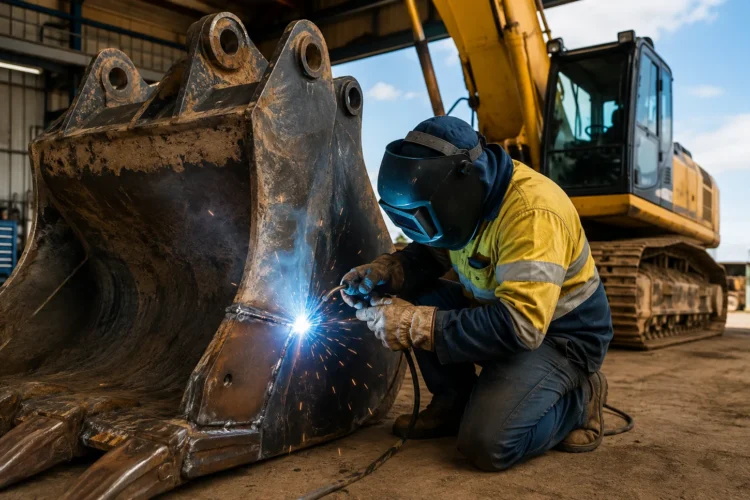
Excavator Bucket Welding Repairs
Excavator buckets are among the most commonly repaired items in earthmoving. They are in constant contact with hard, abrasive material and absorb significant impact loads during normal operation.
Common excavator bucket repairs include:
- Cracked bucket bodies and side plates
- Worn or perforated bucket floors
- Broken bucket ears and pin boss areas
- Worn cutting edges and tooth attachment areas
- Damaged or cracked shroud and heel sections
- Installation of wear plates and reinforcement to extend service life
Depending on the extent of wear, a bucket may benefit from hardfacing applied to high-wear surfaces rather than simply welding over cracks. For a more detailed look at common welding repairs for heavy machinery, including bucket work, the CJS website has more information.
Excavator Arm and Boom Repairs
The excavator arm and boom absorb enormous forces during digging and lifting. Cracks in these components typically appear around high-stress areas — weld toes, bracket connections, pin boss regions and areas of geometric change.
Repairs in this area require careful attention to alignment and structural integrity. It is not sufficient to simply fill a crack; the repair needs to address the underlying failure and restore the component to a condition suitable for the loads it will face. Reinforcement plates are commonly used to provide additional material across high-stress sections.
Given the critical structural role of the arm and boom, professional assessment before repair is essential. These components should not be returned to service without confirmation that the repair is sound.
Loader and Skid Steer Bucket Repairs
Loader and skid steer buckets experience similar wear and damage patterns to excavator buckets, though the specific failure areas differ depending on how the machine is used. Common repairs include:
- Cracked bucket corners
- Worn or holed floors
- Damaged cutting edges
- Cracked or bent side plates
- Wear plate replacement or addition
- Hardfacing of high-wear surfaces
These buckets often work in applications involving abrasive materials — road base, sand, gravel — and may benefit from preventive hardfacing before wear becomes a problem rather than after.
Dozer Blade and Grader Component Repairs
Dozer blades and grader components are exposed to significant pushing forces and abrasive contact with the ground surface. Common repairs include:
- Worn or thinned blade sections
- Cracked mounting points and brackets
- Damaged push arm and C-frame connections
- Structural reinforcement of areas that have undergone repeated loading
- Repair or replacement of worn steel sections
Ripper, Attachment and Hitch Repairs
Rippers, quick hitches and other attachments operate at the interface between the machine and the material — the point of maximum stress and impact. Cracked attachment frames, worn mounting points and damaged hitch components are common repair requirements.
Where the damage is localised, repairing an attachment is often more economical than replacing the entire assembly. That said, attachment components that connect to the machine’s arm or boom require the same care as structural repairs — alignment and load-carrying capacity must be maintained.
Machinery Frame and Chassis Repairs
Frame and chassis repairs are among the most consequential welding jobs on an earthmoving machine. A cracked frame, broken cross-member or damaged mounting bracket affects the structural integrity of the entire machine.
Common frame repairs include:
- Cracks in main structural members
- Broken or cracked supports and gussets
- Damaged cross-members
- Cracked mounting brackets for components and attachments
Frame repairs require careful assessment before work begins. The cause of the cracking, the extent of the damage, and the structural implications of the repair method all need to be considered. In some situations, engineering input may be appropriate before the machine returns to service.
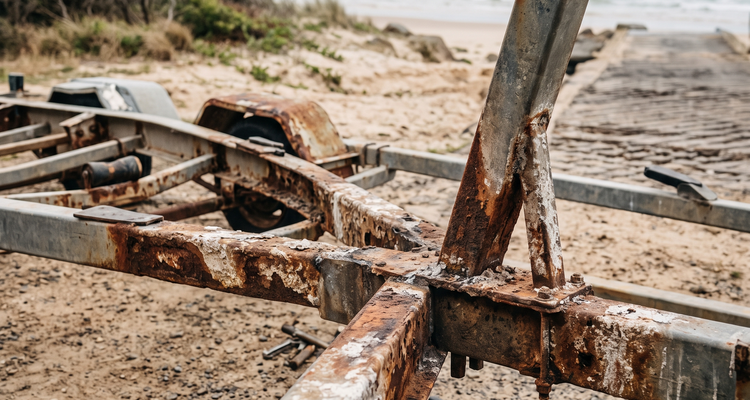
Tipper Bodies, Trailers and Earthmoving Transport Equipment
Tipper bodies and trailers are exposed to heavy loads, impact from dropped material and the effects of repeated tipping cycles. Common repair requirements include:
- Cracked tray sections and floor plates
- Damaged side walls and corners
- Trailer frame and cross-member repairs
- Mounting bracket and hinge repairs
- Wear and impact damage across tray surfaces
CJS has direct experience with welding repairs for trailers and transport equipment, which connects to its broader work across earthmoving and construction machinery.
Signs Your Earthmoving Equipment Needs Welding Repairs
Visible Cracks in Steel Components
Cracks in steel components are the most direct indicator that welding assessment is needed. These can range from hairline surface cracks — which may not be obvious unless the steel is cleaned and examined closely — to more visible fractures extending through a structural section.
Pay particular attention to:
- Cracks appearing around existing welds
- Cracks radiating from bolt holes or mounting points
- Cracks at corners, brackets and areas of geometric change
A small crack does not necessarily indicate immediate danger, but it should not be ignored. Cracks in steel under cyclic loading tend to grow, and a crack that is minor today may propagate into a significant structural issue if left unaddressed.
Broken or Bent Brackets
Brackets secure components in position and transfer loads between parts of the machine. A bent, cracked or broken bracket affects the integrity of whatever it is supporting — and may place additional load on adjacent components. Loose or displaced brackets should be inspected and repaired before the machine continues in heavy service.
Excessive Wear on Buckets and Attachments
Wear that has progressed to the point of thinning the base steel, creating holes or perforations, or rounding cutting edges to the point of ineffectiveness indicates that rebuilding or reinforcement is required. Visible exposure of underlying steel beneath worn wear plates, or cutting edges that have been reduced significantly in thickness, are clear signals that the component needs attention.
Unusual Movement, Vibration or Noise
New rattles, unexpected movement in components that were previously stable, or changes in how a machine behaves during operation can sometimes indicate structural damage rather than a mechanical fault. If a machine develops unusual symptoms without an obvious mechanical explanation, inspection of structural components and attachment points is worth including in the diagnostic process.
Misalignment of Attachments or Components
If an attachment sits visibly out of alignment, does not operate as smoothly as it should, or has shifted in a way that is not explained by normal adjustment, damage to the attachment frame, hitch or structural connection may be the cause. Misalignment affects both performance and the way loads are distributed through the machine — continued use without inspection can accelerate damage.
Repeatedly Failing Welds
A weld that keeps cracking in the same location is telling you something about the underlying problem. Simply rewelding the same area without addressing the cause — whether that is excessive loading, fatigue, poor previous repair preparation, or inadequate reinforcement — is unlikely to produce a lasting result. Repeated weld failures at the same location warrant a more thorough assessment of why the repair is not holding.
How Welding Repairs for Earthmoving Equipment Are Carried Out
Step 1: Inspecting the Damaged Component
A proper repair starts with understanding what you are dealing with. Inspection involves identifying all cracks, fractures, wear areas and deformation — not just the most obvious damage. It also means assessing whether the damage is localised or part of a broader structural issue, and evaluating accessibility and the conditions the component operates under.
Step 2: Identifying the Cause of the Damage
Repairing the symptom without identifying the cause tends to produce temporary results. Common causes of damage in earthmoving equipment include:
| Cause | Description |
| Impact | Sudden high-magnitude force from striking hard material |
| Fatigue | Crack growth from repeated stress cycles over time |
| Abrasion | Gradual material loss from contact with abrasive material |
| Overloading | Operating the machine beyond its intended capacity |
| Corrosion | Material loss from rust and environmental exposure |
| Poor previous repairs | Inadequate preparation or incorrect welding method |
| Component misalignment | Damage caused by components operating outside their intended geometry |
Understanding the cause informs both the repair method and any reinforcement required to prevent recurrence.
Step 3: Preparing the Damaged Area
Preparation is one of the most important — and most commonly underestimated — steps in a welding repair. This involves:
- Cleaning the area of dirt, grease, paint, rust and other contaminants
- Removing damaged or unsound material
- Preparing cracks by grinding or cutting to create a proper weld profile
- Ensuring the area is accessible for the welding process being used
Welding over contaminated or structurally compromised steel is a common cause of poor weld quality and premature repair failure.
Step 4: Selecting the Appropriate Welding Process
The choice of welding process depends on the material, the location of the repair, the thickness of the steel and the environment in which the work is being carried out. Common processes used in earthmoving equipment repair include:
- MIG welding — suitable for many structural repairs, relatively fast and versatile
- TIG welding — provides greater control and is suited to thinner materials and precision work
- Stick welding — practical for outdoor and on-site work, less sensitive to surface conditions
No single process is universally superior for earthmoving equipment. If you want to understand the differences in more detail, the guide to MIG, TIG and stick welding on the CJS website explains when each process is most appropriate.
Step 5: Welding and Reinforcing the Component
The welding itself should be carried out with appropriate filler materials for the base metal, with controlled heat input to avoid introducing distortion or weakening the surrounding steel. Where the component has been identified as susceptible to recurring damage, reinforcement plates or wear materials may be incorporated into the repair to address the underlying vulnerability rather than simply restore the damaged area.
A good repair addresses the reason the damage occurred, not just the visible result of it.
Step 6: Inspecting the Finished Repair
Once welding is complete, the repair should be inspected visually, alignment should be checked where relevant, and the repaired area assessed for obvious defects before the component is returned to service. For critical structural components — particularly frames, booms and other primary load-bearing parts — more formal inspection or engineering assessment may be appropriate.
Hardfacing and Wear Plate Repairs for Earthmoving Equipment
What Is Hardfacing?
Hardfacing is the application of a wear-resistant weld deposit to a surface that is subject to abrasion, impact or erosion. The deposited material is harder than the underlying steel, providing a sacrificial layer that wears in place of the base component.
It is not a cosmetic treatment — it is a practical strategy for extending the service life of components that would otherwise wear through in normal operation.
Where Hardfacing Is Used on Earthmoving Machinery
Hardfacing is applicable across a range of high-wear components, including:
- Excavator and loader bucket floors, lips and side plates
- Cutting edges
- Ripper tips and shanks
- Dozer blades and grader blades
- Wear surfaces on attachments
- Any steel surface in sustained contact with abrasive material
How Wear Plates Extend Component Life
Wear plates are sections of hardened steel fitted to high-wear areas of a bucket or attachment. When a wear plate wears down, it can be replaced without the need to repair or replace the structural component it protects. This scheduled wear maintenance — replacing wear plates at appropriate intervals — is generally more economical than allowing the underlying steel to wear and then rebuilding it.
The combination of hardfacing and wear plate installation gives operators more control over maintenance timing and cost.
Hardfacing vs Simply Replacing a Worn Component
When a component has worn significantly but is otherwise structurally sound, rebuilding through hardfacing can be more cost-effective than sourcing and fitting a replacement. The economics depend on the extent of the wear, the cost and availability of a replacement, and the remaining service life of the machine overall.
The right answer varies by situation — which is why it is worth having an experienced repairer assess the component rather than assuming that either repair or replacement is automatically the better option.
Can All Earthmoving Equipment Damage Be Repaired by Welding?
When Welding Is a Practical Repair Solution
Welding is well-suited to:
- Localised cracks in structural and non-structural components
- Broken or cracked brackets and mounting points
- Worn bucket floors, cutting edges and attachment surfaces
- Damage to attachment frames and hitch components
- Areas requiring reinforcement to prevent recurrence of damage
In most of these situations, a well-prepared and properly executed weld repair can restore the component to service at reasonable cost.
When Replacement May Be the Safer Option
There are situations where replacement is the more appropriate outcome, including:
- Severe deformation that cannot be corrected without compromising structural geometry
- Extensive metal loss across a large area
- Components where the extent of damage makes a reliable repair impractical
- Situations where repairing a component would not meet safety or engineering requirements
An experienced repairer will be able to advise when a component has reached the point where repair is not the right answer.
Why Professional Assessment Matters
The appearance of damaged steel does not always reflect the true extent of the problem. A crack that looks superficial may have propagated further than is visible. Steel that appears intact around a damaged area may have been weakened by the same event that caused the visible damage.
For structural and load-bearing components, professional assessment before repair is not optional — it is the foundation of a repair that will actually perform safely in service. Safety should always take precedence over the desire to minimise repair cost.
Why Professional Welding Matters for Earthmoving Equipment
Earthmoving Machinery Places Extreme Demands on Weld Repairs
A weld repair on earthmoving equipment needs to withstand heavy static loads, shock loading, sustained vibration, abrasion from contact with material, and thousands of repeated stress cycles across the life of the repair. That is a demanding set of requirements, and not every welding approach is up to the task.
Poor Welding Can Lead to Repeat Failures
A repair that fails shortly after completion is often the result of one or more of the following:
- Inadequate preparation — welding over contaminated or structurally compromised steel
- Incorrect welding process for the material and application
- Poor penetration or fusion, leaving a weld that appears sound but lacks strength
- Incorrect filler material selection
- Failure to address the original cause of the damage
Understanding common welding repairs for heavy machinery and equipment — and how they should be carried out — helps distinguish between a repair that will last and one that will need to be redone.
Professional Repairs Can Reduce Machinery Downtime
An idle machine costs money. Planned repair downtime — where a machine is taken out of service for a scheduled repair — is almost always less expensive than an unexpected breakdown during a critical period of work. An experienced repairer can assess the damage, provide an honest estimate of what is involved, and carry out the work efficiently to minimise the time the machine is out of service.
Quality Repairs Can Extend Equipment Life
A well-executed welding repair does not just restore a component to its pre-damage condition. It can reinforce areas that have been identified as vulnerable, address the underlying cause of repeated failures, and apply protective measures — hardfacing, wear plates, additional reinforcement — that reduce the likelihood of the same problem recurring. Over the life of a machine, this kind of proactive approach can reduce total maintenance costs and extend the useful service life of the equipment.
Mobile Welding for Earthmoving Equipment Repairs
What Is Mobile Welding?
Mobile welding involves bringing welding equipment directly to the machinery, rather than transporting the machinery to a workshop. For earthmoving equipment — which is often large, heavy and not designed for road transport — this can make a significant practical difference.
When On-Site Welding Makes Sense
Mobile welding is particularly useful for:
- Large or heavy machinery that is difficult or expensive to transport
- Equipment that has become immobile due to the damage being repaired
- Urgent repairs where minimising downtime is a priority
- Machinery on construction sites, farms or remote locations
- Situations where transporting the machine would create more downtime than the repair itself
Benefits of On-Site Earthmoving Equipment Repairs
| Benefit | Detail |
| Reduced transport requirements | No need to organise a float or low-loader for large machinery |
| Faster response | Work begins at the machine’s location without staging time |
| Less equipment downtime | Machine returns to service at its operating location |
| Convenience | Repairs carried out where the equipment is actually working |
When a Workshop Repair May Be More Appropriate
Not all repairs are suited to on-site execution. Situations where a workshop repair is the better option include:
- Extensive rebuilds requiring repositioning the component in multiple orientations
- Repairs requiring specialised lifting, fabrication or machining equipment
- Components requiring precise alignment that is difficult to achieve in the field
- Repairs where engineering inspection or formal testing is required before return to service
The nature of the repair and the conditions at the site will generally determine which approach is more practical.
Preventing Welding Repairs and Structural Failures
Conduct Regular Machinery Inspections
The most effective way to manage welding repair costs is to catch damage early. Regular visual inspections — looking for cracks, deformation, unusual wear and corrosion — allow small issues to be addressed before they develop into larger, more costly problems. Building a visual check into routine maintenance is a straightforward step that can produce significant savings over the life of a machine.
Address Small Cracks Before They Spread
A crack that is caught early is almost always cheaper and faster to repair than the same crack after it has propagated. In structural steel under cyclic loading, cracks grow — sometimes slowly, sometimes rapidly, depending on the loads involved and the location of the crack. Early intervention is not just cost-effective; it is also a safety measure.
Monitor High-Wear Components
The following components benefit from regular monitoring and scheduled maintenance:
- Bucket floors and side plates
- Cutting edges
- Wear plates
- Ripper tips and shanks
- Dozer and grader blades
- Attachment mounts and hitch components
Replacing or hardfacing these items on a scheduled basis, before they wear through, tends to produce better outcomes than waiting for a failure.
Operate Equipment Within Its Intended Limits
Overloading, using attachments for applications outside their intended purpose, and operating machinery in conditions beyond its design parameters all accelerate wear and increase the likelihood of structural damage. This is straightforward in principle but worth stating — the operating conditions a machine faces directly affect the frequency and cost of repairs.
Keep Repair and Maintenance Records
Recording significant repairs, noting the location and nature of recurring failures, and tracking when wear components were last replaced provides useful information for managing the machine over its service life. Repeat failures at the same location can indicate that the repair method, the reinforcement provided or the operating conditions need to be revisited.
How Much Do Earthmoving Equipment Welding Repairs Cost?
Factors That Affect Welding Repair Costs
Welding repair costs vary considerably depending on the job. The main factors that affect the price of a repair include:
| Factor | Notes |
| Type of machinery | Larger, more complex machines generally require more preparation and labour |
| Size and location of damage | Accessible, localised damage costs less than structural or hard-to-reach repairs |
| Preparation required | Heavily corroded or contaminated steel requires more work before welding |
| Material thickness | Thicker structural steel requires more heat, time and filler material |
| Welding process | Some processes and consumables cost more than others |
| Replacement steel or wear plates | Additional material for reinforcement or wear components adds to cost |
| On-site vs workshop | Mobile work may involve a callout component; workshop work may involve transport |
| Labour time | The total hours involved is usually the largest cost driver |
| Engineering or inspection requirements | Critical structural components may require additional assessment |
Why Early Repairs Can Cost Less
Smaller damage areas generally require less preparation, less filler material and less labour than damage that has been left to develop. A crack addressed when it is short and accessible is a different job to the same crack after it has propagated through a structural section or caused secondary damage to adjacent components.
This is not a guarantee of a specific saving — every job is different — but the general principle holds: catching damage early tends to reduce the cost of addressing it.
Repair vs Replacement: What Should You Consider?
When assessing whether to repair or replace a damaged component, the relevant considerations include:
- The cost of the repair versus the cost of a replacement component
- The availability of replacement parts and the lead time involved
- The downtime associated with each option
- The expected remaining service life of the machine overall
- The safety and structural requirements that apply to the component
There is no universal answer. For a machine with significant service life remaining and localised damage on an otherwise sound component, repair usually makes sense. For a machine nearing the end of its service life with extensively damaged components, replacement may be the more practical outcome. A professional assessment is the starting point for making that decision accurately.
Choosing an Earthmoving Equipment Welding Service in Hervey Bay
Look for Experience with Heavy Machinery
Welding general steel is different from repairing structural components exposed to heavy loads, shock and sustained vibration. An experienced welder working on earthmoving equipment should be able to explain what they are repairing, why the damage occurred, and how the repair addresses the underlying problem — not just the visible symptom.
Consider Mobile Welding Capability
For large or immobile earthmoving machinery, the ability to bring welding equipment to the machine reduces transport costs and minimises the time the equipment is out of service. If you are dealing with machinery that is difficult to move, mobile earthmoving equipment repairs are worth prioritising.
Look for a Welding Service That Understands Machinery
The best welding repairs on earthmoving equipment come from repairers who understand how the machine works, not just how to run a weld bead. Knowing where loads are concentrated, what conditions the component operates under, and what is likely to cause recurring failure informs better repair decisions.
Welding Repairs for Earthmoving Equipment from CJS Machinery Hire
Local Welding Support Across Hervey Bay, Booral and Maryborough
CJS Machinery Hire is a family-owned business based in Booral, providing welding repairs for earthmoving equipment across Hervey Bay, Maryborough, the Fraser Coast and surrounding areas. With more than 25 years of experience across construction and earthmoving, the team understands the demands that working machinery is exposed to and the kind of repairs that need to be done properly.
Welding Repairs for Heavy Machinery and Attachments
CJS provides welding repairs across a range of earthmoving equipment and components, including:
- Structural repairs to frames, chassis and load-bearing components
- Excavator and loader bucket repairs and hardfacing
- Broken bracket and mounting point repairs
- Attachment frame and hitch repairs
- Trailer and tipper body repairs
- General steel repairs on earthmoving and construction equipment
Repairs are assessed on the basis of what the component needs to withstand and what will produce a durable result — not just what is quickest to execute.
Practical Repairs from a Team That Understands Earthmoving
CJS’s welding capability is grounded in direct experience with the machinery itself. For local contractors, farmers, machinery operators and businesses across the Fraser Coast, that means straightforward advice, honest assessment of what a repair involves, and work carried out by a team that understands what earthmoving equipment goes through.
If you are dealing with heavy machinery welding repairs and want an assessment from a team with genuine earthmoving experience, CJS is worth talking to.
Get Your Earthmoving Equipment Repair Assessed
If you have spotted cracks, broken brackets, worn buckets or other steel damage on your earthmoving equipment, the right first step is to get it assessed before the damage progresses.
Contact CJS Machinery Hire to discuss your repair, request a quote, or arrange an assessment. The team covers Hervey Bay, Booral, Maryborough and surrounding Fraser Coast areas and can advise whether on-site or workshop repair is the more practical option for your situation.
Frequently Asked Questions About Earthmoving Equipment Welding Repairs
Can excavator buckets be repaired by welding?
Yes, excavator bucket welding repairs are among the most common jobs on earthmoving equipment. Cracks in the bucket body, worn floors, broken ears, damaged cutting edges and worn tooth attachment areas can all be addressed by welding. The appropriate repair method depends on the extent and location of the damage. Extensively worn buckets may benefit from hardfacing or wear plate installation to rebuild the component, rather than a simple crack repair. If the structural integrity of the bucket has been significantly compromised, replacement may be the safer option.
Can a cracked earthmoving equipment frame be welded?
Some frame cracks can be repaired by welding, but structural damage always requires professional assessment before any repair is attempted. The extent of the crack, its location within the frame, the cause of the damage and the material condition all affect whether welding is a safe and practical repair option. For significant frame damage, engineering input may be appropriate before the machine returns to service.
Can welding extend the life of an excavator bucket?
Yes. Hardfacing applied to high-wear surfaces, wear plate installation on bucket floors and side plates, rebuilt cutting edges and reinforcement of vulnerable areas can all extend the service life of an excavator bucket. Scheduled maintenance of wear components is generally more cost-effective than waiting for the steel to wear through.
Can earthmoving equipment be welded on-site?
Yes, mobile welding repairs for earthmoving equipment can be carried out on-site in many situations. This is particularly practical for large machinery that is difficult to transport, equipment that has become stranded on a worksite, or situations where transport would create more downtime than the repair itself. Some repairs — extensive rebuilds, jobs requiring specialised equipment or engineering inspection — are better suited to a workshop.
What type of welding is best for heavy equipment repairs?
There is no single process that is best for all earthmoving machinery welding repairs. MIG, TIG and stick welding are all used in different contexts depending on the material, the component, the accessibility of the repair and the operating environment. Selecting the right process for the specific job is part of carrying out a repair that will last.
How do I know if earthmoving equipment needs welding repairs?
The main indicators are visible cracks in steel components, broken or bent brackets, excessive wear on buckets or attachments, unusual movement or noise during operation, misalignment of attachments or components, and welds that keep failing in the same location. If any of these signs are present, professional inspection before continued heavy use is the appropriate response.
Is it cheaper to weld earthmoving equipment than replace it?
In many cases, yes — but not always. Repair is generally more economical for localised damage on a component with significant remaining service life. Replacement becomes more appropriate when damage is extensive, the component is severely deformed, replacement parts are readily available, or the cost of a reliable repair approaches the cost of a new component. A professional assessment is the only reliable basis for making that comparison accurately.
How quickly can earthmoving equipment welding repairs be completed?
Turnaround depends on the size, accessibility and complexity of the repair, the availability of materials and the current workload of the repairer. A straightforward bucket crack or bracket repair can often be turned around quickly, while extensive rebuilding work or jobs requiring engineering assessment will take longer. Contacting CJS with details of the damage is the most direct way to get an honest indication of timing for your specific job.
Keep Your Earthmoving Equipment Working with Professional Welding Repairs
Don’t Ignore Small Cracks or Early Signs of Damage
A crack found during a routine inspection is almost always cheaper and faster to deal with than the same crack discovered when a component fails mid-job. Early assessment is the most straightforward way to manage repair costs over the life of a machine.
Repair Wear Before It Becomes a Major Failure
Scheduled maintenance of high-wear components — hardfacing, wear plate replacement, cutting edge rebuilding — costs less and causes less disruption than emergency repairs prompted by a component failure on-site. Routine attention to wear is a practical investment, not just a maintenance cost.
Choose an Experienced Local Welding Service
For contractors and operators across the Fraser Coast, having access to a local welding service with genuine earthmoving experience matters. CJS Machinery Hire brings more than 25 years of construction and earthmoving knowledge to its welding work, with mobile capability for large or on-site machinery and an honest approach to assessing what a repair actually involves.
Talk to CJS Machinery Hire About Your Welding Repair
If your earthmoving equipment has cracks, broken brackets, worn attachments or other steel damage, contact CJS Machinery Hire to discuss what is involved. The team covers Hervey Bay, Booral, Maryborough and surrounding Fraser Coast areas and can assess whether on-site or workshop repair is the right fit for your situation.
Visit the CJS Welding Services page to learn more or get in touch to arrange an assessment today.
Earthmoving Equipment Welding Repairs Across the Fraser Coast — CJS Machinery Hire
For machinery hire in Hervey Bay and welding repairs across the Fraser Coast, CJS Machinery Hire has been a trusted name in local construction and earthmoving for more than 25 years. Whether you need a bucket repaired, a cracked frame assessed, an attachment rebuilt or wear surfaces reinforced, the team at CJS can provide a straightforward assessment and carry out the work to a standard that will hold up in service.
Cracked steel that is caught early and repaired properly does not need to mean significant downtime or expense. If you are seeing signs of damage on your earthmoving equipment — cracks, worn steel, broken brackets, failing welds — do not wait for the problem to develop. Reach out to CJS Machinery Hire and get the damage assessed before it becomes a bigger job.
Related Posts
Post a Comment