
A boat trailer does a lot of hard work. It hauls heavy loads, reverses into saltwater, rattles along rough roads, and sits exposed to the elements for months at a time. It’s no surprise that over time, the welds holding everything together start to show the strain.
Catching welding problems early is one of the most important things a boat owner can do. A small crack at a joint might seem harmless, but left untreated, it can develop into a structural failure at the worst possible time — on the highway, at the ramp, or somewhere far from home.
This guide covers what to look for, what commonly causes weld damage on boat trailers, and what professional repairs actually involve.
Why Boat Trailer Welding Repairs Matter
The Importance of a Structurally Sound Boat Trailer
A boat trailer’s frame is under near-constant stress. It has to support the full weight of the vessel, absorb road vibration, and handle the dynamic forces of launching and retrieving a boat. The welds at every joint, bracket, and crossmember are what hold this system together — and when they fail, the whole structure is compromised.
Unlike a general-purpose trailer, a boat trailer is regularly submerged in water up to its axles. This creates conditions that accelerate corrosion and metal fatigue far faster than most people expect.
Why Boat Trailers Experience More Wear Than Other Trailers
Most trailers are exposed to road conditions and general moisture. Boat trailers are exposed to all of that plus:
- Full or partial submersion during launching and retrieval
- Saltwater contact if used in marine environments
- Rapid temperature changes between water and dry land
- Long periods of storage, often without protective covering
These factors put additional stress on every weld, joint, and bracket across the trailer’s lifespan.
The Risks of Ignoring Small Welding Problems
What starts as a hairline crack or surface rust around a weld can quickly develop into a more serious structural problem. Cracks propagate under load — meaning every trip you take with a compromised weld makes it worse. Eventually, a weld failure can cause a crossmember to separate, a drawbar to crack, or a spring hanger to pull free from the frame, none of which you want to discover at highway speed.
Addressing small problems early is almost always cheaper and safer than waiting until a repair becomes unavoidable.
Why Boat Trailers Are Prone to Structural Damage
Constant Exposure to Saltwater and Moisture
Saltwater is highly corrosive. Every time a trailer is reversed into the ocean or estuary, saltwater contacts the steel frame, the welds, the axle, and the suspension components. If the trailer isn’t thoroughly rinsed after each use, that salt residue continues to attack the metal long after you’ve left the ramp.
Corrosion Inside Hollow Steel Sections
Most trailer frames are built from hollow rectangular steel. The problem is that moisture can get inside these sections through any small gap, crack, or opening — and once inside, it has nowhere to go. This trapped moisture causes internal corrosion that’s invisible from the outside until the metal is already significantly weakened. By the time you see rust appearing at a weld or seam, there’s often corrosion inside the steel that’s been developing for much longer.
Heavy Loads and Repeated Road Vibration
A loaded boat trailer is heavy. Larger vessels on tandem or triple-axle trailers can put enormous loads on every structural joint. Add road vibration, uneven surfaces, and the dynamics of cornering and braking, and every weld on the trailer is experiencing repeated stress cycles over thousands of kilometres.
Metal fatigues under cyclic loading. Welds, which are already heat-affected zones with slightly different material properties to the parent steel, are often the first places this fatigue manifests.
Launch Ramp Stress and Uneven Terrain
Boat ramps are rarely perfectly smooth. Concrete ramps can be cracked, angled, or submerged under murky water with uneven surfaces beneath. Reversing a loaded trailer down an angled ramp and partially floating it — then dragging the boat back on for retrieval — puts significant stress on the drawbar, winch post, and rear frame sections with every use.
Age and Metal Fatigue
Older trailers accumulate damage over time regardless of how well they’re maintained. As steel ages through repeated load cycles, it becomes more susceptible to cracking — particularly at welds, where the heat-affected zone can have slightly different metallurgical properties to the surrounding steel. An inspection that would have found nothing five years ago might reveal multiple areas of concern today.
Signs Your Boat Trailer May Need Welding Repairs
Visible Cracks Around Welded Joints
This is the most obvious sign. Cracks appearing at or near welds indicate the joint has been overloaded or fatigued. Even hairline cracks deserve attention — they will grow under continued load.
Rust Forming Around Existing Welds
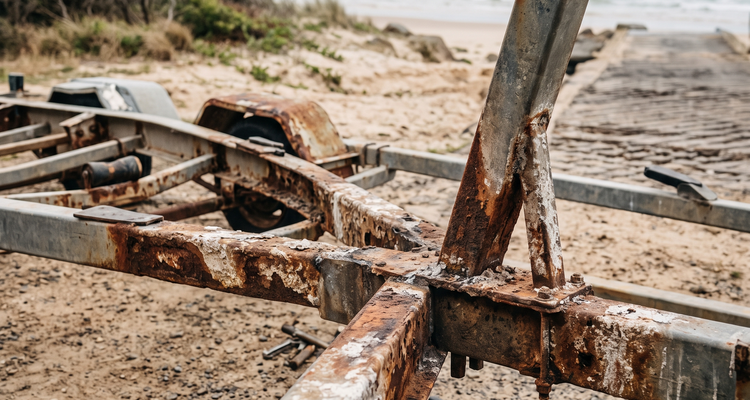
Surface rust is common, but rust concentrated around welds is worth examining more closely. Welds can create small gaps or surface imperfections where moisture collects, accelerating corrosion at those points. If rust is appearing specifically at weld beads, it’s worth having the area properly inspected.
Bent or Twisted Trailer Components
Visible bending or twisting in the frame, crossmembers, or drawbar usually means the steel has been overloaded at some point. Bent steel often has associated weld cracking near the deformation zone.
Loose Crossmembers
Crossmembers that move, flex, or shift when you push on them shouldn’t be doing that. They’re welded in place for a reason — to maintain the frame’s geometry and provide structural rigidity. Movement indicates a weld has partially or fully failed.
Cracked Drawbar or A-Frame
The drawbar is one of the highest-stress areas on the trailer — it connects the entire trailer to the tow vehicle and takes the brunt of acceleration, braking, and tongue weight. Cracks in the drawbar or at the A-frame junction should be treated as urgent.
Damaged Winch Post Mounts
The winch post takes a lot of load during retrieval, particularly if the boat is heavy or the ramp angle is steep. The welds at the base of the winch post and at its mounting points on the frame can crack over time.
Broken or Cracked Spring Hangers
Spring hangers hold the leaf springs that support the axle and absorb road shock. These brackets are welded to the main frame rails and are under load every time the trailer moves. A cracked or broken spring hanger can lead to axle misalignment or, in a worst case, the axle becoming detached.
Safety Chain Attachment Damage
Safety chain attachment points seem minor, but they’re legally required to be functional — and they need to be welded securely enough to actually do their job if the trailer detaches from the vehicle. Cracks or movement at these mounts need immediate attention.
Suspension Bracket Movement
Any movement you can detect in suspension mounting points — brackets, U-bolt plates, shackle mounts — indicates welding failure or serious metal fatigue. These components need to be solidly fixed to the frame.
Unusual Trailer Flex While Towing
If your trailer seems to flex, sway, or behave differently while towing, it’s worth pulling over and checking the frame. While tyre pressure and load distribution play a role, unusual flex can also indicate that the frame has lost rigidity due to weld failure somewhere along its length.
The Most Common Boat Trailer Welding Repairs
Repairing Cracked Trailer Frames
Frame cracks are among the most serious repairs a trailer can need. The crack must be fully excavated before welding — attempting to weld over a crack without removing all the affected material will leave the repair vulnerable to re-cracking. In many cases, reinforcing plates are added to increase strength at the repaired section.
Reinforcing Fatigued Structural Sections
Areas that have experienced repeated stress without cracking may still be fatigued and weaker than new steel. A professional welding service can identify these zones and weld reinforcing plates or gussets before a crack develops.
Crossmember Repairs and Replacement
Failed crossmember welds are re-welded after the damaged section is properly prepared. If a crossmember itself is bent, twisted, or heavily corroded, full replacement is often the better option.
Drawbar Welding Repairs
Drawbar repairs require care because this is a safety-critical component that connects the trailer to the tow vehicle. Proper material preparation, correct welding technique, and reinforcement at stress points are all essential. This isn’t a job for a basic repair kit — it needs proper structural welding.
Winch Post Reinforcement
Winch post base plates can crack or partially detach from the frame. Repairing these involves cleaning out the damaged weld, re-welding with proper penetration, and often adding a reinforcing plate to distribute load more effectively.
Spring Hanger Repairs
Cracked or partially detached spring hangers are re-welded with attention to proper penetration and alignment. Correct positioning matters here — misaligned spring hangers can cause axle tracking issues.
Safety Chain Mount Repairs
Chain mount repairs may seem straightforward, but they need to be done properly to be legally and practically effective. Weld quality matters as much as convenience here.
Mudguard and Fender Bracket Repairs
Mudguard brackets often crack where they meet the frame, particularly on trailers that are frequently submerged. These are relatively minor repairs but are worth addressing to avoid rust tracking and bracket loss on the road.
Trailer Accessory Mount Repairs
Roller mounts, bunk brackets, guide post mounts, and similar accessories are often welded to the trailer frame. When these fail, the boat can shift during towing or retrieval — both inconvenient and potentially damaging.
Areas That Deserve Extra Attention During Inspection
A-Frame and Tow Hitch Connection
The junction between the A-frame and the coupler is a high-stress area. Look closely at the welds around the hitch ball mount, the A-frame legs, and where the A-frame meets the main frame rails.
Crossmember Welds
Check every crossmember — particularly those at the front and rear of the trailer, which typically carry the highest loads. Look for cracking at the junction between the crossmember and the main rail.
Suspension Mounting Points
Spring hanger brackets, equaliser brackets (on tandem axle trailers), and U-bolt plates all deserve close visual inspection. Any movement detected by pushing or twisting these components should be investigated.
Axle Mounts
On trailers with welded axle mounts, check the welds where the axle seats or brackets attach to the frame. Corrosion, cracking, and looseness are all red flags here.
Winch Post Base
The base of the winch post where it meets the drawbar or front crossmember is a common failure point. Look for cracking at the weld bead and any movement when the post is pushed side to side.
Rear Trailer Section Supporting the Boat
The rear of the trailer takes significant load from the stern of the boat and is frequently submerged. Inspect all welds in this area, particularly around roller or bunk support mounts.
Galvanised Coating Around Weld Areas
Many boat trailers are galvanised for corrosion protection. Inspect the coating around weld areas — if the galvanising has cracked, lifted, or is missing, the bare steel beneath is exposed to accelerated corrosion. Areas where the galvanising has been compromised need prompt attention.
Can Rusted Boat Trailers Be Welded?
When Surface Rust Is Repairable
Surface rust — rust that affects only the outer layer of the steel without penetrating into the material — is generally manageable. The rust is ground back to clean metal, the area is properly prepared, and welding can proceed. The weld area is then treated and, where possible, re-coated for protection.
When Corrosion Has Become Structural
When corrosion has progressed to the point where the steel has thinned significantly, pitted deeply, or become flaky and brittle, welding becomes much more difficult and sometimes impractical. Severely corroded steel doesn’t hold a weld well and may not provide the structural integrity the repair requires.
Why Professional Assessment Is Important
It’s not always obvious from a visual inspection alone how deep corrosion has penetrated. What looks like surface rust on the outside can conceal far worse damage inside a hollow section. A professional welder with experience in structural repairs can assess the extent of the damage and give you an honest recommendation on whether repair is viable.
Repair vs Replacement: Knowing When a Trailer Is Beyond Repair
There are trailers that are no longer worth repairing. When corrosion is widespread across multiple structural sections, when the frame has been significantly weakened in several locations, or when the cost of repairs approaches or exceeds the cost of a replacement trailer, replacement is often the more practical choice. A reputable welding service will tell you this honestly rather than carry out expensive repairs on a trailer that isn’t going to give you reliable service.
What Professional Boat Trailer Welding Involves
Thorough Structural Inspection
Before any welding begins, the trailer should be properly inspected. This means looking at every joint, bracket, crossmember, and attachment point — not just the areas the owner has flagged. Problems are often found in adjacent areas to the obvious damage.
Identifying the Cause of the Failure
Understanding why a weld failed is as important as repairing it. If the cause is overloading, reinforcement is needed. If the cause is corrosion, surface treatment and coating are part of the repair. Addressing only the symptom often means the same weld fails again.
Removing Damaged Material
Cracked welds and corroded steel need to be fully removed before new material is applied. Grinding out a crack completely — including any material in the heat-affected zone around it — is standard practice. Welding over compromised material is a shortcut that compromises the repair.
Precision Welding Techniques
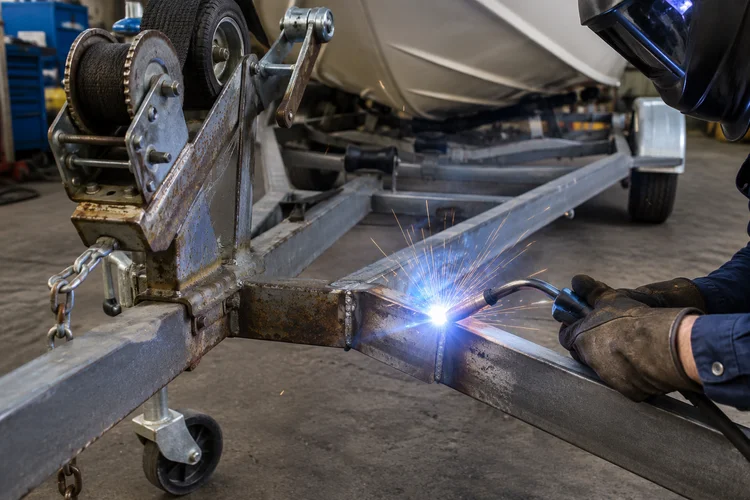
Structural trailer repairs require proper penetration, correct technique for the materials involved, and attention to post-weld quality. Understanding different welding processes and when to use them matters when working on structural components where weld quality is directly related to safety.
Reinforcing High-Stress Areas When Needed
Where a repair is made at a known high-stress point, reinforcing the area — with gussets, backing plates, or doubler plates — reduces the likelihood of the same failure recurring. This is particularly relevant for drawbar repairs, spring hanger replacements, and any repair at a structural joint.
Grinding, Finishing, and Corrosion Protection
After welding, the weld bead is ground flush or to the required profile. Any bare steel — including areas where existing coating was removed during preparation — needs to be treated with primer and an appropriate topcoat or galvanising compound to restore corrosion protection.
Final Safety Inspection Before Returning to Service
A professional service will check the repair against the rest of the trailer before signing it off — confirming that suspension alignment hasn’t been affected, that no secondary issues were missed, and that the trailer is roadworthy.
Why DIY Trailer Welding Can Be Risky
Structural Welds Require Experience
Welding structural components is different from welding sheet metal or fabricating basic attachments. Getting good penetration, managing heat input, and achieving consistent weld quality on thicker structural steel takes experience. Poor technique on a structural weld can look passable on the surface while being significantly weaker than it should be.
Incorrect Repairs Can Create New Stress Points
Welding in the wrong location, using the wrong technique, or adding reinforcement without understanding load distribution can actually create new stress concentrations. A repair that changes how loads flow through the frame can cause failures in previously undamaged areas.
Galvanised Steel Requires Proper Preparation and Safety Procedures
Many boat trailers are galvanised. Welding galvanised steel without proper preparation releases zinc oxide fumes, which are hazardous. Beyond the safety concern, welding over galvanising without removing it first also produces a weaker, more porous weld. Understanding welding terminology and material preparation is essential before attempting any work on galvanised trailer components.
Poor Repairs Can Lead to Trailer Failure
A trailer that has been poorly repaired and then fails on the road creates risks not just for the owner, but for other road users. Regulatory bodies take trailer roadworthiness seriously, and a DIY weld on a safety-critical component that subsequently fails is not a situation anyone wants to be in.
Preventing Future Boat Trailer Welding Repairs
Rinse the Trailer After Every Saltwater Launch
This is the single most effective thing you can do to slow corrosion. A thorough freshwater rinse after every saltwater use — paying particular attention to frame joints, weld areas, and suspension components — removes the salt before it has time to do significant damage.
Inspect Welds Regularly
Make it a habit to visually check the main weld points on your trailer every few months. You don’t need any equipment — a good look at the joints, spring hangers, crossmembers, and drawbar while the trailer is under decent light is enough to catch most developing problems early.
Repair Surface Rust Early
Small rust spots treated promptly rarely become structural problems. Grind back to clean steel, apply a rust converter if needed, prime, and topcoat. Leaving surface rust untreated gives corrosion a foothold that only gets harder to address over time.
Avoid Overloading the Trailer
Every trailer has a rated capacity. Exceeding it doesn’t just risk a fine — it accelerates wear on every weld and structural component. Know your trailer’s capacity and stay within it.
Check Suspension and Axle Components
Leaf springs, shackles, and axle U-bolts all affect how loads are distributed to the frame. Worn or failed suspension components can cause abnormal loading on the frame and welds. Keep these in good condition as part of your overall maintenance routine.
Service the Trailer Before Peak Boating Season
Rather than discovering a problem the morning of a fishing trip, a pre-season inspection gives you time to address any issues before they become urgent. Check the welds, tyres, lights, bearings, and brakes — and deal with anything that needs attention while you’re not under time pressure.
How Often Should You Inspect Your Boat Trailer?
Before Every Trip
A quick visual check before each use doesn’t need to be exhaustive. Look for anything obviously wrong — visible cracks, loose components, unusual deformation. It takes a few minutes and can catch something that would otherwise become a problem on the road.
After Saltwater Use
Post-launch rinse and a quick inspection at the same time makes sense. You’re already there, the trailer is wet, and a visual check while it’s still dripping takes minimal effort. Look at the weld areas and structural joints while you’re rinsing them down.
Annual Professional Inspection
An annual inspection by a professional welder or trailer repairer is worthwhile, particularly for trailers that see regular use. A qualified eye will catch things that an owner inspection might miss — subtle cracking, internal corrosion beginning to show at seam points, or early fatigue in high-stress areas.
Warning Signs That Require Immediate Attention
Don’t wait for a scheduled inspection if you notice:
- Visible cracks at any weld point
- A crossmember or bracket that moves or flexes when it shouldn’t
- The trailer tracking differently than it used to
- Any component that looks bent, twisted, or misaligned
- Unusual noise from the trailer while towing
These warrant immediate professional attention before the trailer is used again.
Choosing a Professional Welding Service for Boat Trailer Repairs
Experience With Structural Trailer Welding
Boat trailer repairs involve safety-critical structural welding. The welder you use should have experience with trailer frames — understanding load paths, knowing what areas require reinforcement, and being able to identify secondary damage that might not be immediately obvious.
Knowledge of Marine Trailer Construction
Marine trailers have specific construction considerations — galvanised coatings, submerged components, hollow sections prone to internal corrosion, and high-cycle loading from regular launch and retrieval. A welder familiar with these characteristics will approach the work differently to someone used to general fabrication.
Quality Materials and Welding Techniques
The steel used in repairs should be comparable in grade to the original material. Consumables, shielding gas, and welding parameters all affect weld quality. A professional service uses the right materials for the job — not the cheapest ones available.
Focus on Safety and Long-Term Durability
A good welding service isn’t just fixing what’s obviously broken — it’s looking at the trailer as a whole and giving you an honest assessment of what needs attention now and what to keep an eye on. The goal is a repair that holds up properly, not one that just looks acceptable on the day.
Fast Turnaround to Get You Back on the Water
We understand that your boat trailer is part of your lifestyle, not just a piece of equipment. At CJS Machinery Hire, we work efficiently to get your trailer assessed and repaired without unnecessary delays.
Boat Trailer Welding Repairs in Hervey Bay and Maryborough — Talk to CJS
If you’re based in Hervey Bay, Maryborough, or the surrounding region and your boat trailer needs welding attention, the team at CJS Machinery Hire can help. With over 25 years of hands-on experience in construction, earthmoving, and structural work, we bring practical knowledge to every job — no guesswork, no shortcuts.
Whether it’s a cracked drawbar, a failed spring hanger, loose crossmembers, or a frame that needs reinforcing before the next season, our welding services are built around doing the job properly the first time. We’ll assess the full trailer, identify what needs attention, and give you a clear picture of what the repair involves before any work begins.
Get in touch with us today to book an inspection or discuss what your trailer needs. We’re a family-owned business, and we’d rather give you an honest assessment than tell you what you want to hear.
Related Posts
Post a Comment