
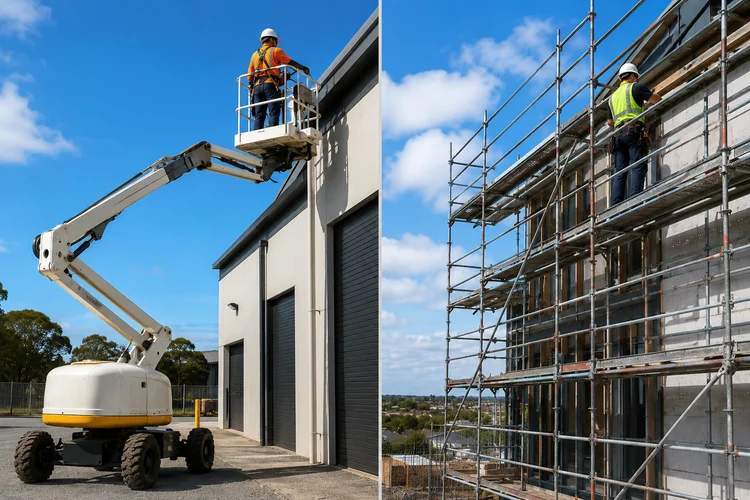
Deciding between a boom lift and scaffolding can make or break your project timeline, budget, and safety record. Whether you’re a tradie working on a commercial build, a homeowner tackling exterior maintenance, or a contractor managing multiple sites, choosing the right access equipment matters more than you might think.
At CJS Machinery Hire, we’ve seen firsthand how the right choice can save time, reduce labour costs, and keep workers safe across Hervey Bay, Maryborough, and surrounding areas. In this guide, we’ll break down exactly when a boom lift is the smarter option — and when scaffolding still has its place.
Boom Lifts and Scaffolding
Why Choosing the Right Access Equipment Matters
Working at heights comes with inherent risks, and your choice of equipment directly impacts job safety, efficiency, and cost. The wrong equipment can lead to project delays, increased labour expenses, and unnecessary safety hazards. Meanwhile, the right choice streamlines workflows and keeps your team productive.
For many jobs across Queensland, particularly short-term work requiring mobility and flexibility, boom lifts offer significant advantages over traditional scaffolding. However, understanding when each option is appropriate ensures you’re not just working hard — you’re working smart.
Common Jobs That Require Working at Heights
Elevated work is part of daily life for many trades and industries. From routine maintenance to complex construction, jobs requiring height access include:
- Building maintenance and facade work
- Electrical and lighting installations
- Gutter cleaning and roof repairs
- Tree lopping and vegetation management
- Painting and signage installation
- HVAC servicing and repairs
- Window cleaning on multi-storey buildings
- Warehouse inventory management
- Building inspections and assessments
Each of these tasks has different requirements for reach, duration, mobility, and workspace — factors that determine whether a boom lift or scaffolding is the better fit.
Overview of Boom Lifts vs Scaffolding
Boom lifts (also called cherry pickers) are mobile elevated work platforms that use hydraulic or articulated arms to position workers at height. They’re self-contained units that can be driven around a site and repositioned quickly.
Scaffolding, on the other hand, is a temporary fixed structure erected around buildings or work areas. It provides a stable working platform but requires assembly, dismantling, and cannot be easily moved once installed.
The key differences come down to mobility, setup time, labour requirements, and the nature of the work being performed.
What Is a Boom Lift?
How Boom Lifts Work
A boom lift uses a hydraulic lifting system mounted on a mobile base. The operator controls the boom arm from the platform (basket), allowing them to raise, lower, extend, and rotate into position. Most modern units feature proportional controls, making them intuitive to operate once you’re properly trained.
The platform itself is surrounded by safety rails and equipped with a control panel. Operators can make precise adjustments while working, positioning themselves exactly where they need to be without climbing down and repositioning equipment.
Different Types of Boom Lifts and Cherry Pickers
There are several types of boom lifts available, each suited to different applications:
- Articulating boom lifts: Feature multiple joints in the boom arm, allowing “up and over” reach to access difficult spots around obstacles
- Telescopic boom lifts: Extend straight out for maximum horizontal reach
- Compact boom lifts: Smaller units designed for indoor use and tight access areas
- Trailer-mounted boom lifts: Can be towed to site and set up quickly
- Truck-mounted boom lifts: Integrated into vehicles for maximum mobility
Key Features of a 13m Boom Lift
A 13-metre boom lift strikes the perfect balance between reach and versatility. At CJS Machinery Hire, our 13m cherry picker offers:
- Maximum working height of 13 metres
- Compact design for navigating tight spaces
- Sturdy platform with safety rails
- 360-degree rotation capability
- Suitable for both indoor and outdoor applications
- Regularly serviced and safety checked
This height capacity covers most residential and light commercial jobs, from two-storey homes to small industrial sites, making it an ideal choice for tradies across the Wide Bay region.
What Is Scaffolding?
How Scaffolding Systems Are Set Up
Scaffolding installation is a multi-step process requiring trained scaffolders. The system involves:
- Setting base plates or footings to ensure stability
- Erecting vertical standards (uprights)
- Installing horizontal ledgers and transoms
- Adding platforms (decks) at working heights
- Fitting guardrails and toe boards for fall protection
- Anchoring the structure to the building
- Installing access ladders or stair towers
Once erected, scaffolding must be inspected regularly and can only be modified or dismantled by qualified personnel.
Common Types of Scaffolding Used in Australia
Australian work sites typically use:
- Tube and coupler scaffolding: Traditional system using steel tubes connected with couplers
- Frame scaffolding: Pre-fabricated frames that clip or pin together
- Mobile scaffolding towers: Freestanding units on wheels for smaller jobs
- Suspended scaffolding: Hung from the roof structure for facade work
Each type has specific applications and regulatory requirements under Australian Work Health and Safety regulations.
Typical Applications for Scaffolding
Scaffolding excels in situations requiring:
- Long-term site access (weeks or months)
- Multiple workers operating at height simultaneously
- Heavy materials or equipment storage at elevation
- Continuous work zones along building facades
- Load-bearing capacity for construction materials
- Stable platforms for bricklaying, rendering, or cladding installation
Key Differences Between Boom Lifts and Scaffolding
Mobility and Flexibility
This is where boom lifts truly shine. A boom lift hire gives you the freedom to move around your work site quickly. Need to switch from the front of the building to the side? Drive the boom lift over. Working around trees or poles? Manoeuvre into position in minutes.
Scaffolding, once erected, is fixed in place. Moving it requires partial dismantling and reassembly, which is time-consuming and labour-intensive.
Setup Time and Labour Requirements
A boom lift can be operational within minutes of arrival on site. One person can drive it off the trailer, perform pre-start checks, and begin working.
Scaffolding requires a crew of qualified scaffolders, often taking hours or even days to erect depending on the scale. You’re also paying for dismantling time at the end of the job.
Height and Reach Capabilities
Modern boom lifts can reach impressive heights, with some models extending beyond 40 metres. Our 13m unit covers most residential and light commercial needs.
Scaffolding can theoretically reach any height but becomes increasingly complex, expensive, and time-consuming as you go higher. Each additional level requires more materials, more labour, and more engineering considerations.
Access in Tight or Awkward Spaces
Articulating boom lifts can navigate around obstacles, reaching over rooflines, around power lines, or between trees. The compact footprint of many models allows access through standard doorways and gates.
Scaffolding needs clear ground space and cannot easily work around obstacles. If you’re dealing with uneven terrain, existing structures, or limited site access, scaffolding can be challenging or impossible to install properly.
Safety Considerations for Each Option
Both options have safety requirements, but they differ significantly. Boom lifts require operator licensing (High Risk Work licence for units with boom length 11m or more), pre-start inspections, and adherence to safe operating procedures. The risks are generally related to tip-overs, electrocution from overhead power lines, and falls from the platform.
Scaffolding must be erected by licensed scaffolders, regularly inspected, and properly tagged. Risks include collapse from improper installation, falls during access, and struck-by hazards from falling tools or materials.
When a Boom Lift Is the Better Choice
Short-Term Jobs That Need Fast Setup
If your job is measured in hours or days rather than weeks, a boom lift is almost always the better option. The time saved in setup and pack-down alone often justifies the choice. Jobs like gutter cleaning, light repairs, or quick inspections simply don’t warrant the investment in scaffolding installation.
Working Around Obstacles or Uneven Terrain
Queensland properties often present challenges — sloped blocks, existing landscaping, trees, and structures that make ground-level work difficult. A boom lift can operate on mild grades and position itself where scaffolding would be impractical or impossible to install safely.
Jobs Requiring Frequent Movement
When you need to access multiple points around a building or across a site, the mobility of a boom lift saves enormous amounts of time. Rather than erecting scaffolding in multiple locations or constantly moving a mobile scaffold tower, you simply drive to your next work area.
Tree Lopping and Pruning
This is boom lift territory. Scaffolding around trees is impractical and dangerous. A boom lift allows arborists and property owners to safely access all parts of a tree, with the ability to reposition quickly as work progresses. The platform provides a stable base for operating chainsaws and managing branches.
Important: Tree work from elevated platforms carries specific risks including branch kickback and falling limbs. We recommend consulting a qualified arborist for complex or large-scale tree work. Never operate near power lines without proper clearances and utility approval.
Electrical and Lighting Installations
Electricians regularly use boom lifts for installing or servicing overhead lighting, building-mounted fixtures, and signage. The ability to position exactly where needed and carry tools and materials in the basket makes the work efficient and safe.
Work near power lines must comply with No Go Zone requirements and requires written approval from your local electricity provider (such as Ergon Energy in Queensland). Never assume safe clearance — verify before operating.
Roof and Gutter Maintenance
Roof inspections, gutter cleaning, and minor repairs are perfect boom lift applications. You gain safe access to the roof edge without the risk of working from ladders or the expense of full scaffolding. For homeowners and property maintenance companies across Hervey Bay, this is one of the most common uses for hired boom lifts.
Painting, Signage, and Building Inspections
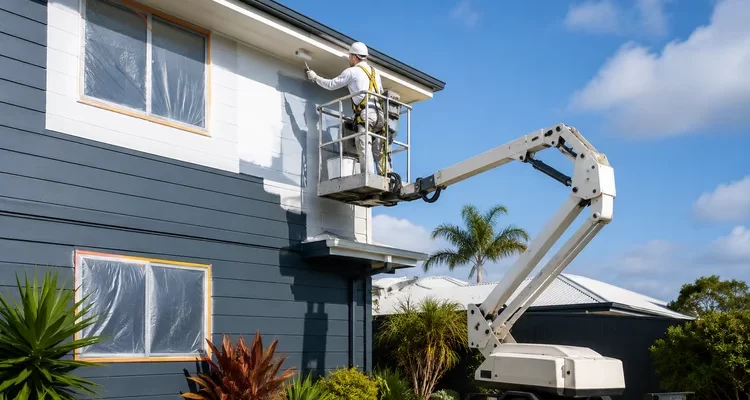
Exterior painting of residential properties, sign installation on shop fronts, and building inspections for defects or damage all benefit from boom lift access. The ability to move along a wall face while maintaining a consistent working position beats repeatedly shifting ladders or working from scaffolding sections.
When Scaffolding Is the Better Option
Long-Term Construction Projects
If your project spans weeks or months, scaffolding often makes more financial sense. The daily hire costs of a boom lift would quickly exceed scaffolding rental, and you need continuous access anyway. Major renovations, new builds, and extensive facade work typically justify scaffolding.
Jobs Requiring Multiple Workers at Height
When you need several tradies working at elevation simultaneously — think bricklayers, renderers, or large painting crews — scaffolding provides the workspace. Multiple people can work at different sections without interfering with each other, and materials can be staged on platforms for easy access.
Continuous Access Across Large Work Areas
For work along an entire building elevation or around a complete structure, scaffolding creates a continuous working platform. This is essential for tasks like bricklaying, rendering, or cladding installation where workers need to move freely along the work face.
Heavy-Duty Renovation or Bricklaying Work
Scaffolding can support significant loads — materials, tools, and multiple workers. When you’re stockpiling bricks, carrying bags of render, or moving heavy building materials, scaffolding’s load-bearing capacity is essential. Boom lifts have strict weight limits and aren’t designed for material storage.
Safety Considerations for Working at Heights
Importance of Proper Training and Licensing
In Australia, boom-type EWPs with a boom length of 11 metres or more require a High Risk Work (HRW) licence — specifically the WP Class. This isn’t the yellow card for smaller units; it’s the full HRW ticket. This ensures operators understand safe operating procedures, hazard identification, and emergency procedures. At CJS Machinery Hire, we verify your licence before hire and provide machine-specific familiarisation if needed.
Scaffolding must be erected, modified, and dismantled by workers holding the appropriate scaffolding tickets. Using unqualified personnel is illegal and extremely dangerous.
Fall Protection and PPE Requirements
Both boom lifts and scaffolding require appropriate fall protection. For boom lifts, this typically means wearing a harness attached to designated anchor points within the platform. Scaffolding requires fully decked platforms with guardrails, toe boards, and harness use when working near unprotected edges.
Other PPE includes hard hats, safety footwear, high-visibility clothing, and task-specific equipment like gloves or safety glasses.
Safe Operating Procedures for Boom Lifts
Following boom lift safety best practices is non-negotiable. Key procedures include:
- Conducting pre-start inspections every time
- Checking ground conditions for stability
- Maintaining safe clearances from overhead power lines
- Never exceeding the platform’s rated capacity
- Keeping the platform floor clear of trip hazards
- Using three points of contact when entering/exiting
- Lowering the boom before driving if safe to do so
- Never using the boom lift in high winds
Risks of Improper Scaffolding Installation
Scaffolding failures can be catastrophic. Common issues include:
- Inadequate foundation or base support
- Missing or improperly installed bracing
- Overloading platforms beyond their rated capacity
- Incomplete edge protection
- Inadequate tie-ins to the building structure
- Using damaged components
This is why only licensed scaffolders should erect or modify scaffolding systems, and why regular inspections are mandatory.
Cost Comparison: Boom Lift vs Scaffolding
Equipment Hire Costs
Boom lift hire in Hervey Bay typically costs between $250-$300 per day for a 13m unit (with specials available). Weekly rates offer better value for slightly longer jobs. At CJS Machinery Hire, we offer half-day rates at $150 and full-day rates from $250, making boom lift hire accessible for both small and larger projects.
Scaffolding costs vary widely based on height and complexity but generally involve higher upfront costs for materials and installation. For a simple two-storey house, expect scaffolding to cost $2,000-$5,000+ depending on coverage and duration.
Labour and Installation Expenses
A boom lift requires minimal labour — one licensed operator can handle the entire job. Delivery fees ($180 at CJS) are optional if you prefer to collect.
Scaffolding requires a professional crew for installation (often $1,000+ in labour alone) and dismantling. These labour costs significantly impact total project expenses.
Time Savings and Productivity Benefits
Time is money in any trade. A boom lift gets you working faster, moving between work areas efficiently, and packing up quickly. Jobs that might take a week with scaffolding can often be completed in days with a boom lift.
Consider a gutter cleaning job: with a boom lift, you might complete the work in 2-3 hours. With scaffolding, you’d wait for installation, do the work, then wait for dismantling — possibly taking a full day or more.
Which Option Offers Better Value for Short-Term Work?
For any job under a week, boom lift hire almost always offers better value. The combination of lower equipment costs, minimal labour requirements, and faster job completion makes it the smart choice for short-term elevated access needs.
Advantages of Hiring a Boom Lift
Faster Job Completion
With immediate setup and no installation delays, you start working sooner and finish faster. This translates to more jobs per week, happier clients, and improved cash flow.
Reduced Labour Requirements
One person with a High Risk Work licence can operate a boom lift independently. No need for ground crew, riggers, or scaffolders — just you and the equipment.
Greater Flexibility on Site
Site conditions change, and so do job requirements. With a boom lift, you adapt quickly. Need to access a different area? Move it. Weather clearing up and work can proceed? Get started immediately.
Improved Access and Manoeuvrability
Modern boom lifts, particularly compact models, can access areas scaffolding simply can’t reach. Through doorways, around corners, across uneven ground — the mobility opens up possibilities.
Easier Transport and Setup
Our 13m cherry picker can be delivered to your site or collected with appropriate towing capacity. Setup is straightforward, and you’re operational within minutes rather than hours or days.
Choosing the Right Boom Lift for the Job
Understanding Working Height Requirements
Working height differs from platform height. A 13m boom lift provides a working height of approximately 13 metres, accounting for the platform elevation plus average reach. Calculate your needs carefully — it’s better to have slightly more reach than to come up short mid-job.
Considering Terrain and Site Conditions
Assess your site before booking. While boom lifts handle mild grades and uneven surfaces better than scaffolding, extreme slopes or soft ground may require additional precautions. Our team at CJS Machinery Hire can discuss your site conditions and recommend the best approach.
Indoor vs Outdoor Applications
Some boom lifts are designed for indoor use (electric, non-marking tyres, compact dimensions) while others suit outdoor work (diesel, rough-terrain capabilities). Our 13m unit works well in both environments, making it versatile for various applications across residential and commercial sites.
Why Compact Boom Lifts Are Ideal for Tight Spaces
Queensland properties, particularly older homes in established areas like Hervey Bay, often have limited access. A compact boom lift can navigate through standard residential gates and work in confined spaces where larger equipment wouldn’t fit — yet still deliver impressive reach and working height.
Common Mistakes to Avoid When Choosing Access Equipment
Underestimating Height Requirements
Measure twice, hire once. Account for working height, not just the elevation you need to reach. You need room to work comfortably and safely, not just touch the highest point. Add extra height for tool reach and working clearance.
Choosing Equipment Based on Price Alone
The cheapest option isn’t always the best value. Consider total costs including labour, time, and productivity. A slightly more expensive boom lift hire might save thousands in labour costs and finish the job days earlier.
Ignoring Site Access Limitations
Before committing to scaffolding, verify there’s adequate ground space, access for materials delivery, and suitable anchor points. Before booking a boom lift, confirm gate widths, overhead clearances, and ground conditions. A site visit can prevent expensive surprises.
Failing to Consider Safety Regulations
Compliance isn’t optional. Both scaffolding and boom lift operations are governed by Work Health and Safety regulations. Ensure all operators are properly licensed, equipment is maintained to standards, and safety procedures are followed. Cutting corners on safety puts lives at risk and exposes you to legal liability.
Why Choose CJS Machinery Hire for Boom Lift Hire
Reliable 13m Cherry Picker Hire in Hervey Bay
Our cherry picker hire service is built on reliability. Our 13m boom lift is regularly serviced, safety checked before every hire, and maintained to Australian standards. When you book with us, you’re getting equipment you can trust.
Affordable Rates with No Large Deposits
Unlike bigger hire companies that require deposits of thousands of dollars, we work on goodwill with local tradies and businesses. You need a credit card and valid licence, but we don’t tie up your cash flow with excessive deposits. It’s just good business and fair treatment.
Flexible Half-Day and Full-Day Hire Options
Not every job needs a full day. We offer half-day hire at $150 for shorter tasks, or full-day hire at $250 (current special) and $300 standard. This flexibility means you’re not paying for equipment sitting idle — just for the time you actually need it.
Well-Maintained and Safety Checked Equipment
Safety is non-negotiable. Our boom lift undergoes scheduled servicing and is inspected before every hire. All components are checked, hydraulics tested, and safety systems verified. We also provide machine-specific familiarisation covering the controls and features of our 13m boom lift if you need it.
Local Support and Delivery Options
Based in Booral, just outside Hervey Bay, we’re a local family-owned business serving the Wide Bay region. We offer free pick-up or optional delivery for $180. If you need support during your hire, we’re just a phone call away — and we actually answer.
Get Your Job Done Right with CJS Machinery Hire
Choosing between a boom lift and scaffolding comes down to your specific job requirements, timeline, and budget. For most short-term work requiring height access across Hervey Bay, Maryborough, and the Fraser Coast region, a boom lift offers unbeatable versatility, safety, and value.
At CJS Machinery Hire, we’ve helped countless tradies, contractors, and homeowners complete their elevated work safely and efficiently. Our well-maintained 13m cherry picker is perfect for everything from tree pruning to electrical work, from gutter cleaning to building inspections.
Don’t risk working from ladders or overpaying for scaffolding on short-term jobs. Get in touch with our friendly team today to discuss your project and book your boom lift hire. We’ll make sure you have the right equipment, proper familiarisation, and local support to get the job done safely.
Related Posts
Post a Comment