
Heavy machinery and equipment take a beating on the job. Whether it’s an excavator bucket working through rocky ground, a trailer frame flexing under load, or a loader boom absorbing repeated stress, the wear and damage that accumulates over time is unavoidable. Welding repairs play a central role in keeping this equipment operational, safe, and cost-effective to run. For operators and fleet owners across Hervey Bay, Maryborough, and surrounding regions, understanding what to look for — and when to act — can make the difference between a quick fix and a costly replacement.
This guide covers the most common welding repairs needed on heavy machinery and equipment, the causes behind them, and what the repair process typically involves.
Welding Repairs for Heavy Machinery and Equipment
Why Heavy Machinery Experiences Wear and Damage
Heavy equipment operates under demanding conditions. Continuous exposure to impact, vibration, abrasive materials, and harsh weather causes even high-grade steel components to crack, fracture, and wear down over time. The nature of most machinery jobs — digging, lifting, pushing, and hauling — puts extreme stress on frames, buckets, booms, and attachment points. This wear is a normal part of equipment life, but left unmanaged, minor damage quickly becomes a serious problem.
The Importance of Timely Welding Repairs
Catching damage early is the most effective way to control repair costs and keep machinery in service. A hairline crack in a boom arm or a worn cutting edge on a bucket are manageable repairs when addressed promptly. Delay the repair and the same crack can propagate through a structural member, turning a one-hour weld job into a full component replacement. Timely welding services protect both the equipment and the people working around it.
How Professional Welding Services Help Minimise Downtime
Every hour a machine sits idle costs money. Professional welders with experience in heavy equipment can diagnose damage accurately, apply the right repair technique, and return machinery to service faster than a general repair approach. Mobile welding services add another advantage — repairs can often be completed on-site, avoiding the time and expense of transporting equipment to a workshop.
Understanding the Role of Welding in Equipment Maintenance
Restoring Structural Integrity and Performance
When a structural component cracks or a mounting point fails, the entire machine’s performance is affected. Welding restores the original strength of damaged components, returning them to working specification. In many cases, repairs using quality filler materials and correct welding procedures can match or exceed the original strength of the base metal.
Extending the Lifespan of Machinery Components
A well-executed weld repair can add years of serviceable life to a component that would otherwise need replacement. Techniques such as hardfacing and wear plate application go further by building up surfaces that are more resistant to abrasion than the original material, effectively extending the working life of high-wear parts.
Reducing Long-Term Repair and Replacement Costs
Replacing a major component — a bucket assembly, a boom section, or a trailer frame — is significantly more expensive than repairing it. Proactive maintenance and repair welding reduces the frequency of major failures, spreads equipment costs over a longer operational life, and keeps machinery available for revenue-generating work.
Common Causes of Welding Repairs in Heavy Equipment
Normal Wear and Tear from Daily Operations
Even under normal operating conditions, components wear down. Cutting edges dull and thin, bucket lips crack from repeated digging cycles, and mounting hardware loosens over time. Regular inspections help identify this gradual wear before it escalates.
Impact Damage and Accidental Collisions
Heavy machinery often operates in tight or unpredictable environments. Collisions with rocks, stumps, other equipment, or fixed structures can cause sudden structural damage — bent frames, cracked welds, or deformed attachment points. Impact damage typically requires prompt attention to prevent further propagation.
Metal Fatigue from Repetitive Stress
Components that undergo repeated loading and unloading cycles — such as excavator booms, loader lift arms, and trailer drawbars — are susceptible to metal fatigue. Fatigue cracks typically start at stress concentration points like weld toes, holes, or geometric changes in the metal profile. Once a fatigue crack initiates, it can grow rapidly under continued loading.
Corrosion and Environmental Exposure
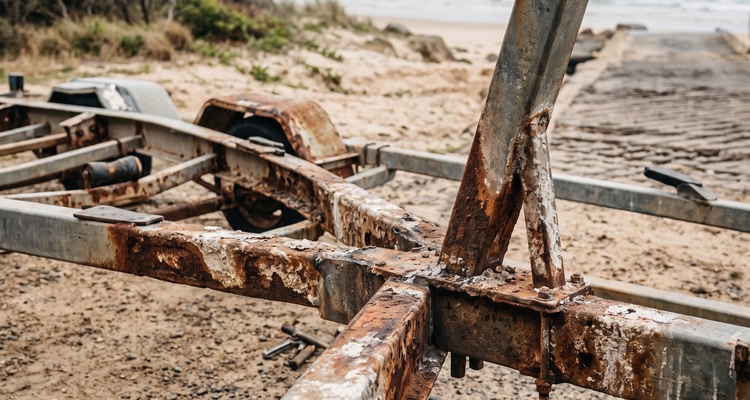
Queensland’s coastal and humid climate accelerates corrosion on steel equipment. Rust weakens base metal and weld joints, particularly in areas where protective coatings have worn away. Equipment used near saltwater, in wet soil conditions, or exposed to fertilisers and chemicals is especially vulnerable.
Overloading and Improper Equipment Use
Operating machinery beyond its rated capacity or using attachments incorrectly places loads on components that weren’t designed for them. This can cause sudden fractures or accelerated fatigue damage across frames, mounting points, and structural joints.
Welding Repairs for Cracked Machinery Frames
Why Frame Cracks Occur
Machinery frames carry the entire structural load of the equipment and its payload. Cracks develop at points of stress concentration — typically around welded joints, bolt holes, and areas where the frame section changes profile. Heavy impact, metal fatigue, and corrosion all contribute to frame cracking.
Signs of Structural Frame Damage
Operators should look for visible cracks, paint lifting or rust staining in a linear pattern, misalignment of attachment points, and unusual machine behaviour such as twisting or racking during operation. A machine that suddenly handles differently may have an underlying structural crack.
Repair Techniques Used to Restore Strength
Frame crack repairs typically involve grinding out the crack to clean metal, preheating the work area to the appropriate temperature, applying multi-pass MIG or stick welds using compatible filler material, and grinding the finished weld flush. For highly critical structural components — such as certified lifting equipment or major structural members on regulated plant — third-party non-destructive testing may be specified to verify weld integrity as part of the compliance process.
Preventing Future Frame Failures
After repairing a frame crack, gusset plates or reinforcement doublers are often welded over the repaired area to redistribute stress and prevent recurrence. Regular inspections of known stress concentration points should be included in ongoing maintenance programs.
Repairing Excavator Buckets and Attachments
Common Bucket Wear Areas
Excavator buckets wear most heavily at the cutting edge, bucket lip, side plates, and around tooth adapter mounting points. The type and rate of wear depends on the material being excavated — sandy soils cause even abrasion, while rocky or clay-heavy ground creates impact wear and cracking.
Cracked Side Plates and Cutting Edges
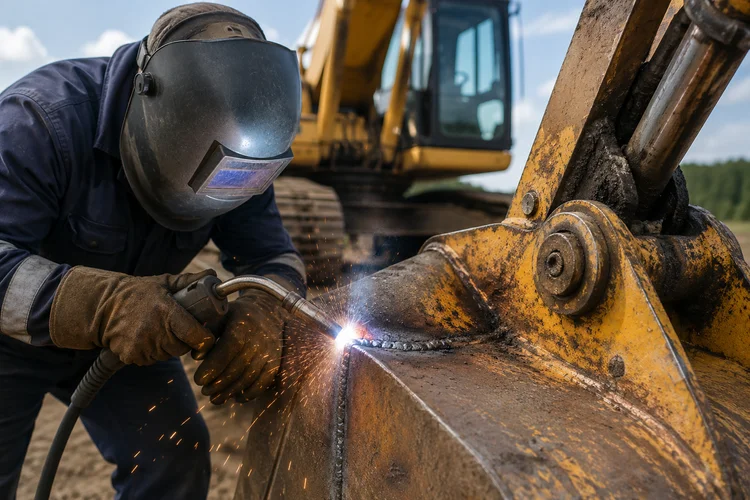
Side plate cracks are common on buckets used in rocky or mixed soil conditions. The plates flex under digging loads and crack along weld lines or at stress risers. Cutting edges wear thin and may crack longitudinally. Both types of damage respond well to weld repair, with the option to build up worn areas using hardfacing wire.
Reinforcing High-Stress Zones
High-wear areas such as the bucket lip, heel, and side shroud zones can be reinforced by welding on additional wear plates or applying hardfacing overlays. These reinforcements extend bucket life significantly and are far more cost-effective than bucket replacement.
Hardfacing Solutions for Increased Durability
Hardfacing involves depositing a layer of abrasion-resistant weld metal over worn surfaces. On excavator buckets, hardfacing is commonly applied to the base metal between teeth, the cutting edge, and the outer floor of the bucket. Chromium carbide hardfacing products provide excellent abrasion resistance in high-wear applications.
Welding Repairs for Loader Buckets and Skid Steer Attachments
Typical Damage Caused by Heavy Loads
Loader buckets and skid steer attachments experience heavy stress from crowd forces, side loading, and impact. Cracking at the bucket back plate, wear on the cutting edge, and damage to quick-attach mounting components are the most frequent repair requirements.
Repairing Worn Cutting Edges
Cutting edges on loader buckets can be built up with weld metal when worn, or replaced as bolt-on or welded segments. Choosing the right cutting edge profile and material for the application — whether a straight edge for smooth surfaces or a serrated edge for penetration in tough materials — affects both productivity and longevity.
Restoring Attachment Mounting Points
Quick-attach mounting frames take significant stress during operation and are prone to cracking around the mounting pins and locking mechanisms. Weld repairs to these areas need to maintain correct geometry to ensure the attachment interfaces properly with the machine’s coupler system.
Strengthening Frequently Used Components
For attachments that are in constant use, proactive reinforcement — adding wear plates to high-contact zones and gussets to stress points — reduces repair frequency and extends time between maintenance cycles.
Boom and Arm Welding Repairs
Stress Points in Excavator and Loader Booms
Booms and arms are subject to both bending and torsional loads. Stress concentrations form at cylinder mounting brackets, pin boss locations, and weld toes along the boom body. These are the areas where fatigue cracks are most likely to develop and should be checked regularly.
Detecting Cracks Before They Worsen
Visual inspection of boom and arm surfaces should look for paint cracking, surface rust in a linear pattern, or weld cracking at known stress points. Magnetic particle inspection or dye penetrant testing can reveal surface cracks that aren’t visible to the naked eye.
Welding Procedures for Structural Components
Boom and arm repairs require careful attention to preheat requirements, filler material selection, and weld sequence to minimise distortion and residual stress. The high-strength steels used in modern booms are sensitive to hydrogen-induced cracking if welding procedures aren’t followed correctly.
Safety Considerations During Repairs
Before carrying out welding repairs on booms or arms, the equipment should be properly supported and isolated. Welding on structural lifting components requires a competent welder with appropriate qualifications, and repairs should be documented for the equipment’s maintenance record.
Chassis and Undercarriage Welding Repairs
Common Damage Found in Undercarriage Systems
Tracked machines in particular accumulate damage to their undercarriage systems from rock impacts, abrasion from soil and aggregate, and the constant stress of track tension and travel loads. Track frame cracking, roller guard damage, and sprocket mounting failures are common repair items.
Repairing Mounting Brackets and Supports
Mounting brackets for hydraulic cylinders, track guards, and ancillary components are frequent weld repair candidates. These brackets are often smaller sections welded to the main chassis and can crack at their attachment welds when subjected to shock loads.
Addressing Wear from Rough Terrain
Operating on rough terrain accelerates wear across all undercarriage components. Wear plates and hardfacing applied to high-contact zones — such as track guide rails and rock guards — can significantly extend service intervals on equipment operating in abrasive conditions.
Importance of Precision Alignment
When repairing chassis or undercarriage components, maintaining correct alignment is critical. Misaligned frames cause uneven load distribution, accelerated wear in neighbouring components, and can compromise machine stability. Repairs should be checked against manufacturer specifications before returning the machine to service.
Welding Repairs for Trailers and Transport Equipment
Cracked Trailer Frames and Drawbars
Trailer frames and drawbars operate under constant flex and fatigue loading. Cracks typically develop at the corners of the main rail, around crossmember welds, and at the drawbar eye or ball coupling attachment. These are safety-critical repairs that should be addressed immediately and inspected by a licensed repairer where required.
Suspension Mount and Axle Support Repairs
Suspension mounts, spring hangers, and axle seats are high-stress locations on trailer chassis. Cracking or fracture at these points causes handling instability and, in severe cases, loss of load control. Weld repairs must restore full strength and correct geometry.
Repairing Loading Ramps and Gates
Loading ramps and tail gates are frequently damaged by heavy machinery driving over or across them. Cracked ramp plates, broken hinges, and bent stiffeners are all repairable by welding, and wear-resistant surfacing can be applied to ramp decks to reduce future damage.
Maintaining Roadworthiness and Safety
Trailers operating on public roads must meet roadworthiness standards. Structural weld repairs to trailer frames, couplings, and axle supports should be carried out by qualified tradespeople, and vehicles may require re-inspection before returning to road use depending on the nature and location of repairs.
Wear Plate Replacement and Hardfacing Applications
What Is Hardfacing?
Hardfacing is a welding process that deposits a layer of wear-resistant alloy over a base metal surface. The deposited material — typically containing chromium carbide, tungsten carbide, or manganese — is significantly harder than the parent metal and provides substantially better resistance to abrasion, impact, and erosion. Hardfacing can be applied by MIG, stick, or flux-cored arc welding processes depending on the application.
Components That Benefit from Hardfacing
Hardfacing is commonly applied to excavator bucket lips and floors, dozer blade cutting edges, loader cutting edges, grader blades, auger flights, crusher liners, and any other component that operates in direct contact with abrasive materials. Almost any steel component subject to wear is a candidate.
Advantages of Wear-Resistant Surfaces
Properly applied hardfacing can multiply component service life by two to five times or more compared to untreated mild steel. This reduces the frequency of maintenance interventions, lowers overall operating costs, and keeps equipment available for productive work.
When to Replace Versus Rebuild Components
The decision to rebuild a worn component with welding or replace it outright depends on the extent of wear, the availability and cost of replacement parts, and the structural condition of the base material. In many cases, rebuilding is significantly cheaper and faster than waiting for a replacement part, particularly for imported or specialist components.
Repairing Broken Brackets, Mounts, and Supports
Causes of Bracket Failure
Brackets, mounts, and supports are often the first components to fail under shock and fatigue loading because they act as stress concentrators where load is transferred between major structural members. Weld quality, design geometry, and the dynamic loading environment all influence bracket service life.
Welding Techniques Used for Repairs
MIG welding is commonly used for bracket repairs in workshop environments due to its speed and ease of use. Stick welding is preferred for field repairs or where surface preparation is limited. In both cases, achieving adequate fusion at the weld root and correct weld size for the load application is essential.
Reinforcement Strategies for High-Stress Areas
After repairing a failed bracket, a reinforcement gusset is often added to increase the load-carrying capacity and reduce the stress concentration at the original weld toe. The geometry of the gusset — its shape, size, and how it transitions into the main structure — significantly affects how well it redistributes stress.
Importance of Correct Material Selection
Using filler material that is compatible with the base metal and appropriate for the strength requirements of the repaired joint is critical. Mismatched filler materials can result in brittle welds or soft joints that fail prematurely under operational loads.
Welding Repairs for Agricultural Machinery
Common Repairs on Tractors and Implements
Agricultural machinery — from tractors and front-end loaders to hay equipment and slashers — endures heavy seasonal use followed by periods of storage, which creates its own set of maintenance challenges. Frame cracking, three-point hitch damage, and PTO gearbox mount failures are among the more common weld repairs seen on farm equipment.
Repairing Ploughs, Cultivators, and Attachments
Ground-engaging implements like mouldboard ploughs, chisel ploughs, and cultivation discs wear aggressively and are frequently in need of cutting edge replacement, wear plate application, or structural repair of the frame and tine mounting points. Hardfacing plough shares and cultivation points is a cost-effective way to extend service life.
Seasonal Maintenance Considerations
Timing agricultural repairs around the farming calendar helps avoid lost productivity during planting, harvesting, or other peak activity periods. End-of-season inspections give enough time to carry out repairs before the next busy period and allow parts to be sourced without urgency-driven cost premiums.
Minimising Downtime During Peak Farming Periods
For farming operations, a machine breakdown at the wrong time can have significant financial consequences. Mobile welding capability means that many field repairs can be completed on-site without the machine needing to leave the property, keeping downtime to a minimum during critical periods.
Welding Repairs for Mining and Construction Equipment
High-Wear Components in Harsh Environments
Mining and construction sites expose equipment to some of the most abrasive, corrosive, and high-impact operating conditions possible. Dozer push frames, ripper shanks, dragline components, and dump truck bodies all accumulate significant wear and structural damage under these conditions.
Managing Heavy Impact and Abrasion Damage
In high-impact applications, using impact-resistant weld overlays rather than purely abrasion-resistant materials can provide a better service life outcome. The right hardfacing product selection depends on whether abrasion, impact, or a combination of both is the dominant wear mechanism.
Reinforcement Techniques for Critical Equipment
Critical equipment components such as front-end loader buckets on mining applications are often rebuilt to a higher specification than the original, using thicker wear plates, harder cutting edges, and more extensive hardfacing coverage to extend service intervals in demanding conditions.
Benefits of Scheduled Inspection Programs
Scheduled inspection programs — where equipment is checked at defined intervals rather than only when a problem becomes visible — allow repairs to be planned and scheduled rather than reacted to. This approach reduces unplanned downtime, allows parts and materials to be ordered in advance, and makes better use of maintenance resources.
Signs Your Equipment Requires Welding Repairs
Visible Cracks and Fractures
Any visible crack in a structural component should be treated as a priority repair. Even small cracks can grow rapidly under dynamic loading, particularly in high-stress areas such as boom welds, bucket lips, and frame joints.
Excessive Vibration During Operation
Unusual vibration that wasn’t present before can indicate a structural issue — a cracked component that is flexing rather than remaining rigid, or a mounting bracket that has failed and is allowing relative movement between components.
Misalignment of Components
If attachments no longer sit correctly on the machine, if pins are hard to install, or if the machine’s geometry looks different from normal, a structural repair may have been compromised or a new failure may have occurred.
Unusual Noises or Performance Issues
Knocking, cracking, or popping sounds during operation — particularly under load — can indicate cracked welds or failing structural members. Performance issues such as reduced digging force or difficulty maintaining position under load may also point to structural damage.
Accelerated Wear Around Joints and Connections
If one area of the machine is wearing unusually quickly compared to similar machines or to its previous service history, it may indicate that loads are being concentrated abnormally due to a structural failure elsewhere in the assembly.
The Risks of Delaying Welding Repairs
Increased Equipment Downtime
A small crack that could have been repaired in a couple of hours may develop into a complete structural failure requiring the machine to be taken out of service for extended repairs or awaiting replacement components. Planned repairs almost always result in less downtime than emergency repairs.
Escalating Repair Costs
Damage that progresses from a localised crack to a major structural failure requires more material, more labour, and potentially more preparation work than an early-stage repair. The cost difference between catching a problem early and waiting for a catastrophic failure can be substantial.
Reduced Productivity and Efficiency
Equipment operating with damaged components rarely performs at its rated efficiency. A cracked bucket lip affects digging performance. A worn cutting edge increases fuel consumption. A damaged mount increases vibration transmitted to the operator. Addressing damage promptly keeps machines running at their intended performance level.
Potential Safety Hazards for Operators
Structural failures on heavy machinery create real safety risks for operators and those working nearby. A failing boom arm, a cracked trailer drawbar, or a broken attachment mount can cause sudden, unpredictable machine behaviour. Maintaining equipment in sound structural condition is a basic workplace safety requirement.
Choosing a Professional Welding Service for Heavy Equipment Repairs
Experience with Heavy Machinery and Industrial Equipment
Not all welding services are equipped to handle heavy equipment repairs. Working with structural steels, high-strength alloys, and hardfacing applications requires specific experience and equipment. Look for a service provider with a demonstrable track record in heavy machinery maintenance and repair.
Mobile Welding Versus Workshop Repairs
Mobile welding is ideal for field repairs, where transporting the machine to a workshop would cause excessive downtime or logistical difficulty — and for the practical, day-to-day attachment rebuilds and structural repairs that make up the bulk of heavy equipment maintenance. More complex repairs involving precise alignment verification or specialised heat treatment processes may require referral to a dedicated heavy-fabrication facility. The right choice depends on the nature and severity of the repair.
Importance of Quality Materials and Techniques
Using the correct filler wire or electrode for the base metal, following appropriate preheat and interpass temperature controls, and achieving proper fusion and penetration are all non-negotiable factors in a quality repair. Cutting corners on materials or technique leads to premature failures and potentially dangerous outcomes.
Safety Standards and Compliance Considerations
Welding repairs to structural components on plant and equipment in Queensland must be carried out in accordance with applicable Australian Standards. Operators and fleet owners should ensure their welding service provider operates to current standards and maintains appropriate records of repairs, particularly for lifting equipment, trailers, and other regulated plant.
Preventive Maintenance Tips to Reduce Welding Repairs
Conducting Regular Equipment Inspections
Regular visual inspections — ideally before each shift for high-use equipment — allow operators and supervisors to identify developing problems before they become serious. A structured inspection checklist that covers high-wear and high-stress components ensures nothing is overlooked.
Addressing Minor Damage Early
Small cracks, worn edges, and minor bracket damage are far simpler and less expensive to repair when addressed promptly. Encouraging operators to report minor defects rather than working through them prevents small issues from becoming major failures.
Proper Operator Training and Usage Practices
Many welding repairs result from equipment being used outside its design parameters — wrong attachment for the job, overloading, incorrect operation technique. Ensuring operators are trained for the specific machines they use and understand load limits and correct operating procedures reduces avoidable damage.
Maintaining Equipment According to Manufacturer Guidelines
Manufacturer maintenance schedules exist for good reason. Following them — including lubrication intervals, torque specifications for fasteners, and replacement intervals for wear items — keeps equipment in good mechanical condition and reduces the secondary damage that can result from mechanical failures causing structural overloading.
Why Professional Welding Repairs Are Essential for Equipment Reliability
Maximising Equipment Uptime
Machinery that is maintained in good structural condition spends more time working and less time waiting for repairs. Professional welding repairs deliver outcomes that hold up under real operating conditions, keeping equipment productive and available.
Improving Workplace Safety
Sound structural maintenance is fundamental to safe equipment operation. Properly repaired and maintained machinery behaves predictably, reduces the risk of sudden failures, and provides operators with confidence that the equipment will perform as expected.
Protecting Your Machinery Investment
Heavy machinery represents a substantial capital investment. Proactive welding maintenance — addressing wear and damage before it escalates — protects that investment by extending the equipment’s operational life and maintaining its residual value.
Partnering with a Trusted Welding Service Provider
Developing a working relationship with a welding service provider who knows your equipment builds institutional knowledge about your fleet’s maintenance history, common failure points, and the best repair approaches for your operating conditions. That continuity pays dividends over time.
Welding Services from CJS Machinery Hire
At CJS Machinery Hire, we understand what heavy machinery demands because we work with it every day. Based in Booral and serving the Hervey Bay and Maryborough region, we’ve spent over 25 years in the construction and earthmoving industry — which means we know firsthand how wear and damage accumulate on working plant, and what it takes to fix it properly.
Our professional welding services are available for a wide range of heavy equipment repairs, including structural frame repairs, excavator bucket and attachment rebuilds, hardfacing applications, trailer repairs, and broken bracket and mounting point restoration. Whether you need a fast field repair to get a machine back to work or a more involved workshop repair, we bring the same commitment to quality and honesty that’s built our reputation with local operators and contractors.
We also hire out tipper trucks, tilt box trailers, and cherry pickers across the region, so if you need transport gear or access equipment to keep the rest of the job moving while your primary machinery is down, we can help with that too.
If you’ve got equipment that needs attention, don’t wait for a minor problem to become a costly one. Get in touch with the team at CJS Machinery Hire to discuss your welding repair needs. We’ll give you a straight assessment and get your machinery back to work.
Related Posts
Post a Comment